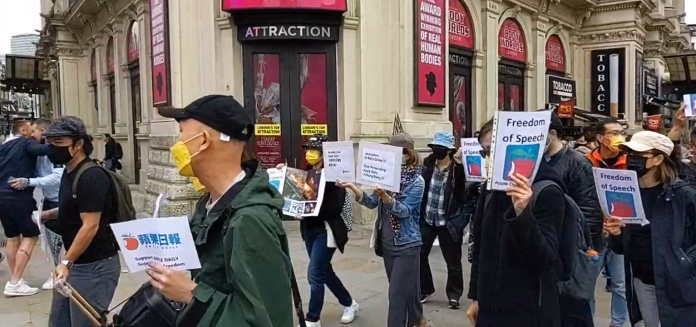
NEW DELHI – In 2015, Hong Kong journalists were crowdfunding the future. FactWire, the city’s first independent investigative wire service, raised HK$4.7 million from more than 3,300 backers — a record for the platform — all of whom were citizens putting money where their civic faith was.
It was a rare, hopeful signal that even as mainland China’s grip on institutions tightened, Hong Kong’s information ecosystem retained the pluralism that had made it Asia’s press capital for decades.
Seven years later, that same organization became evidence in a chilling cautionary tale: its newsletter system was hacked in April 2022, exposing the email addresses of more than 3,700 subscribers — roughly five weeks before FactWire quietly ceased operations. The message was unmistakable. Even passive solidarity carried risk.
That arc — from crowdfunded hope to weaponized data — encapsulates the full story of Hong Kong’s media collapse. But to understand what was truly lost, you must stop reading it as an industry story and start reading it as a democracy story.
The Infrastructure of Dissent
Free press is not merely a cultural amenity. It is load-bearing infrastructure for civil society. In Hong Kong’s case, independent outlets like Apple Daily, Stand News, and FactWire were not just news organizations. They were institutional memory, accountability mechanisms, and proof that the “one country, two systems” framework retained some operational meaning.
When Beijing imposed the National Security Law (NSL) in June 2020, it did not simply change the legal landscape. It undermined the foundational premise on which Hong Kong’s civic life had operated since the 1997 handover. The NSL’s deliberately broad language — criminalizing “collusion with foreign forces” and acts of “subversion” without precise legal definitions — created a chilling environment in which editorial decisions became existential gambles.
This is precisely how authoritarian press suppression works in Beijing’s playbook: not always through direct censorship orders, but through a fog of legal ambiguity that makes self-censorship the rational survival strategy.
The Measurable Collapse
The numbers are stark. Hong Kong fell from 80th to 148th on Reporters Without Borders’ Press Freedom Index in 2022 alone — a drop of 68 places in a single year, the steepest single-year decline of any territory in that edition of the index.
At least 860 employees lost their jobs when Apple Daily and Stand News were shuttered. RSF puts the broader toll — across all closures since the NSL’s enactment — at more than 900 journalism jobs. These were not redundancies driven by digital disruption or failing revenue models. They were erasures.
Apple Daily’s closure in June 2021 was particularly instructive. Authorities did not simply shut it down. They froze its assets, arrested five senior executives under the NSL, and raided its newsroom with approximately 500 officers. It was a show of force designed to be witnessed. The performance was the point: demonstrating to every remaining journalist, editor, and media investor exactly what institutional participation in critical journalism would cost.
Beijing’s Historical Pattern
This is not improvisation. The suppression of Hong Kong’s press follows a pattern Beijing has refined across decades and geographies.
In Tibet and Xinjiang, independent reporting was eliminated before international attention consolidated around human rights concerns. On the mainland, outlets like Southern Weekly — once a beacon of investigative journalism — were progressively neutered through editorial interference and ownership restructuring throughout the 2010s.
The methodology migrates: first, redefine the legal risk threshold; second, make examples of prominent outlets; third, allow the chilling effect to complete the work. Hong Kong represented a more complex target because its legal traditions, international financial connections, and visible civil society created friction. The NSL was engineered to override that friction.
A Democratic Regression Index
Every closure should be understood as a data point in democratic regression. When FactWire’s subscriber list was hacked, civic participation became dangerous. When Apple Daily was raided, watchdog journalism became criminalized. When Stand News editors were arrested on sedition charges — in a raid by 200 officers in December 2021 — opinion and analysis became legally actionable speech.
Hong Kong did not lose a media industry. It lost the civic organs through which a society identifies abuses of power, coordinates dissent, and holds governance accountable. What remains is a media landscape in which the most consequential stories — about the NSL’s application, political detentions, and the erosion of judicial independence — are precisely the stories that carry the greatest legal risk to tell.
That is not a press freedom crisis. That is what democratic dismantlement looks like from the inside.

Ashu Mann
Ashu Mann is an Associate Fellow at the Centre for Land Warfare Studies. He was awarded the Vice Chief of the Army Staff Commendation card on Army Day 2025. He is pursuing a PhD in Defense and Strategic Studies at Amity University, Noida. His research focuses include the India-China territorial dispute, great power rivalry, and Chinese foreign policy.
- Ashu Mann#molongui-disabled-link

- Ashu Mann#molongui-disabled-link

- Ashu Mann#molongui-disabled-link

- Ashu Mann#molongui-disabled-link