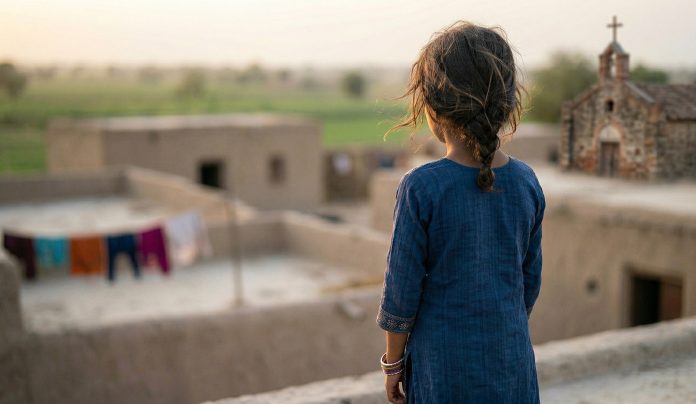
WASHINGTON – In Pakistan today, many minority girls live in fear that, despite being born here, they are not fully recognized as daughters of their own land. Forced conversions, underage marriages, and inconsistent legal protections make them question whether the constitution truly safeguards their rights—underscoring that Pakistan’s promise of equality remains unfulfilled for its minorities.
This fear is well-founded. Since 1947, religious minorities have endured persistent vulnerabilities—ranging from social prejudice and institutional discrimination to targeted violence. Reports by Human Rights Watch (2023) and Amnesty International (2022–23) highlight issues such as forced conversions, underage marriages, and inadequate enforcement of laws. Incidents of communal violence—like those in Shanti Nagar (1997), Gojra, and Jaranwala—reveal an alarming pattern of delayed or incomplete accountability.
The recent Federal Constitutional Court ruling in the case of Maria Shahbaz underscores this reality. In March 2026, the Court upheld a marriage involving a minor Christian girl and dismissed a petition seeking her recovery. While legally grounded in interpretations of personal and religious law, the ruling has raised concerns among human rights advocates, as it exposes how constitutional protections can fail when inconsistently applied. This case symbolizes the broader insecurity many minorities face: despite being citizens, they feel they cannot rely on the state to protect their rights, safety, or dignity.
Such vulnerabilities extend past individual cases. Minority women are particularly at risk, with reports by the United Nations Human Rights Council and the Movement for Solidarity and Peace estimating hundreds of forced conversions and marriages annually. Legal remedies, even though theoretically available, are often obstructed by administrative delays, social pressure, and systematic injustices. Combined with narrow political representation and structural economic gaps, these factors produce a pervasive sense of uncertainty.
As a consequence, Pakistan has witnessed a gradual yet consistent outflow of minority populations. The decline of historically prominent groups, along with the emigration of Christians, Hindus, and others, demonstrates a broader pattern of fear and anxiety. Studies by the Pew Research Center (2020) and the United States Commission on International Religious Freedom (2023) suggest that this migration is caused by concerns about safety, a lack of institutional trust, and limited opportunities for meaningful participation.
This exodus forces a reckoning with Pakistan’s future. Will the country continue to undermine its own diversity, or will it finally fulfill its constitutional promise of protection and equality for all? If religious minorities are pushed to leave because the system does not guarantee them equality, security, and dignity, what groups will remain, and who will be left to inherit the country’s future?
Pakistan’s credibility and strength depend on defending its most vulnerable citizens. Real progress requires more than acknowledgment; it requires making constitutional promises a lived reality. The key questions remain:
Can constitutional guarantees be translated into everyday reality? Can vulnerable groups feel secure within existing systems?
Can access to justice, education, and opportunity become equitable? Can representation evolve into meaningful participation?
Till these questions are addressed, migration will continue—not simply as a choice, but as a response to systemic fear and exclusion. With each departure, Pakistan risks losing not only individuals but vital fibers of its social fabric and collective strength.
And yet, among all these statistics and legal debates, the human voice endures:
“If I am born here, in this land, why am I not considered a daughter of it? Who will protect me when the law and the nation fail me?”
This question lingers, demanding national reflection. Pakistan’s strength rests not in uniformity but in the genuine embrace, protection, and empowerment of its diverse citizens. Delivering on its founding promise remains the principal challenge—and the country’s urgent task.
References
- Human Rights Watch. World Report 2023 – Pakistan.
- Amnesty International. Pakistan Annual Report 2022/23.
- United Nations Human Rights Council. Reports on Freedom of Religion or Belief.
- Movement for Solidarity and Peace (MSP). Forced Marriages & Conversions in Pakistan.
- International Commission of Jurists (2021). Minority Rights and Political Representation in Pakistan.
- World Bank. Pakistan Social Inclusion Indicators.
- Pakistan Bureau of Statistics. Census Reports (2017, 2023).
- Pew Research Center (2020). Religious Composition and Migration Trends.
- United States Commission on International Religious Freedom (USCIRF). Annual Report 2023.
- Minority Rights Group International. Pakistan Briefing Papers.

Seemab Asif
Seemab Asif is a multi-award-winning educator, human rights advocate, Peace Ambassador, and Executive Board Member of AMMWEC. She currently serves with Spring Education Group in the United States, where she is committed to advancing inclusive education and empowering women and underserved communities. Through education, advocacy, and public engagement, she champions dignity, equality, and equitable opportunities for marginalized populations, working to foster lasting social change and cross-cultural understanding.
- Seemab Asif#molongui-disabled-link

- Seemab Asif#molongui-disabled-link

- Seemab Asif#molongui-disabled-link

- Seemab Asif#molongui-disabled-link