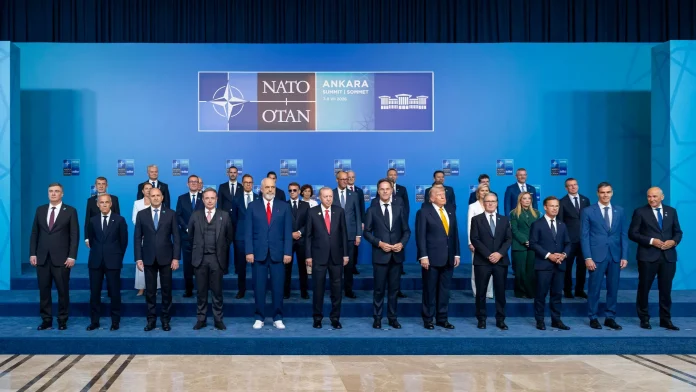
TOURS, France – On Thursday, June 25th, American think tank The Atlantic Council hosted NATO Secretary General Mark Rutte for a conversation ahead of the NATO Summit in Ankara, Türkiye. Rutte shared the framework for what he deems the Alliance’s future, a “NATO 3.0”.
The Three Phases: Defining the Shift to NATO 3.0
The North Atlantic Treaty Organization’s history can be divided into three phases. NATO, which brings together North American and European countries, initially organized collective defense against the Soviet Union before shifting its focus to crisis management after the end of the Cold War. Today, the Alliance faces a twofold problem: Russia is threatening Europe by invading Ukraine, and the United States, which, under President Trump, is calling into question its involvement in the alliance.
Rutte put it this way: the new NATO will be defined by “conviction of purpose,” “magnitude of investment,” and “true transformation.” For the Secretary, Ankara’s goal was to usher in this new NATO.
Magnitude of Investment: Europe’s $634 Billion Defense Surge
The Summit took place from July 7th to July 8th. During those two days, numerous defense contracts were signed, mobilizing millions of dollars. The emphasis was put on European firms, which are encouraged by the United States to boost their defense capabilities. For example, French aircraft manufacturer Airbus has signed a contract to provide the alliance with a new Airbus A330 Multi-Role Tanker Transport (MRTT), a supply aircraft.
This is in line with the newest NATO commitments. Last year’s Summit in The Hague saw member states pledge to invest 5% of GDP annually in defense by 2035. Specifically, Allies agreed to allocate at least 3.5% to core defense requirements and up to 1.5% to resilience and preparedness.
Progress is significant among European states, something Secretary Rutte was eager to remind them of in Ankara. European allies and Canada are projected to spend $634 billion on their militaries in 2026, up from $571 billion in 2025, an 11% increase, according to NATO estimates. Countries like Poland and the Baltic States have already reached 5%. However, major European members are lagging behind, with investment at 2-2.5% of GDP in France, Italy, and the UK.
| Defense Metric / Project | Current 2026 Status / Target | Strategic Context |
| Euro-Canadian Military Spending | $634 Billion | Up 11% from $571 Billion in 2025 to offset potential US withdrawal. |
| Long-Term NATO GDP Target | 5% annually by 2035 | Pledged at The Hague; split 3.5% for core needs, 1.5% for resilience. |
| Ukraine Aid Package (2026–2027) | $70 Billion | Jointly pledged by allies to secure robust air defense and drone scaling. |
| The US-Europe Offset Cost | €870 Billion | Estimated investment required for Europe to entirely replace US military tech. |
| Airbus MRTT Contract | Signed at Ankara 2026 | New Multi-Role Tanker Transport aircraft secured to boost European logistics. |
Transatlantic Friction: Public Rhetoric vs. Closed-Door Reality
Since President Trump took office in January 2025, allies have grown increasingly defiant of the United States. To blame are territorial and political claims over Greenland and Canada, personal criticism of other heads of state, and a unilateral stance. Lately, President Trump has been especially distressed by the lack of support for the war on Iran. For instance, Spain denied the United States basing rights in their offensive against the Islamic Republic.
“I was very disappointed with NATO”, “if it weren’t held in Turkey, where my friend (Recep Tayyip Erdoğan) happens to be a very strong leader, a very strong person, it’s possible that I wouldn’t have attended”, declared President Trump.
That sentiment may have grown, as hostilities with Iran resumed during the Summit. But the president had apparently changed his mind by the end of the summit, after the closed-door meeting of all the NATO leaders, saying, “The unity in that room was incredible, really a love”. “It was sort of pretty wild,” he added. Meanwhile, an AFP source who attended the talks claimed that “There is a strong contrast between what Trump says in public and what he actually says inside”.
This, together with the United States’ threats to withdraw its technological, intelligence, and military support from Europe, certainly helps explain why NATO members are stepping up their efforts. According to the International Institute for Strategic Studies, Europe would need to invest €870 billion to offset the United States’ withdrawal. Other experts estimate that such a transition could develop over five to ten years.
True Transformation: Ukraine and the Future of Industrial Warfare
Ukrainian President Volodymyr Zelenskyy was present at the Ankara summit. NATO members once again assured that they would support Ukraine, pledging to invest $70 billion in 2026 and 2027. President Zelenskyy reiterated that Ukraine wished to join NATO not only for protection but also because it could bring “extraordinary” defense capabilities to the alliance.
Indeed, Ukraine has become a proficient drone manufacturer. The Alliance has noted that drones have “fundamentally altered the character of modern warfare” and that they are becoming a “decisive factor on the battlefield”. Ukraine now possesses this major asset, as well as other combat-proven technologies.
Zelenskyy admits that Ukraine still needs support from allies to fill gaps in its air defense. Thus, during the summit, Trump offered Zelenskyy a license to produce the Patriot air defense system.
The bottom line is that Ukraine reveals how NATO is evolving. Allies will essentially have to focus on building a robust industrial network and, in the meantime, convince the United States to continue its support.

Patrick Moutier-Paubel
Patrick Moutier-Paubel is a sophomore student in a preparatory class based in Tours, France, with a strong academic focus on geopolitics. His travels across Europe and the United States have fostered a deep and evolving interest in international affairs, particularly in the fields of journalism and diplomacy. Outside the classroom, he is a dedicated martial artist who values discipline, creativity, and personal growth—qualities that inform both his practice on the mat and his approach to life.
- Patrick Moutier-Paubel#molongui-disabled-link

- Patrick Moutier-Paubel#molongui-disabled-link

- Patrick Moutier-Paubel#molongui-disabled-link

- Patrick Moutier-Paubel#molongui-disabled-link