“Everything ever said to me by any Chinese of any station during any visit was part of an intricate design” — Henry Kissinger.
COLOMBO – That design may already be complete before this week’s Trump–Xi summit, a meeting that could shape the future balance of global power.
The wind arrives quietly. By the time it is heard, history has already begun to turn. Across Asia, that wind is no longer distant. It carries with it the exhaustion of an old order and the uncertain birth of another. The question now is not whether the world will change. It is whether those who hold power possess the wisdom to guide that change toward something less violent than the century behind us.
Since 1945, the United States has carried the burden of a global order built with its Western allies. To its credit, the world avoided another direct world war between great powers. The conflicts remained contained in distant lands—proxy wars fought in the shadows of ideology, oil, and influence. From Latin America to Asia, the American century expanded not only through prosperity but through intervention. Yet empires, even democratic ones, grow tired. Fatigue settles slowly into institutions, alliances, and public memory. The role of global policeman no longer inspires certainty in Washington as it once did.
The “rules-based order” now confronts its own contradiction: it was built to be universal, yet it often appeared selective. During my recent visit to the Kathmandu regional conference, a young researcher asked me quietly, “Does the West itself still believe in the rules-based order?” The question lingered long after the conversation ended. The rising century demands a more inclusive architecture—one that recognizes the reality of Asian power, especially China.
My three years of field research across South and Southeast Asia, documented in Winds of Change, revealed a transformation too significant to dismiss as temporary. China has moved beyond being merely a competitor to the United States. In trade, infrastructure, technology, cultural diplomacy, and economic influence, Beijing has established itself as what may be called the world’s “US +1.”
Great powers often search for such a partner. History shows this tendency clearly. When an empire becomes overextended—burdened by wars, alliances, sanctions, tariffs, and crises—it seeks another center of gravity to stabilize the system it can no longer manage alone. The United States today faces disorder stretching from Venezuela to Iran, from Ukraine to the unsettled Middle East. In this landscape, China emerges not simply as a rival but as a state powerful enough to broker peace where Washington alone cannot.
Drawing from the lessons of the Nixon–Mao era, Robert D. Hormats warned that “when great powers misunderstand one another, the dangers quickly grow.” The United States and China are now engaged in a long-term economic, technological, political, and strategic competition. Managing that competition wisely may become the defining challenge of this century. In such a deeply polarized and unstable world, recognizing China as a “US +1” partner is not surrender, but strategic realism.
Donald Trump understood this reality before boarding his flight to meet Xi Jinping. Their meeting inside Zhongnanhai—the guarded compound where China’s leadership governs—was never merely ceremonial. It symbolized a deeper recognition already acknowledged quietly within the Pentagon itself: China is the nearest peer competitor the United States has ever confronted. Before departing Washington, Trump seemed to reassess not only China’s strength, but its unavoidable position as a “superpower” shaping the future global balance.
Yet the significance of a Trump–Xi meeting extends beyond trade wars, tariffs, or diplomatic spectacle. It presents an opportunity to confront two crises shaping the century ahead: global energy insecurity and regional instability. Washington increasingly understands the limits of direct engagement with Tehran. Decades of pressure, sanctions, and confrontation have produced exhaustion rather than resolution. In that vacuum, Beijing now possesses leverage that Washington does not.
For China, this is an opportunity to evolve from a development partner into a security actor. Xi Jinping’s Global Security Initiative (GSI) was never designed merely as rhetoric. It was intended as the next phase of Chinese influence—transforming economic dependence into strategic trust. The geopolitical spillover from the Iranian conflict now offers Beijing a historic opening to project itself as a stabilizing force in the region, not against the United States, but alongside it as a “US +1” partner.
If China succeeds in helping stabilize the Gulf and secure energy corridors vital to Asia, it will reshape global perceptions of Chinese power. Beijing would no longer be seen solely as a builder of ports, railways, and industrial zones, but also as a guarantor of regional balance. This transition—from infrastructure diplomacy to security diplomacy—may become one of the defining geopolitical shifts of the coming decade.
Xi Jinping does not seek open confrontation. His strategy is older, more patient, and perhaps more formidable because of its restraint. Beijing speaks not of domination, but of a “Shared Future for Mankind,” advanced through three instruments of influence: the Global Development Initiative (GDI), the Global Security Initiative (GSI), and the Global Civilization Initiative (GCI). These are not slogans alone. Across Asia, many governments increasingly trust China as a development partner more than any other power.
India, despite its ambitions, has not matched this scale of regional penetration. In both ASEAN and South Asia, China’s economic gravity is felt more deeply. Ports, railways, technology networks, and financial dependency have quietly altered the geopolitical map, without the spectacle of war.
In Winds of Change, I compared three inward-looking national strategies shaping Asia today: Trump’s MAGA, Modi’s emerging economic nationalism MIGA, and Xi’s Dual Circulation strategy. Among them, China has demonstrated the greatest structural resilience. Faced with American tariffs and decoupling pressures, Beijing diversified its supply chains across Central Asia, Europe, and Southeast Asia. Rail corridors now connect the Chinese industry to European markets through Eurasia. ASEAN has surpassed the United States as China’s largest trading partner, while the European Union follows closely behind. Exports to America have declined sharply, yet China continues to expand. Trump, once defined by confrontation, now arrives seeking a new “board of trade” with China—an acknowledgment that economic rivalry alone can no longer define the relationship between the world’s two largest powers.
Unlike Washington, which increasingly retreats from multilateral institutions, Beijing presents itself as the defender of multilateralism. Whether genuine or strategic matters less than perception. In geopolitics, perception often becomes reality.
What emerges, then, is not surrender between rivals, but interdependence between powers too large to isolate one another. The future may not belong to a bipolar Cold War, but to a reluctant coexistence. The United States now recognizes that China possesses diversified markets and partnerships capable of reducing dependence on America. China, in turn, understands that its long march toward global primacy still requires strategic engagement with the United States.
This is where the true geopolitical shift begins.
Many analysts continue to frame China solely as a threat. Yet history rarely moves through absolutes. The next world order may not be built through confrontation alone, but through uneasy partnership. Artificial intelligence, technological supremacy, economic stability, and global governance now demand cooperation between Washington and Beijing, whether either side admits it publicly or not.
Trump will likely celebrate his personal relationship with Xi, presenting himself as the American leader capable of negotiating a “better deal” with China than his predecessors. But beneath the rhetoric lies something larger: the gradual acceptance of China’s indispensable role in shaping the future international order.
Even the question of war increasingly returns to Beijing. If Washington seeks an understanding with Tehran, China’s influence becomes unavoidable. Iran listens to Beijing in ways it no longer listens to the West. This alone signals how profoundly the balance of power has shifted. And Xi, careful as always, refuses to openly inherit the mantle of global leadership. He delays, softens, and obscures intention. It is part of a longer strategy: to rise without provoking the final resistance of a declining hegemon too early.
History rarely announces its turning point. Empires fade slowly, while new powers rise quietly beneath the noise of the old order. Washington still holds immense power, but Beijing increasingly holds the patience, reach, and strategic depth to shape what comes after.
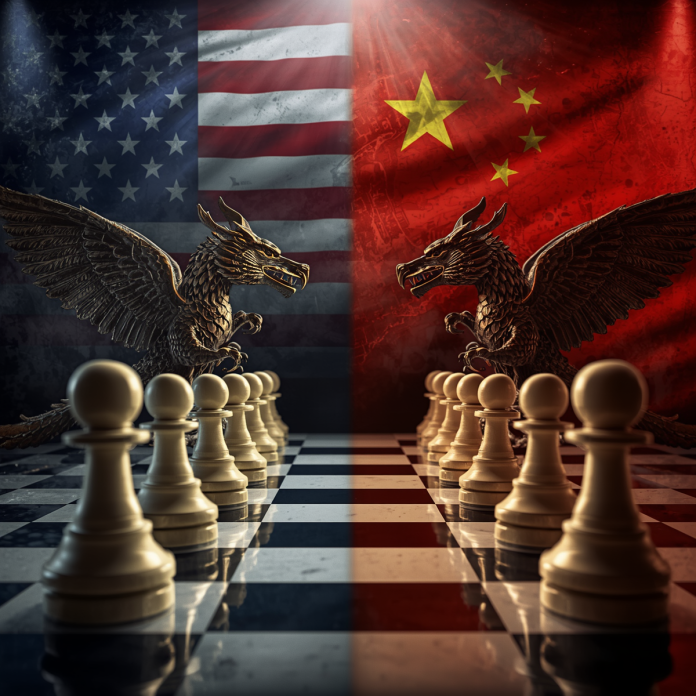
The century ahead may not belong to one power alone, but to the uneasy balance between Washington and Beijing. And in that silence, a new world order is already taking shape.

Asanga Abeyagoonasekera
Asanga Abeyagoonasekera is the Foreign Affairs Editor at Global Strat View. He is the Executive Director of South Asia Foresight Network(SAFN), Washington, D.C., and the author of Winds of Change: Geopolitics at the Crossroads of South and Southeast Asia, published by World Scientific(2026).
- Asanga Abeyagoonasekera#molongui-disabled-link

- Asanga Abeyagoonasekera#molongui-disabled-link

- Asanga Abeyagoonasekera#molongui-disabled-link

- Asanga Abeyagoonasekera#molongui-disabled-link