NEW DELHI – Pakistan’s acceptance of a ceasefire on 10 May 2025 was the product of cascading operational failures, exposed command vulnerabilities, unsustainable multi-theatre commitments, and a credible Indian signaling posture that threatened systemic degradation of Pakistan’s military command architecture. Post-conflict acquisition patterns and institutional restructuring confirm that the ceasefire was compelled by necessity, not negotiated from a position of parity.
PHASE 1—INDIAN STRIKE OPERATIONS (07 MAY 2025): India conducted precision strikes against nine terrorist infrastructure targets in Pakistan and Pakistan-Occupied Jammu and Kashmir under Operation SINDOOR. Strike selection was deliberate — Pakistan military assets were excluded, and this restraint was publicly communicated during the 07 May press conference. India simultaneously indicated willingness to de-escalate, providing Islamabad a viable off-ramp. Pakistan’s rejection of this off-ramp triggered the subsequent operational phases.
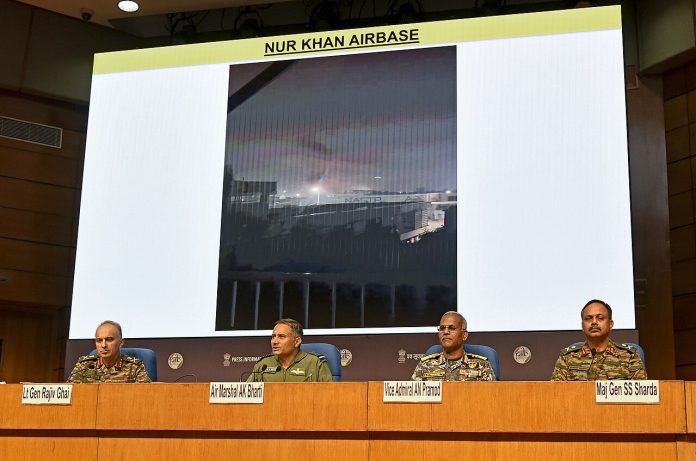
PHASE 2—PAKISTANI COUNTER-ACTIONS AND INDIA’S CONTROLLED ESCALATION (08–10 MAY 2025): Pakistani drone employment and artillery/rocket engagements between 08–10 May were assessed as attempts to test Indian air-defense resilience and demonstrate retaliatory capacity. These actions were operationally ineffective. India’s response — precision strikes against eleven Pakistani air bases on 10 May, including Nur Khan Air Base adjacent to GHQ and the Islamabad Capital Territory — constituted a decisive escalation dominance signal. The strikes demonstrated: (a) targeting reach across Pakistani strategic depth, (b) capacity to engage command and control nodes, and (c) readiness for a progressive escalation sequence that could include leadership and communications infrastructure.
CRITICAL VULNERABILITY INDICATORS—POST-CONFLICT ACQUISITIONS: Pakistan’s procurement activity following the conflict directly maps to operational failures identified during the ten-day confrontation. In the domain of long-range fires, the establishment of the Army Rocket Force Command and the induction of the FATAH-series GMLRS highlight precision-strike and battlefield-deterrence gaps.
Regarding aviation, the emergency induction of Chinese Z-10ME attack helicopters fills a close air support deficit. For ground sustainment, the new 155 mm ammunition production facility addresses munitions shortfalls exposed during sustained artillery exchanges. The procurement of SH-15 Mounted Gun Systems addresses deficiencies in artillery mobility and survivability. In the domain of ISR and targeting, the development of a dedicated UAV force under the Bahawalpur Corps reflects inadequate battlefield surveillance capability. Electronic warfare gaps are addressed through the Turkey–Pakistan EW cooperation agreement of May 2025.
COMMAND AND INSTITUTIONAL RESTRUCTURING
The reported 27th Constitutional Amendment is the most strategically significant post-conflict development. The abolition of the Chairman Joint Chiefs of Staff Committee, the creation of the Chief of Defence Forces post, and the establishment of the Commander, National Strategic Command position collectively indicate: (a) recognized failure of inter-services command coordination under operational stress, (b) the need to reconsolidate strategic authority under Army leadership, and (c) concern that Pakistan’s nuclear signaling credibility was materially degraded by India’s demonstrated willingness to conduct deep precision strikes under nuclear overhang. The reconfiguration of nuclear command architecture signals an attempt to restore deterrence coherence.
OPERATIONAL CONTEXT—MULTI-THEATRE COMMITMENTS: Pakistan’s force availability at the time of the conflict was significantly constrained by concurrent operational commitments: deployments to Saudi Arabia under the Strategic Mutual Defense Agreement; active kinetic operations along the Durand Line under Operation GHAZAB-LIL-HAQ; and the ongoing internal security framework of Operation Azm-e-Istekam across Khyber Pakhtunkhwa and Balochistan. These commitments imposed substantial strain on logistics, reserve activation, and operational endurance, making a sustained conventional confrontation with India operationally untenable and rendering early conflict termination a military necessity.
STRATEGIC ASSESSMENT: Pakistan’s post-May 2025 surge in military modernization, constitutional restructuring, and accelerated foreign defense partnerships are not indicators of strategic confidence. They are reactive measures responding to demonstrated capability deficits, command fragmentation, and deterrence erosion, conditions that compelled Islamabad to pursue an early ceasefire before Indian escalation could inflict systemic damage to its military command architecture.

Ashu Mann
Ashu Mann is an Associate Fellow at the Centre for Land Warfare Studies. He was awarded the Vice Chief of the Army Staff Commendation card on Army Day 2025. He is pursuing a PhD in Defense and Strategic Studies at Amity University, Noida. His research focuses include the India-China territorial dispute, great power rivalry, and Chinese foreign policy.
- Ashu Mann#molongui-disabled-link

- Ashu Mann#molongui-disabled-link

- Ashu Mann#molongui-disabled-link

- Ashu Mann#molongui-disabled-link