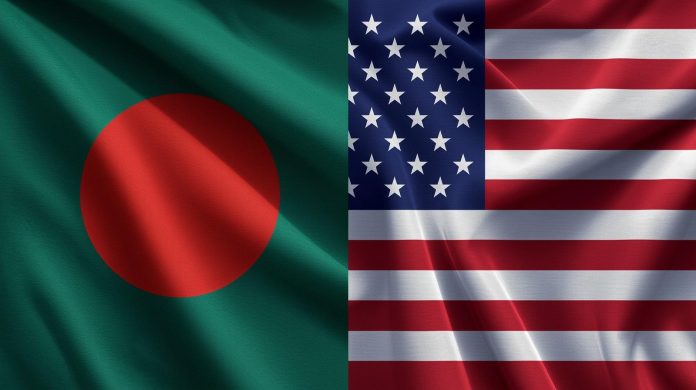
NEW DELHI – The February 2026 U.S.-Bangladesh Agreement on Reciprocal Trade appears less like a traditional trade pact and more like a guide for managed dependence. Washington’s own description is noteworthy: the deal aims to provide the United States with “unprecedented levels of market access” in Bangladesh while advancing U.S. economic and national security interests. That language is significant because the published text shows the agreement extends beyond tariffs and customs. Its provisions cover digital regulation, cybersecurity, export controls, sanctions compliance, investment transparency, defense trade, and even future diplomatic choices.
From a Bangladeshi perspective, this may not resemble true reciprocity. It is a policy capture by clause. The assault begins in the digital chapter. Article 3.1 bars Bangladesh from imposing digital services taxes that discriminate against U.S. companies. Article 3.2 requires Dhaka to “facilitate digital trade” with the United States by refraining from discrimination against U.S. digital products, ensuring cross-border data transfer, and collaborating with Washington on cybersecurity.
Furthermore, if Bangladesh signs a new digital trade agreement with a country considered to jeopardize “essential U.S. interests,” the United States may terminate the agreement and reimpose tariffs. Article 3.3 also bars customs duties on electronic transmissions and commits Bangladesh to support a permanent WTO moratorium on such duties. In plain terms, Bangladesh’s ability to tax, regulate, or strategically negotiate in the digital economy is constrained by U.S. commercial and geopolitical priorities.
Section 4 is even more intrusive because it welds Bangladesh’s economic and foreign policy posture to Washington’s security agenda. Article 4.1 states that if the United States adopts a border measure or trade action for its own economic or national security, Bangladesh shall, after consultations, adopt or maintain a “complementary restrictive measure” in support of the U.S. action. This places substantial obligations on Bangladesh.
It means Dhaka is not merely asked to consider alignment; it is pushed toward synchronizing its trade restrictions with American strategic moves. Article 4.2 goes further still. Bangladesh must cooperate with the United States to harmonize export controls on sensitive goods, ensure its firms do not “backfill” those controls, and restrict transactions that would violate U.S. sanctions or export controls if conducted in the United States or by a U.S. person.
Such provisions effectively turn Bangladesh into an enforcement arm for U.S. sanctions. Article 4.3 clarifies this power dynamic: while the United States commits to enhancing defense trade with Bangladesh, it reserves the right to terminate the deal and restore tariffs if Bangladesh forms new trade agreements with “non-market countries” that threaten the pact. The agreement also prohibits Bangladesh from purchasing certain nuclear materials from countries opposed by the United States, save for rare exceptions.
Annex III further illustrates U.S. influence, calling on Bangladesh to increase purchases of U.S. military equipment and restrict similar buys from specified countries. This means Bangladesh’s strategic choices are vetted through U.S. preferences. While Bangladesh secured a 19 percent tariff rate and zero tariffs for certain goods using U.S. inputs, this apparent benefit makes the agreement’s coercive design more visible.
But that relief came bundled with significant preferential market access for U.S. industrial and agricultural exports, non-tariff concessions, large-scale energy purchases, Boeing aircraft procurement, and increased purchases of U.S. military equipment. This is the familiar imperial bargain: limited tariff relief in exchange for deep structural concessions that reshape the weaker partner’s regulatory and strategic space. Bangladeshi critics were therefore right to warn that Article 4.3 and related provisions tie the country to U.S. trade wars and narrow its ability to remain neutral in great-power competition.
Any government that prioritizes sovereignty may find that this goes beyond a standard trade arrangement. Articles 4 to 4.3 do not simply influence Bangladesh’s policy environment; they include the United States in aspects of economic, digital, foreign, and defense decision-making. The core message is clear: trade access comes with clear conditions, and regulatory flexibilities depend on U.S. approval. Bangladesh is therefore asked to operate within the parameters outlined in Washington. For these reasons, this agreement could be viewed less as a partnership and more as a case of compromised autonomy for U.S. leverage.

Ashu Mann
Ashu Mann is an Associate Fellow at the Centre for Land Warfare Studies. He was awarded the Vice Chief of the Army Staff Commendation card on Army Day 2025. He is pursuing a PhD in Defense and Strategic Studies at Amity University, Noida. His research focuses include the India-China territorial dispute, great power rivalry, and Chinese foreign policy.
- Ashu Mann#molongui-disabled-link

- Ashu Mann#molongui-disabled-link

- Ashu Mann#molongui-disabled-link

- Ashu Mann#molongui-disabled-link