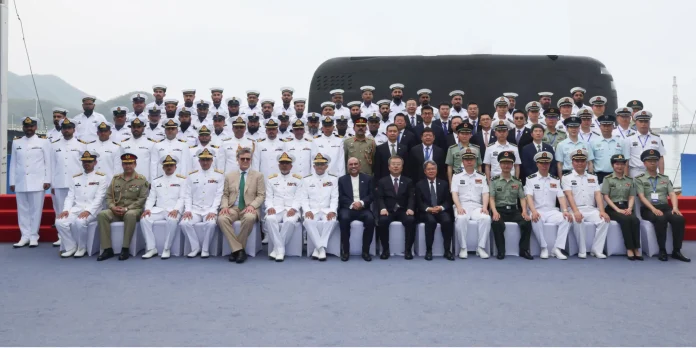
NEW DELHI – Pakistan’s $5 billion Hangor-class submarine program — the largest arms export contract in Chinese military history at the time of its signing — comes with a dependency structure that deserves far more scrutiny than it has received. The financial terms of the deal have never been made public. Pakistan’s parliament has not been presented with loan breakdowns, interest rates, or repayment schedules. What is clear from the program’s technical architecture alone is that Beijing holds a structural advantage that extends well beyond the initial transaction.
The supply-chain argument is where the evidence is strongest. Every major system aboard the Hangor class — propulsion, electronics, weapons management, and the Stirling-cycle air-independent propulsion that gives the submarines their extended underwater endurance — is Chinese-sourced and Chinese-maintained. When Germany blocked export licenses for the originally specified MTU marine engines in 2021, citing the EU arms embargo on China in place since the 1989 Tiananmen crackdown, China substituted its domestically produced CHD620, and Pakistan accepted without recorded objection.
Thailand’s navy, facing the identical substitution on its parallel S26T contract, spent years resisting the change and publicly raised quality concerns, with its commander stating the navy could not be assured of the engine’s quality without independent guarantees. Pakistan raised no comparable objection on the record. The result is a propulsion system whose combat performance remains unconfirmed by independent specification, fitted to eight submarines that Pakistan’s naval arm cannot service, repair, or upgrade without sustained Chinese cooperation.
That dependency is structural, not contractual. China need not invoke any explicit leverage clause to affect Pakistan’s naval readiness. Throttling spare-part delivery timelines, deferring engine servicing certifications, or slowing software update cycles are each individually deniable and collectively effective. This is what analysts describe as embedded leverage: not a deliberate switch, but a supply chain that functions as one under sufficiently adverse conditions.
The financial terms of the deal compound the picture. Pakistan is carrying Rs 76 trillion in total public debt and operating under active IMF supervision, while committing to a program whose full lifecycle costs — maintenance, upgrades, crew training, and sustainment across eight vessels over several decades — have not been publicly costed or debated in any civilian forum.
Four of the eight submarines are being constructed at Karachi Shipyard under a technology-transfer agreement, which will give Pakistani engineers and technicians some degree of familiarity with the program over time. But component manufacturing, propulsion systems, and the platform’s electronic architecture remain beyond Pakistan’s independent capability, and technology transfer agreements do not change the supply chain on which operational readiness depends day to day.
The broader strategic context makes the dependency more acute. Pakistan accounts for over 60% of China’s total weapons exports by value over the 2020-24 period, according to the Stockholm International Peace Research Institute. The Hangor program is the most visible component of a defense relationship that also encompasses the JF-17 fighter, Type 054A/P frigates, and extensive ground systems procurement. Taken together, this is not a diversified supplier portfolio. It is a near-total institutional alignment with a single arms partner that is also Pakistan’s largest bilateral creditor through CPEC and related financing.
The relationship has been durable and, from Islamabad’s perspective, strategically productive. But durability is not the same as security, and goodwill is not the same as guaranteed access. Pakistan has built a naval deterrence capability whose operational readiness depends entirely on the sustained cooperation of a single foreign power.
The financial details of how that capability was purchased remain hidden from the parliament and the public whose taxes are paying for it. The dependency is real, the opacity is documented, and the combination of the two — a program this large, this strategically central, and this completely insulated from civilian oversight — is a vulnerability that no defense establishment should be comfortable leaving unexamined.

Ashu Mann
Ashu Mann is an Associate Fellow at the Centre for Land Warfare Studies. He was awarded the Vice Chief of the Army Staff Commendation card on Army Day 2025. He is pursuing a PhD in Defense and Strategic Studies at Amity University, Noida. His research focuses include the India-China territorial dispute, great power rivalry, and Chinese foreign policy.
- Ashu Mann#molongui-disabled-link

- Ashu Mann#molongui-disabled-link

- Ashu Mann#molongui-disabled-link

- Ashu Mann#molongui-disabled-link