
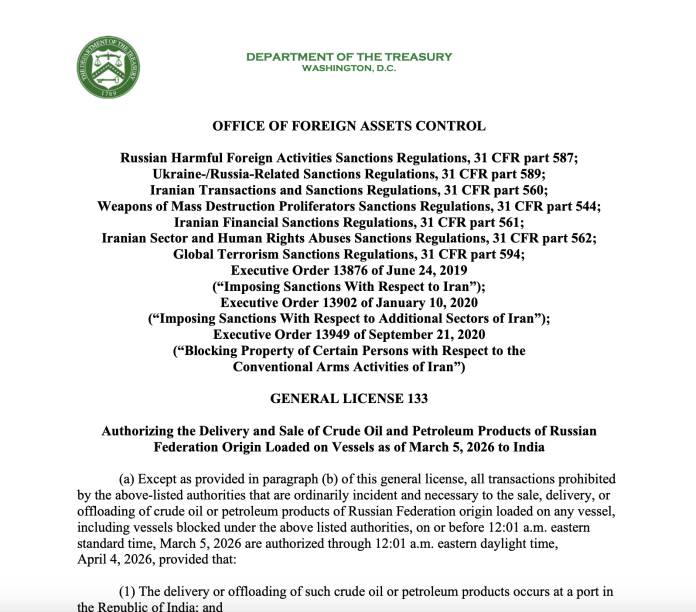
WASHINGTON – The U.S. Treasury Department has issued a 30-day waiver allowing Indian refiners to buy stranded Russian crude, aiming to steady global energy markets amid the Middle East conflict threatening key supply routes.
In a post on X (formerly Twitter), Treasury Secretary Scott Bessent stated it was necessary to maintain global liquidity after Iranian efforts to disrupt energy supplies. The waiver allows delivery of Russian crude and petroleum products to Indian ports until April 4, 2026.
“President Trump’s energy agenda has resulted in oil and gas production reaching the highest levels ever recorded,” Bessent said. “To enable oil to keep flowing into the global market, the Treasury Department is issuing a temporary 30-day waiver to allow Indian refiners to purchase Russian oil.”
This decision comes amid heightened volatility following military action in the Middle East that, in late February 2026, halted traffic through the Strait of Hormuz, which accounts for about 40 percent of India’s oil imports. With domestic reserves covering only 25 days, New Delhi reportedly requested relief from the Trump administration, as Russian oil tankers waited off the Indian coast and in Oman.
Secretary Bessent stressed that the waiver is narrowly tailored to prevent Moscow from reaping a windfall. “This deliberately short-term measure will not provide significant financial benefit to the Russian government as it only authorizes transactions involving oil already stranded at sea,” he said.
The announcement marks a pragmatic shift for the administration. In 2025, President Trump pressured India to halt Russian oil imports and imposed a 25 percent tariff on Indian goods. In February 2026, these tariffs were rescinded after Prime Minister Modi’s government agreed to reduce Russian purchases and increase imports from the U.S.
Bessent underscored that the long-term goal of the U.S.-India energy partnership remains unchanged despite the 30-day reprieve. “India is an essential partner of the United States, and we fully anticipate that New Delhi will ramp up purchases of U.S. oil,” he stated.
Analysts note that the waiver allows several Indian refiners, including Indian Oil Corporation and Bharat Petroleum, to finalize deals for about 20 million barrels of Russian crude. This provides immediate relief to India’s energy sector. The 30-day limit keeps pressure on New Delhi to secure stable, non-Russian alternatives as the crisis continues.

GSV News Service
- GSV News Service#molongui-disabled-link

- GSV News Service#molongui-disabled-link

- GSV News Service#molongui-disabled-link

- GSV News Service#molongui-disabled-link