
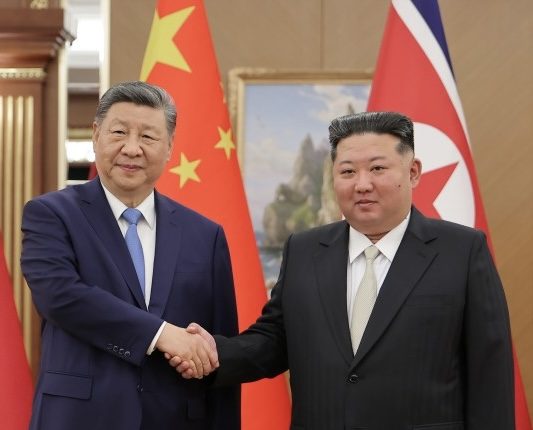
NEW DELHI – When Chinese President, also the General Secretary of the Communist Party of China’s (CPC) Central Committee, Xi Jinping’s special plane touched down at Pyongyang International Airport on the afternoon of June 8, 2026, he was greeted by the full, meticulously choreographed theater of the Democratic People’s Republic of Korea (DPRK). Alongside a twenty-one-gun salute, cheering crowds wielding flowers, and the presence of the DPRK’s State Affairs Commission President and the General Secretary of the Workers’ Party of Korea (WPK), Kim Jong Un, the optics of the two-day state visit were designed to project an image of solidarity. Coming just weeks after Xi hosted the United States of America’s President Donald Trump and the Russian Federation’s President Vladimir Putin in Beijing, Xi’s decision to make Pyongyang his first overseas destination of the year sent a resounding signal across Northeast Asia.
Traveling alongside President Xi and his wife, Peng Liyuan, were some of the most senior figures in the Chinese party-state apparatus. The entourage included Cai Qi, the powerful Chief of Staff and a member of the Politburo Standing Committee, and Foreign Minister Wang Yi. Crucially, Chinese Defense Minister Dong Jun was also present, arriving alongside Commerce Minister Wang Wentao, National Development and Reform Commission Chairman Zheng Shanjie, Central Policy Research Office Director Tang Fangyu, and Liu Haixing, head of the CPC’s International Department. On the DPRK’s side, along with SAC President Kim, was his wife, Ri Sol Ju. The DPRK’s Foreign Minister Choe Son-hui and Defense Minister No Kwang-chol were also present, representing the state’s security and diplomatic apparatus, joined by First Vice Premier Kim Tok-hun. The inner core of the WPK leadership was also mobilized, represented by International Department Director Kim Song-nam, Organization Department Director Kim Jae-ryong, and Propaganda and Agitation Department Director Ri Il-hwan.
Over the past two years, global attention has been intensely focused on the burgeoning military bromance between Pyongyang and Moscow, cemented by a 2024 mutual defense pact and the deployment of the DPRK’s munitions and troops to support Russia’s war in Ukraine. This transactional relationship has undoubtedly injected Kim’s regime with renewed swagger, diplomatic oxygen, and advanced aerospace technology. Yet, Xi’s 2026 visit starkly illuminated a different geopolitical reality: the DPRK remains structurally and inescapably dependent on China in ways that Russia simply cannot replicate. Despite Pyongyang’s tactical maneuvers to diversify its benefactors, Beijing remains the DPRK’s essential external partner in trade, border access, diplomatic protection, political coordination, and long-term strategic viability.
To understand Beijing’s objectives for the visit, one must look at the specific narrative broadcast by the Chinese state apparatus. Coinciding with the sixty-fifth anniversary of the 1961 Sino-DPRK Treaty of Friendship, Cooperation, and Mutual Assistance-China’s only binding mutual defense treaty with a foreign state-official Chinese media framed the visit as an effort to restore and structurally advance bilateral relations. According to the Xinhua News Agency and the Chinese Ministry of Foreign Affairs, Xi presented Kim with a four-point proposal to guide the new era of their relationship. Xi emphasized the alignment of national development strategies, the expansion of practical cooperation in agriculture and commerce, and joint opposition to hegemonism and power politics.
Crucially, though, Chinese state media explicitly noted that Xi pushed to strengthen exchanges across diplomacy, law enforcement, and military affairs. In Beijing, prioritizing military-to-military communication is evident, likely a calculated intelligence-gathering measure rather than mere goodwill. By establishing structured military channels, China seeks to directly assess the technological changes within the Korean People’s Army resulting from the influx of sensitive Russian dual-use technology, ensuring that the DPRK’s rapid modernization remains visible and manageable to Chinese security planners.
The view from Pyongyang, mediated through the Korean Central News Agency (KCNA), offered a subtly different framing that preserved the DPRK’s fierce insistence on sovereign parity. KCNA heralded the summit as producing a far-reaching blueprint for bilateral ties, describing the talks as reaching a satisfactory consensus. Kim publicly declared that strengthening ties with China was his country’s most important top-priority strategic work and explicitly pledged the DPRK’s unwavering support for Beijing’s One China principle regarding Taiwan.
Yet, what the DPRK state media omitted from its domestic dispatches is just as telling as what it published. KCNA completely censored Xi’s proposals on military and law-enforcement exchanges, as well as the specifics of border customs protocols. This is interpreted as a deliberate editorial omission by the Kim regime as a defensive mechanism to avoid the appearance of subservience. Even as the DPRK deepens its strategic reliance on its massive neighbor, Pyongyang remains hypersensitive to any framing of geopolitical dependency, actively resisting the perception that it is submitting to Chinese oversight.
Despite the DPRK’s rhetorical resistance to dependency, the material foundations of the Sino-DPRK relationship reveal the stark limits of Pyongyang’s pivot to Moscow: while Russia can provide emergency fuel and military technology in exchange for artillery shells, it cannot sustain the DPRK’s civilian economy. China remains the ultimate guarantor of the DPRK’s economic survival, accounting for an estimated 95-98 percent of the country’s official external trade. Following a severe pandemic-era contraction, bilateral commerce has surged, with customs data showing that two-way trade values rebounded to $2.73 billion in 2025, nearing pre-COVID levels. The mechanics of this trade highlight the DPRK’s reliance on Chinese markets for low-end manufacturing and resource extraction, with Chinese imports dominated by wigs and false hair products, as well as strategic minerals like tungsten.
This asymmetric interdependence is most visible along the physical geography of the 1,350-kilometer Sino-DPR Korean border. Independent satellite imagery and border-economy reporting show a frantic, sustained effort by both states to expand logistical arteries. According to geospatial analysis, the DPRK and China have established at least 32 makeshift dirt river crossings spanning a 59-mile stretch of the Yalu River since early 2024. These crossings, operating outside formal customs channels and conveniently obscured by a massive Chinese highway construction project, facilitate a highly organized state smuggling scheme designed to move cargo trucks and sensitive machinery while maintaining plausible deniability regarding United Nations sanctions violations.
Formal infrastructure is also undergoing a massive, Chinese-subsidized overhaul. In the remote northeastern city of Hyesan, satellite imagery from 2024 and 2025 shows that the DPRK demolished a dilapidated textile factory to construct a sprawling dirt staging lot to process an influx of Chinese cargo trucks. More significantly, the New Yalu River Bridge, a $350 million cable-stayed highway crossing funded entirely by China and completed in 2014, is finally showing signs of life after a decade of dormancy due to Pyongyang’s failure to build connecting roads. Throughout 2025 and early 2026, satellite data captured the rapid, simultaneous construction of expansive customs complexes, immigration buildings, and truck inspection lanes on both the Chinese and the DPR Korean sides of the bridge. Once operational, this bridge will drastically expand the volume of heavy freight traffic between Dandong and Sinuiju. These concrete and asphalt realities demonstrate that while Moscow offers a wartime partnership of convenience, Beijing is actively building the permanent physical infrastructure required to keep the WPK’s state afloat.
In the realm of grand strategy, Xi Jinping’s visit served a dual purpose. The first was for counterbalancing Russian influence, and the second was for reshaping the security architecture of the Korean Peninsula to frustrate the United States. Following the 2024 mutual defense treaty between Putin and Kim, Chinese strategists grew quietly alarmed that Moscow’s influence could embolden Pyongyang to engage in destabilizing behavior that might draw U.S. and allied forces into a regional conflict. By traveling to Pyongyang, Xi effectively planted the Chinese flag, reminding both Kim and the international community that Beijing retains the ultimate geopolitical leverage over the regime.
Perhaps the most consequential strategic outcome of the 2026 summit was what remained unsaid. In official state readouts from both Beijing and Pyongyang, the phrase denuclearization was completely absent. When Xi last visited the DPRK in 2019, Chinese state media explicitly noted his willingness to play a constructive role in the denuclearization of the peninsula. Seven years later, Xi’s rhetoric shifted entirely to defending the DPRK’s sovereignty and security.
This omission might be a watershed geopolitical shift, because, by dropping denuclearization from its diplomatic agenda, Beijing is signaling a tactical, de facto acceptance of the DPRK as a permanent nuclear-armed state. This recalibration is intimately tied to China’s broader competition with Washington. As the United States deepens its trilateral security and military cooperation with South Korea and Japan, Beijing increasingly views a nuclear-armed DPRK as a useful strategic buffer and a counterweight to the U.S. alliance network in the Indo-Pacific. The DPRK has capitalized on this changing field; just days before Xi’s arrival, Kim’s powerful sister, Kim Yo Jong, dismissed U.S. claims of a shared Sino-American goal of denuclearization as fake information, declaring the country’s nuclear program an irreversible line of no retreat.
The June 2026 summit codified the enduring realities of power in Northeast Asia. Kim Jong Un may command global attention through his provocative missile tests and transactional military alliance with Russia, projecting an image of fierce independence and defiance. Yet, this is underwritten by the quiet, continuous flow of Chinese capital, fuel, and diplomatic cover. Xi Jinping’s presence in Pyongyang and the massive infrastructure corridors currently being built across the Yalu River serve as a definitive reminder that, while the geopolitical weather may fluctuate amid the war in Europe, the climate of the Korean Peninsula is still dictated by Beijing. The DPRK’s long-term survival remains inextricably tethered to China, bound by an asymmetric interdependence that no amount of Russian artillery shells can replace.

Samyak Mishra
Samyak Mishra is pursuing International Relations, Political Science, and China Studies at Ashoka University, India. His academic interests center on East Asian authoritarianism and totalitarianism, the politics of one-party states, and civil-military relations, with a particular focus on the ideological and institutional foundations of the People’s Republic of China and the Democratic People’s Republic of Korea.
- Samyak Mishra#molongui-disabled-link

- Samyak Mishra#molongui-disabled-link

- Samyak Mishra#molongui-disabled-link

- Samyak Mishra#molongui-disabled-link