
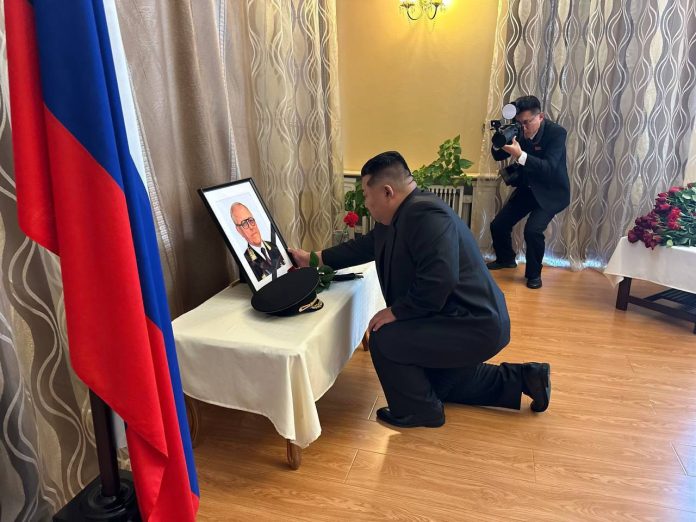
The veteran diplomat oversaw Moscow’s shift from post–Cold War distance to a wartime alliance with Pyongyang, including arms transfers and troop deployments linked to the Ukraine war.
Aleksandr Ivanovich Matsegora, the career diplomat who stewarded Moscow’s relationship with Pyongyang from a post-Cold War dormancy into a full-fledged wartime military alliance, died suddenly on December 6, 2025, at the age of 70. His death marks the end of an era for the Russian diplomatic corps in Northeast Asia. He served as ambassador extraordinary and plenipotentiary of the Russian Federation to the Democratic People’s Republic of Korea (DPRK) since 2014. This made him the longest-serving Russian envoy to the DPRK in recent times. His death announcement came just days after the official entry into force of the Treaty of Comprehensive Strategic Partnership, a pact he himself helped engineer that binds Moscow and Pyongyang in a mutual defence commitment, reminiscent of the Cold War but now in a new environment.
Ambassadors are often seen as mere messengers for their capitals, especially when they are posted to a niche, esoteric country like the DPRK. But looking at Matsegora’s career, one can conclude that he was a pivotal institutional actor. He served as the primary conduit for the rapid intensification of Russia-DPRK ties following Vladimir Putin’s 2022 invasion of Ukraine. His tenure oversaw the relationship’s transformation from transactional diplomatic cover at the United Nations to tangible military integration.
Matsegora was born in Odessa, Ukraine, in 1955 and was a product of the elite Soviet diplomatic tradition. He graduated from the Moscow State Institute of International Relations (MGIMO) in 1978 and spent the vast majority of his career focused on the Korean Peninsula. Matsegora possessed deep institutional memory and linguistic fluency, which helped him stay in Pyongyang, unlike many Western diplomats who rotate through on short, restricted terms. He served as first secretary at the embassy in 1999, returned as minister-counsellor from 2006 to 2011, and assumed the ambassadorship in 2014. His facility with the Korean language and long presence in the country also granted him unusual access to the opaque leadership circle of Kim Jong Un. Following his death, DPRK’s state media carried a personal message from Kim Jong Un to Vladimir Putin, a diplomatic protocol typically reserved for heads of state, but The Rodong Sinmun, the official newspaper of the Workers’ Party of Korea, reported that Kim visited the Russian embassy to lay flowers and described Matsegora as a “close friend and comrade” whose contribution to the alliance would be “long remembered.” This personal rapport was very publicly visible. In May 2024, during a reception marking the anniversary of the Soviet victory in World War II, Matsegora was photographed in close proximity to Kim’s daughter, Kim Ju-ae, even exchanging a cheek kiss with her, a breach of protocol that would be unthinkable for almost any other foreign representative.
Matsegora’s death comes at a moment of definitive strategic realignment. For three decades following the collapse of the Soviet Union, the Russian Federation pursued a policy of equidistance on the Korean Peninsula, in an attempt to balance economic ties with Seoul against historical political ties with Pyongyang. Matsegora’s final years in office saw the complete dismantling of this framework, and the catalyst was the war in Ukraine. This was because, as Russia faced isolation from the West and sought conventional munitions to sustain its artillery-heavy war of attrition, Matsegora’s embassy became the logistical hub for a new axis. By late 2022, U.S. intelligence indicated that the DPRK was covertly supplying artillery shells to Russia. Matsegora vigorously denied these reports at the time while also working behind the scenes to facilitate the high-level visits that would formalise the trade.
The shift culminated in the June 2024 summit in Pyongyang, where Putin and Kim signed the Treaty on Comprehensive Strategic Partnership. The agreement, which entered into force on December 4, 2025, includes a mutual defence clause. Article 4 of the treaty obligates both nations to provide “military and other assistance with all means in its possession without delay” if either is attacked. This legal framework allowed the deployment of the Korean People’s Army (KPA) troops to the Russian front lines.
In October 2024, the Republic of Korea’s intelligence and Western intelligence confirmed the movement of approximately 12,000 KPA soldiers, including special forces from the “Storm Corps,” to Russia’s Kursk region. Matsegora’s role in managing the diplomatic fallout of this deployment was critical, as he maintained the narrative that such cooperation complied with international law despite widespread condemnation at the United Nations.
Beyond the battlefield, Matsegora oversaw the construction of an economic and financial architecture designed to circumvent the very United Nations sanctions Russia had once voted to impose. The U.S. Department of the Treasury designated Matsegora’s operational environment as a hub for illicit finance. In September 2024, the Treasury sanctioned a network involving the Russian Financial Corporation Bank and the DPRK’s state banks. These entities utilised “cut-out” banks in the Russian-occupied Georgian region of South Ossetia to facilitate payments for Russian fuel exports to DPRK. While Matsegora was not personally named in the banking sanctions, these mechanisms operated under the diplomatic umbrella he maintained, ensuring the Kim regime retained access to the international financial system and liquidity for its weapons programs. Under his watch, Russia also moved to dismantle the international monitoring regime regarding DPRK. In March 2024, Russia vetoed the renewal of the UN Panel of Experts, the body responsible for monitoring sanctions enforcement against Pyongyang. This move effectively blinded the international community to the details of the oil-for-weapons trade that the Russian embassy under Matsegora helped coordinate.
Matsegora was keenly aware of the importance of information warfare as well. In November 2025, just weeks before his death, he facilitated the signing of agreements between Russia’s Ministry of Digital Development and the DPRK’s Committee on Public Information. These accords formalised cooperation between state media outlets, including Russia’s Rossiya Segodnya and the Korean Central News Agency (KCNA), to align their public messaging and combat “hostile” Western narratives.
This focus on soft power extended to his personal conduct. Matsegora was known for maintaining a Facebook page that offered Russian audiences a curated, humanising glimpse of life in Pyongyang, videos of autumn leaves and daily life that stood in stark contrast to the austere imagery typically associated with the North. This effort helped condition the Russian domestic public to view DPRK as a misunderstood ally in the struggle against Western hegemony instead of a pariah state.
Russian Foreign Ministry spokesperson Maria Zakharova praised Matsegora as a “patriot” who made a “significant contribution” to the bilateral relationship. His successor will inherit a diplomatic mission that has fundamentally changed its character. Following the comprehensive treaty, the Russian embassy in Pyongyang is now essentially a coordinating centre for a military alliance that impacts security from the 38th Parallel to the trenches of Eastern Europe. As the Kremlin prepares to appoint a new envoy, there is little to no doubt that the relations Matsegora built ensure that the trajectory of Moscow-Pyongyang relations is unlikely to shift. The policy of equidistance is dead, and has been replaced by a strategic partnership that views Seoul as an adversary and Pyongyang as an arsenal.
Kim Jong Un’s condolence message stated that Matsegora’s “noble life dedicated to combative friendship… will shine forever.” For the international community, however, Matsegora’s legacy is cast in the shadow of the munitions trains moving north and the soldiers moving west, an exemplification of a diplomatic tenure that helped reshape the geopolitical stability of two regions.

Samyak Mishra
Samyak Mishra is pursuing International Relations, Political Science, and China Studies at Ashoka University, India. His academic interests center on East Asian authoritarianism and totalitarianism, the politics of one-party states, and civil-military relations, with a particular focus on the ideological and institutional foundations of the People’s Republic of China and the Democratic People’s Republic of Korea.
- Samyak Mishra#molongui-disabled-link

- Samyak Mishra#molongui-disabled-link

- Samyak Mishra#molongui-disabled-link

- Samyak Mishra#molongui-disabled-link