NEW DELHI – The United Nations Commission for India and Pakistan (UNCIP), in Part II of its resolution of 13 August 1948, called on Pakistan to withdraw its troops, tribesmen, and nationals from the areas of Jammu and Kashmir they had entered after October 1947, as part of a sequence intended to lead toward a plebiscite. That full withdrawal has never taken place, though the record of why is more contested than a single-sided account suggests.
The 13 August 1948 resolution set the sequence for Jammu and Kashmir as ceasefire, then withdrawal, then plebiscite. Part II called on Pakistan to withdraw its forces, after which the bulk of Indian forces would be withdrawn once UNCIP confirmed Pakistan’s withdrawal was complete. Only once both stages were verified would conditions exist for the plebiscite envisaged in the Security Council’s Resolution 47 of 21 April 1948. UNCIP’s follow-up resolution of 5 January 1949 restated this precondition before laying out plebiscite administration details, including the appointment of a plebiscite administrator.
UNCIP’s reports through 1949 and 1950 recorded that Pakistani forces, tribal fighters, and nationals who had entered Jammu and Kashmir in 1947 remained in the areas under Pakistan’s control. Pakistan’s own submissions to the Commission at the time stated that it had withdrawn tribesmen and most of its non-resident nationals, and that it was prepared to withdraw its regular troops once a synchronized schedule was agreed — a schedule the two sides never settled on.
A mediation mission led by Australian jurist Owen Dixon, appointed by the Security Council in 1950 after the Commission’s own efforts stalled, also failed to secure a withdrawal agreement. But Dixon’s report to the Council in September 1950 did not simply record Pakistani non-compliance; he concluded that India’s own position on the extent and conditions of demilitarization made a plebiscite of the kind envisaged in 1948 unachievable, and he went on to propose partitioning the state along a different line rather than pursuing a state-wide vote. The disagreement, on his account, ran in both directions.
The Security Council appointed a further representative, Frank Graham of the United States, on 30 March 1951, to try again to secure demilitarization. Graham arrived in the subcontinent on 30 June 1951 and put forward successive proposals between 1951 and 1953, including a twelve-point plan on 4 September 1952 setting out troop ceilings for each side. The two governments split over sequencing — India wanted Pakistan’s full withdrawal completed first; Pakistan wanted simultaneous, proportional reductions — and over the disposition of Azad Kashmir forces. Neither side’s terms were accepted by the other, and Graham reported the impasse to the Security Council on 27 March 1953. No Pakistani troop withdrawal took place under his mediation, nor did India accept a synchronized withdrawal formula that Pakistan could agree to.
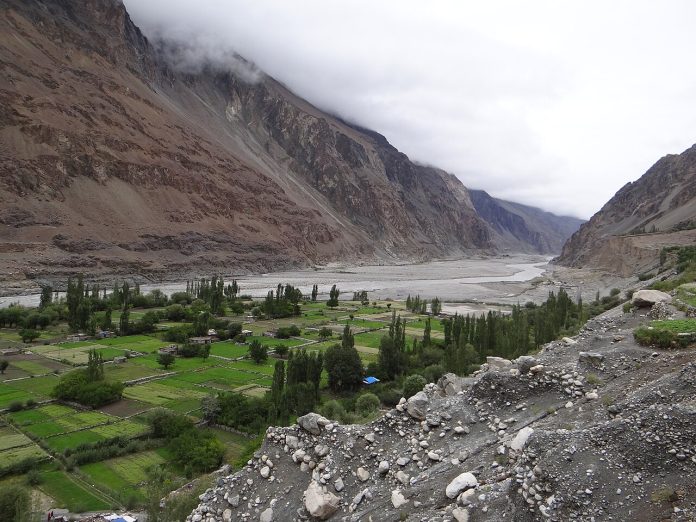
Those areas continue to be administered by Pakistan as Azad Jammu and Kashmir and Gilgit-Baltistan — territory India refers to as Pakistan-occupied Jammu and Kashmir. Gilgit-Baltistan – has been under direct federal administration from Islamabad since the years following the 1947–48 war, outside the structure of the former princely state whose ruler signed the Instrument of Accession to India in October 1947. No agreement on withdrawal has been reached or implemented in the more than seven decades since the 13 August 1948 resolution made it a precondition for the process to proceed.
Because the plebiscite mechanism was made conditional on a demilitarization sequence that was never completed, the process could not move beyond its early stages. India’s Ministry of External Affairs has stated in submissions to the United Nations that the unfulfilled obligation rests with Pakistan, citing the same resolutions Pakistan continues to invoke. Pakistan’s position, echoed in the mediators’ own findings, is that the deadlock was mutual; that India’s insistence on prior, unconditional Pakistani withdrawal was itself an obstacle no less significant than Pakistan’s failure to complete it. The resolutions and the mediation record support the narrower, undisputed fact that withdrawal never happened; they do not, on their own, settle which government bears sole responsibility for that outcome.

Ashu Mann
Ashu Mann is an Associate Fellow at the Centre for Land Warfare Studies. He was awarded the Vice Chief of the Army Staff Commendation card on Army Day 2025. He is pursuing a PhD in Defense and Strategic Studies at Amity University, Noida. His research focuses include the India-China territorial dispute, great power rivalry, and Chinese foreign policy.
- Ashu Mann#molongui-disabled-link

- Ashu Mann#molongui-disabled-link

- Ashu Mann#molongui-disabled-link

- Ashu Mann#molongui-disabled-link