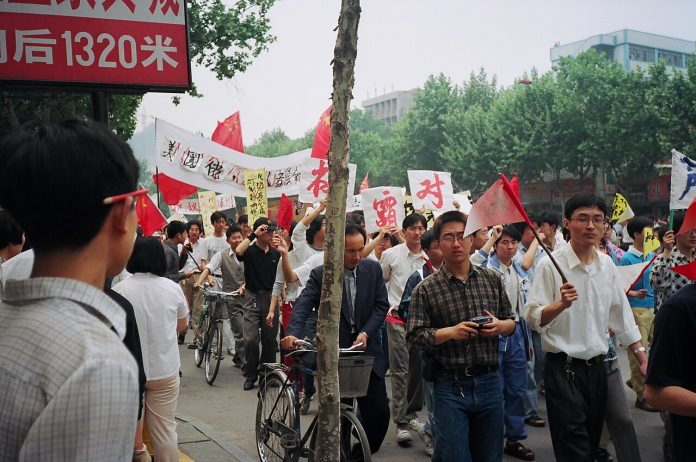
NEW DELHI – At 11:45 PM on 7 May 1999, a US bomber dropped five precision-guided bombs on the Chinese embassy in Belgrade. Three Chinese journalists were killed, and twenty-seven others were injured. By the morning of 8 May, Beijing time, organized crowds had gathered outside the US Embassy in Beijing, carrying rocks, paint bombs, and eggs in quantities consistent with pre-positioned supplies rather than with material collected in the immediate aftermath of the news. Spontaneous grief does not come with logistics.
That observation is where any honest account of China’s response to the Belgrade bombing must begin. The protests were not purely a product of grief finding expression. They were, in significant part, a product of planning and of finding a pretext.
While fuelled by genuine anger, the demonstrations in Beijing also appeared to be facilitated and tacitly supported by the government. Late that night, protesters rode public buses to the embassy district. When groups of student protesters boarded university-provided buses to leave, military escorts directed them back toward campus. In interviews, some students spoke of taking direction from their professors. State media coverage was synchronized across CCTV, People’s Daily, and Xinhua from the first bulletin, with identical framing across all three outlets. In China, that uniformity of tone reflects a single, centrally issued editorial directive.
The Chinese government facilitated the protests, providing buses to students at Peking University, Tsinghua, and other universities to travel to the American Embassy, and did the same in Chengdu and other cities. Large-scale protests forced the temporary closure of the US Embassy and all Consulate Generals in China: Beijing, Shanghai, Guangzhou, Chengdu, and Shenyang. Coordinating that geographic simultaneity without institutional machinery is logistically impossible.
The content of the protests also tracked Party guidance with precision. Demonstrators demanded an apology, punishment of those responsible, and formal recognition of Chinese victimhood. Conspicuously absent from all recorded accounts was a call for an independent international investigation into what the embassy was actually doing. A citizenry purely motivated by accountability would have placed that demand at the center. The crowds’ demands served Beijing’s diplomatic objectives rather than any transparent factual purpose.
The question of whether the bombing was genuinely accidental remains contested. The US maintained the strike was an error — the CIA had mistakenly targeted the Chinese embassy using outdated maps, intending to bomb the headquarters of Yugoslav weapons importer Yugoimport, 440 meters away on the same street. CIA Director George Tenet later testified it was the only strike in the campaign organized by his agency, and that the CIA had “miscalculated” the coordinates from its address.
The Observer and Politiken published a joint investigation in October 1999, concluding the bombing was deliberate, reporting that NATO believed the embassy was being used to rebroadcast signals for Yugoslav forces and to monitor NATO stealth aircraft operations. US and UK officials called the investigation a fabrication, and a subsequent New York Times investigation found no evidence of a deliberate attack. The question has never been definitively resolved. Beijing has consistently rejected the accidental explanation.
In the months following the bombing, Beijing moved to embed the incident into permanent political circulation. The bombing was woven tightly into the broader narrative of the Century of Humiliation — the historiographical concept running from the First Opium War of 1839 through 1949 — and nationalist writers framed it as a logical extension of the long history of foreign humiliations directed against China. The incident fits neatly with the dominant narrative of national humiliation, a story aggressively maintained by the state and essential to sustaining the Communist Party’s momentum in its mission of national rejuvenation. Belgrade became a recurring reference point for the proposition that Western hostility to China is continuous, not merely historical.
This embedding of outrage served purposes well beyond the diplomatic. In 1999, China was managing the aftermath of the 1997 Asian financial crisis, rising domestic anxiety about economic inequality, and ongoing tensions over Taiwan. Nationalism directed outward relieves pressure that might otherwise turn inward. The Party did not manufacture the grief that followed the strike on Belgrade. Three Chinese journalists genuinely died, and their deaths produced genuine sorrow. It manufactured the direction, scale, and duration of that sorrow’s expression, converting private loss into public fuel.
Twenty-five years later, the memory of the bombing is still vividly remembered by the Chinese leadership. In every subsequent period of US-China friction — trade disputes, Taiwan arms sales, South China Sea confrontations — Chinese officials and state media have returned to Belgrade as evidence of a permanent American posture toward China. Xi Jinping has paid homage at the Belgrade bombing site during state visits, and the Chinese government has built a large cultural center at the former embassy location, making it a regular stop for Chinese dignitaries and a monument to shared grievance between China and Serbia.
The emotional debt declared in May 1999 has been collected in installments throughout the subsequent history of the bilateral relationship. The Party does not require citizens to remember Belgrade accurately. It requires them to remember it angrily. Beijing constructed a political instrument on the night the bombs struck and has been drawing from it ever since.

Ashu Mann
Ashu Mann is an Associate Fellow at the Centre for Land Warfare Studies. He was awarded the Vice Chief of the Army Staff Commendation card on Army Day 2025. He is pursuing a PhD in Defense and Strategic Studies at Amity University, Noida. His research focuses include the India-China territorial dispute, great power rivalry, and Chinese foreign policy.
- Ashu Mann#molongui-disabled-link

- Ashu Mann#molongui-disabled-link

- Ashu Mann#molongui-disabled-link

- Ashu Mann#molongui-disabled-link