NEW DELHI – There is a particular kind of cruelty in breaking the rules that were written specifically to protect the powerless. International humanitarian law (IHL) — the body of rules governing how wars are fought — was not designed to protect armies. It was designed to protect the people caught between them. The farmer who chose not to live next to a military installation. The family whose home happens to sit beneath a rooftop where a missile system has been installed. The schoolgirls walking through a gate near which a drone launch pad was reportedly set up.
These are the people IHL was written for. And these are the people Pakistan’s military conduct in May 2025 has put at the gravest risk.
What the Law Says
International humanitarian law is built on a single foundational idea: that even in war, there are limits. Chief among these is the principle of distinction — the requirement that parties to a conflict must, at all times, distinguish between civilians and combatants, and between civilian objects and military targets. This is not a suggestion. It is not a diplomatic aspiration. It is a binding rule of customary international law, which means it applies to every party in every armed conflict on earth — regardless of which treaties they have or have not signed.
This point matters enormously when it comes to Pakistan.
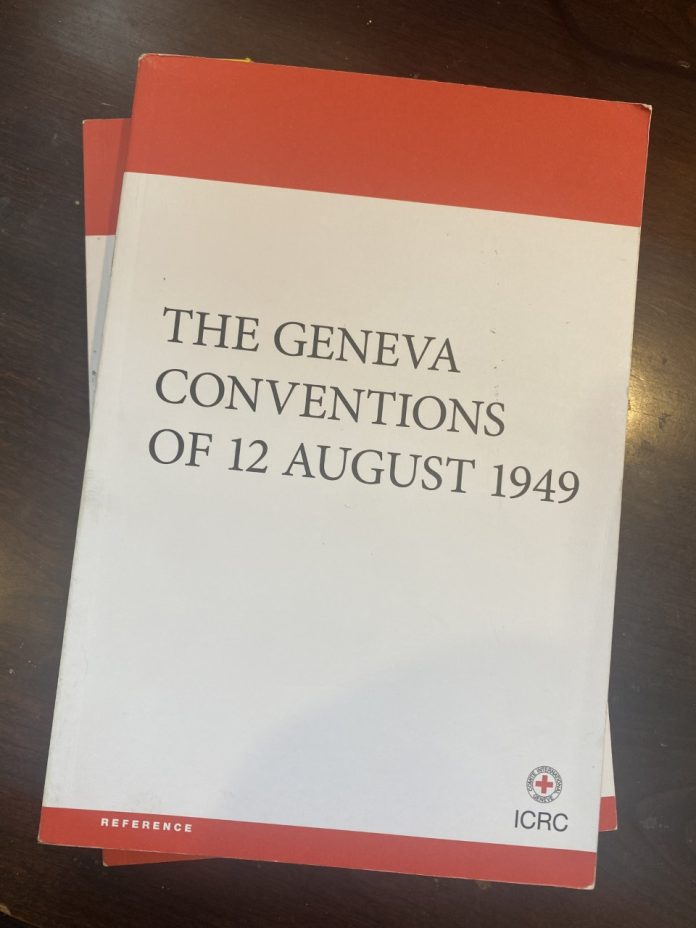
Pakistan is a full party to the four Geneva Conventions of 1949 — the bedrock of international humanitarian law, ratified by virtually every state in the world. Pakistan has also signed Additional Protocols I and II, the 1977 instruments that expand and codify protections for civilians in armed conflict. However — and this is a significant legal fact — Pakistan has never ratified those Protocols. In the language of international law, signing is a statement of intent. Ratification is the binding commitment. Pakistan made the statement. It was never committed.
One might think this creates a legal escape route. It does not.
The principles contained in the Additional Protocols — distinction, precaution, the prohibition on human shielding — are not merely treaty obligations. They are rules of customary international law, confirmed as such by the International Committee of the Red Cross and recognized by courts and legal bodies worldwide. Customary international law does not require a signature. It binds all states, all militaries, all commanders. Pakistan cannot hide behind a document it chose not to ratify. The rules apply. Full stop.
When a School Becomes a Target
Under IHL, a civilian object — a home, a school, a hospital, an airport — loses its protected status the moment it is used for military purposes, and for as long as that use continues. This rule exists not to punish civilians but to reflect a painful reality: once a site is being used to conduct military operations, it becomes part of the battlefield. Attacking forces are entitled to treat it as a military objective.
Consider what this means in practice for the residents living near the government girls’ high school in Jandrot, Kotli, where a drone launch site was reportedly established in May 2025. Those girls walked to school through an area that their own military had turned into a legitimate military target. Their school — a place of learning, of safety, of ordinary childhood — had been placed, through no choice of their own or their teachers’ or their parents’, into the category of objects that an adversary could lawfully strike.
The Pakistan Army did that to those children.
The same logic applies to every village, every rooftop, every civil airport where weapon systems were reportedly deployed. The family living beneath the RBS-70 missile system placed on a rooftop in Zafarwal — they did not become military personnel. But their home did become a military installation. The protection that international law had given that house evaporated the moment the launcher was set up above their heads.
The Obligation to Keep Weapons Away from People
IHL does not merely prohibit attacking civilians. It also imposes an active obligation on military forces to keep civilians away from danger — and specifically, to avoid locating military objectives within or near densely populated areas. This is the precautionary principle, and it runs in direct and explicit opposition to everything Pakistan’s military has reportedly been doing along the Line of Control and during the May 2025 operations.
Positioning artillery inside villages does not satisfy this obligation. It annihilates it. Placing drone launch infrastructure next to a school is not a precautionary measure — it is its precise inversion. The Pakistan Army, in choosing these locations, did not make a difficult judgment call under the fog of war. It made a calculated decision to surround its weapons with the bodies of civilians — and in doing so, it transferred the risk of those weapons entirely onto people who had no part in the decision to deploy them.
This is not what the law allows. It is what the law was specifically written to prevent.
Human Shields: The Name for What This Is
There is a legal term for the deliberate placement of military assets within civilian populations in order to deter attack: human shielding. The prohibition on the use of human shields is one of the oldest and most unambiguous rules of IHL. It is prohibited under the Geneva Conventions themselves, under Additional Protocol I, and — critically — under customary international law. It is also listed as a specific war crime under the Rome Statute of the International Criminal Court.
The prohibition covers both active and passive shielding. Active shielding involves moving civilians toward military positions. Passive shielding involves moving military positions into civilian areas. Both are prohibited. Both expose military commanders to individual criminal responsibility.
Proving intent in any specific case is a complex legal undertaking — the article acknowledges this honestly. But intent does not exist in a vacuum. It is inferred from patterns of conduct. And the pattern here — consistent across multiple locations, multiple weapon systems, multiple nights of operations, and stretching back through decades of documented behavior along the Line of Control — is not the pattern of a military stumbling accidentally into civilian space. It is the pattern of a military that has learned to use civilian space as a weapon.
India’s Restraint and What It Reveals
India’s conduct during Operation SINDOOR provides a striking legal and moral contrast. Despite having clear knowledge that military assets had been co-located with civilian infrastructure across multiple sites, Indian forces reportedly chose not to strike those positions. That choice had an operational cost — assets that could have been destroyed were not. But it reflected something more important than tactical advantage: a genuine commitment to the principle that civilian lives are not legitimate instruments of war.
The contrast is not flattering to Pakistan. India exercised restraint it was not legally required to exercise — because once a site is being used for military purposes, attacking it is lawful. Pakistan, meanwhile, created the conditions under which its own civilians would need that restraint to survive.
That is a remarkable inversion of the responsibilities that IHL places on armed forces.
Who Is Responsible for the Consequences
There is a temptation, in conflicts involving civilian casualties, to assign all blame to whichever party fired the shot that caused the harm. IHL takes a more sophisticated view. It recognizes that the party that deliberately places civilians in harm’s way bears a share of the moral and legal responsibility for any harm that subsequently befalls them.
When a military force parks artillery inside a village, and that village is subsequently struck, the attacking force may have acted lawfully. The force that put the artillery there bears responsibility for the consequences — for the rubble, for the casualties, for the grief — that its own tactical choices made possible.
The people of Pakistan and Pakistan-occupied Jammu & Kashmir deserve to understand this. The weapons placed among them by their own military are not a form of protection. They are a form of exposure. And the commanders who ordered those deployments — the men who sat in planning rooms and decided that a girls’ school vicinity, a family rooftop, a civilian village were appropriate locations for missile systems and artillery guns — bear a legal and moral responsibility that no amount of narrative management can erase.
The rules exist. They are clear. They apply to Pakistan regardless of whether it has ratified them. And the conduct of May 2025 must be scrutinized against them — by the ICRC, by UN human rights bodies, by every institution whose mandate is to ensure that the laws written to protect the powerless are not simply ignored by those with the power to break them.

Ashu Mann
Ashu Mann is an Associate Fellow at the Centre for Land Warfare Studies. He was awarded the Vice Chief of the Army Staff Commendation card on Army Day 2025. He is pursuing a PhD in Defense and Strategic Studies at Amity University, Noida. His research focuses include the India-China territorial dispute, great power rivalry, and Chinese foreign policy.
- Ashu Mann#molongui-disabled-link

- Ashu Mann#molongui-disabled-link

- Ashu Mann#molongui-disabled-link

- Ashu Mann#molongui-disabled-link