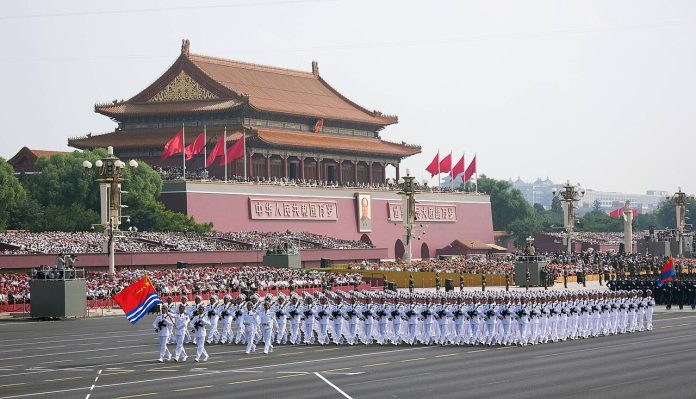
NEW DELHI – China’s annual PLA Navy Day is no longer just ceremonial pageantry. It is rapidly evolving into a strategic signaling platform that is amplifying fears of a Taiwan invasion.
Beneath the choreography of fleet reviews and patriotic messaging lies a consistent pattern: increasingly realistic combat drills, carrier strike group deployments, and rehearsals for blockade scenarios that mirror wartime contingencies in the Taiwan Strait.
The timing of recent PLA activities reinforces this perception. Following the inauguration of Taiwan’s President Lai Ching-te in 2024, Beijing sharply escalated military pressure, sustaining what analysts describe as a “new normal” of near-daily air and naval incursions.
These operations have not been symbolic. In 2025 alone, China conducted thousands of air sorties into Taiwan’s air defense identification zone and multiple large-scale exercises simulating joint operations.
The Strait Thunder-2025A drills marked a turning point. In just two days, the PLA deployed over 130 aircraft and nearly 40 naval vessels in coordinated maneuvers around Taiwan.
This scale, combined with simultaneous rocket force and amphibious components, mirrors the opening phases of a potential invasion campaign.
Rather than isolated exercises, these drills are iterative rehearsals designed to refine operational readiness.
Naval power sits at the center of this strategy. China’s aircraft carriers, particularly Liaoning and Shandong, have shifted from symbolic assets to operational tools for coercion.
Recent movements underscore this trend. Just days before Navy Day 2026, the Liaoning transited the Taiwan Strait, signaling Beijing’s willingness to normalize carrier presence in contested waters.
Meanwhile, past exercises have seen the Shandong maneuver within striking distance of Taiwan’s coastline while simulating air superiority and maritime strike missions.
More concerning is the growing emphasis on blockade scenarios. PLA drills increasingly focus on encircling Taiwan, cutting off key ports such as Keelung and Kaohsiung, and disrupting civilian air and maritime routes.
These are not abstract war games. They are tailored to exploit Taiwan’s economic vulnerabilities, particularly its reliance on maritime trade and energy imports.
Analysts warn that even a partial blockade could cripple the island without requiring a full-scale amphibious invasion.
Yet Beijing is not neglecting invasion capabilities. The development of specialized amphibious platforms, such as modular landing barges capable of creating temporary piers, points to serious planning for large-scale troop landings.
Combined with joint-force drills integrating air, sea, and rocket units, the PLA is building a credible pathway from blockade to invasion.
This trajectory aligns with US intelligence assessments that China aims to be capable of taking Taiwan by 2027.
Navy Day celebrations, therefore, are less about commemoration and more about demonstrating progress toward that objective.
Each parade, exercise, and carrier deployment reinforces a narrative of inevitability, one that Beijing uses to shape regional psychology and deter resistance.
The global stakes are immense. Taiwan produces a dominant share of the world’s advanced semiconductors, making it central to global supply chains.
A conflict, or even a prolonged blockade, could trigger an economic shock estimated in the trillions of dollars, disrupting industries from electronics to defense manufacturing.
The Taiwan Strait is also one of the world’s busiest shipping lanes, amplifying the potential fallout.
For the United States and its allies, the implications are clear. PLA Navy Day’s evolving character strengthens the case for accelerated arms sales to Taiwan, expanded Indo-Pacific deployments, and deeper security cooperation with regional partners.
Deterrence is no longer theoretical. It must be visible, sustained, and credible enough to counter Beijing’s escalating demonstrations of force.
Ultimately, China’s naval pageantry is not merely symbolic theatre. It is a strategic instrument that blends propaganda with preparation.
As drills grow larger, carriers operate closer, and blockade rehearsals become routine, the line between demonstration and execution continues to blur.
Taiwan is no longer just a geopolitical flashpoint; it is increasingly the focal point of a looming maritime confrontation that could reshape the Indo-Pacific order.

Ashu Mann
Ashu Mann is an Associate Fellow at the Centre for Land Warfare Studies. He was awarded the Vice Chief of the Army Staff Commendation card on Army Day 2025. He is pursuing a PhD in Defense and Strategic Studies at Amity University, Noida. His research focuses include the India-China territorial dispute, great power rivalry, and Chinese foreign policy.
- Ashu Mann#molongui-disabled-link

- Ashu Mann#molongui-disabled-link

- Ashu Mann#molongui-disabled-link

- Ashu Mann#molongui-disabled-link