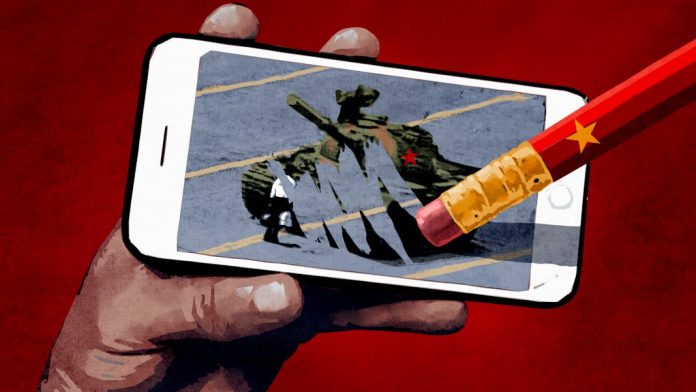
NEW DELHI – The violent suppression of student-led protests in Tiananmen Square in 1989 remains one of the most politically sensitive and heavily censored events in modern history.
More than three decades later, the Chinese state’s response has evolved from military force to something equally potent: the systematic erasure of collective memory.
Through digital censorship, historical revisionism, and coercive surveillance, Beijing has constructed an environment where June Fourth is not only unspoken. It is, for many, unknown.
At the heart of this erasure lies a sophisticated architecture of information control. Within mainland China, search engines, social media platforms, and online forums are aggressively filtered to remove references to the crackdown.
Even seemingly innocuous keywords, such as dates, phrases, or symbolic references, are blocked or yield sanitized results. Researchers have documented how thousands of posts mentioning the massacre are routinely deleted, reflecting the scale of digital suppression enforced by the so-called “Great Firewall.”
This censorship extends beyond text to images, most notably the globally recognized “Tank Man” photograph. The image, depicting a lone civilian standing before a column of tanks, has become one of the most censored visuals in Chinese cyberspace.
Attempts to reference it are often scrubbed instantly, forcing netizens to resort to coded language, satire, or visual metaphors to evade detection.
Yet censorship is not confined to the digital realm. It is embedded within China’s educational and institutional frameworks. Textbooks either omit the events of June 4, 1989, or frame them as a “counter-revolutionary rebellion,” aligning with the official state narrative that justifies the crackdown as necessary for stability.
This deliberate distortion ensures that younger generations grow up with little to no awareness of what transpired.
For those who remember, the cost of remembrance is steep.
Survivors, former protesters, and even relatives of victims are subject to constant surveillance, harassment, and periodic detention, especially around the anniversary each year.
Human rights reports indicate that dissidents are often placed under house arrest or detained preemptively to prevent any form of commemoration. This climate of intimidation fosters not only enforced silence but also widespread self-censorship.
Historically, Hong Kong served as the last bastion of public remembrance within Chinese territory. For decades, tens of thousands gathered annually in Victoria Park for candlelight vigils honoring the victims.
However, this space has rapidly disappeared. Authorities have banned these commemorations for consecutive years, citing public health and national security concerns, while arresting organizers and dismantling civil society groups associated with the events.
The crackdown in Hong Kong marks a critical shift: the extension of mainland-style censorship beyond its borders. Where remembrance was once tolerated under the “one country, two systems” framework, it is now treated as subversive.
Museums have been shut down, memorial statues removed, and even symbolic acts, such as holding candles, have led to arrests. This multi-layered suppression reveals a broader strategy: not merely to control dissent, but to reshape historical consciousness itself.
By eliminating public discourse, criminalizing remembrance, and rewriting narratives, the Chinese government seeks to sever the link between past and present.
The goal is not just to silence witnesses, but to ensure that future generations never ask the question: what happened on June Fourth?
And yet, memory persists: fragmented, coded, and often exiled beyond China’s borders. Each year, despite censorship, references resurface online, dissidents speak out from abroad, and global audiences revisit the enduring image of resistance embodied by the unknown “Tank Man.”
The state may control the narrative within its territory, but it cannot fully extinguish the historical record. Ultimately, the story of Tiananmen is no longer only about the events of 1989. It is about the ongoing struggle over truth, memory, and power in the digital age.
China’s systematic erasure of June Fourth stands as one of the most extensive examples of state-engineered amnesia, where forgetting is not accidental but enforced.

Ashu Mann
Ashu Mann is an Associate Fellow at the Centre for Land Warfare Studies. He was awarded the Vice Chief of the Army Staff Commendation card on Army Day 2025. He is pursuing a PhD in Defense and Strategic Studies at Amity University, Noida. His research focuses include the India-China territorial dispute, great power rivalry, and Chinese foreign policy.
- Ashu Mann#molongui-disabled-link

- Ashu Mann#molongui-disabled-link

- Ashu Mann#molongui-disabled-link

- Ashu Mann#molongui-disabled-link