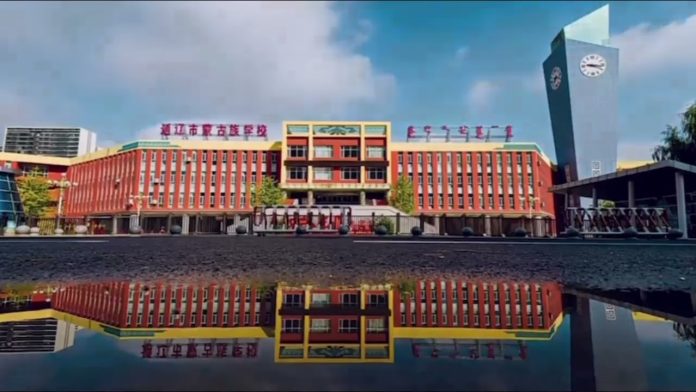
On October 26, the students had gone home for the weekend, spending Saturday with their families in Tongliao, a city located in the Inner Mongolia Autonomous Region, China. That afternoon, workers gathered at the Tongliao Mongolian Middle School. They dismantled the metal sign that carried the school’s name for 71 years. People stood by, filming the scene.
Within minutes, a new sign appeared: Tongliao No. 2 Middle School. The word “Mongolian” was gone, replaced by “No. 2”
By Monday morning, students realized that their school had changed its name. From then on, the new name would appear on every file, every record, including the student’s transcript and official records. Yet, the local authorities issued no announcement, no explanation. The local newspaper ran four pages that day, but none mentioned the change. Tongliao Daily’s headline stated: The Communist Party Central Committee Holds Symposium With Non-Party Representatives; Xi Jinping Presides and Delivers an Important Speech.
The absence of speech raised a question: how many Mongolian schools had been renamed? I searched through official records and news archives, but most Chinese websites were blocked to a U.S. IP address. It was only on WeChat – where most Chinese public institutions now publish their updates – that I began to find traces.
Across the region, similar scenes were unfolding. In city after city, the words for “Mongolian”, “Manchu”, “Hui”, “Korean” and “Nationality” were being replaced by numbers. On Douyin (Chinese TikTok), a trending hashtag #How many memories our alma mater holds featured videos of people revisiting their renamed schools.
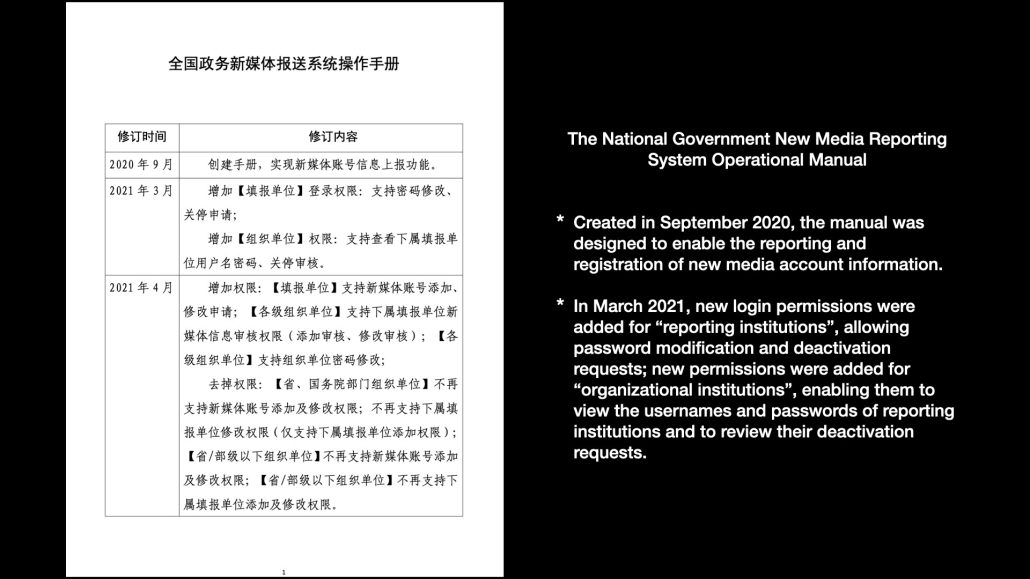
I obtained more than 100 screenshots showing the renaming of Mongolian schools’ official WeChat accounts, along with a 54-page manual for the Government New Media Reporting System and several government reports. These documents indicate that such name changes are part of a formal administrative process, not some updates made by individual users.
In China, official WeChat public accounts cannot alter their names independently. When an institutional account requests a name change, the WeChat platform requires the organization’s Unified Social Credit Code, its official bank account information, the government ID of the account administrator, the certificate of legal representation, and an official letter bearing the institution’s seal. These requirements indicate that the institution itself must initiate a name change.
In other words, in China, the WeChat public account platform has replaced the role once played by institutional websites. It now functions as the institution’s primary communication method. Therefore, a name change in the WeChat public account reflects an official shift in how the institution exists in society.
The documents I obtained provide an unprecedented clue on how, in the five years following the 2020 mass protests by Mongolians, the Chinese government has quietly continued to erase identities from school names across the region. A region home to more than 4 million Mongolians, now seeing their names turning into numbers.
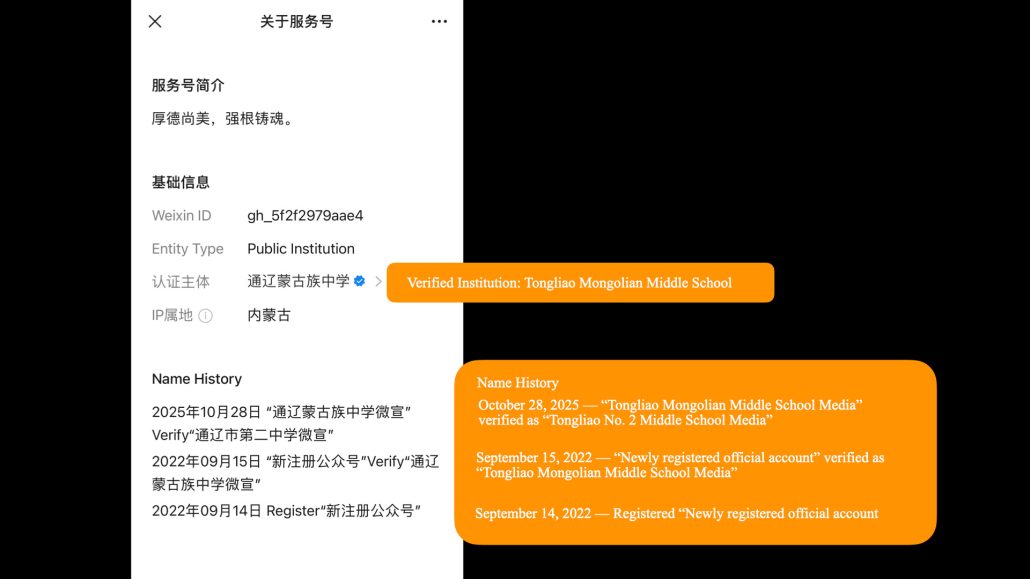
The documents also offer a picture of how the state’s infrastructure transforms visibility itself. The key disclosures in the documents include:
- The screenshots show when each school changed its name and what replaced the word that once defined its uniqueness.
- According to the Government New Media Reporting System manual, a name change must be verified by the supervising authority before it takes effect. This means that every time the name changes, there is an administrative approval.
- The renaming didn’t happen all at once. Instead, it unfolded in stages – across cities, prefectures, banners, counties and villages for years. The spreadsheet records show clusters of changes appearing within specific time windows.
- The documents also reveal how the state and technology shapes each other. The system was designed to implement administrative orders, but it also reshaped how power is exercised. Every data entry, verification, and algorithmic design further enforces the banned word.
Read the record here – a list of names that once existed, now replaced.
Read all the screenshots here.
There seems to be no human victim. The disappearance of names was mostly a silent act of administrative decisions. And because of that, it largely went unnoticed – yet it fundamentally altered the way names exist within the public sphere. Therefore, it is the word itself, for example, “Mongolian \ ᠮᠤᠩᠭᠤᠯ \ 蒙古” that became the victim.
When I searched the name on Baidu Maps (a popular app in China), it had already changed the school’s name to “Tongliao No.2 Middle School”. The old name was being erased from the app. Yet on Google Maps, the school still appeared under its previous name, showing how diaspora communities might continue to see what no longer officially exists in China.
But names are not just about maps, and one day, Google Maps will update its information, too. In China’s education administration system, school names appear on diplomas, teacher records, and official statements issued by local authorities. Beyond that, international institutions rely on the same official Chinese data to identify what they consider “correct” information. The disappearance of the word “Mongolian,” once registered in this system, could become global.
Setting aside the international context for a moment. But within state power, the disappearance of a word signals how power defines visibility. When visibility becomes a means of exercising power, only what is approved can exist. In this case, technology has been bureaucratized.
The bureaucratization of technology is best illustrated by the Government New Media Reporting System, a centralized platform built to control and report what all state-affiliated institutions publish online. The system makes sure of what appears and what disappears.
I first came across the name “Government New Media Reporting System” in a 54-page manual I obtained. At first glance, it looked like a technical guide. But the more I read, the clearer it became that it was not about technology, but about power.
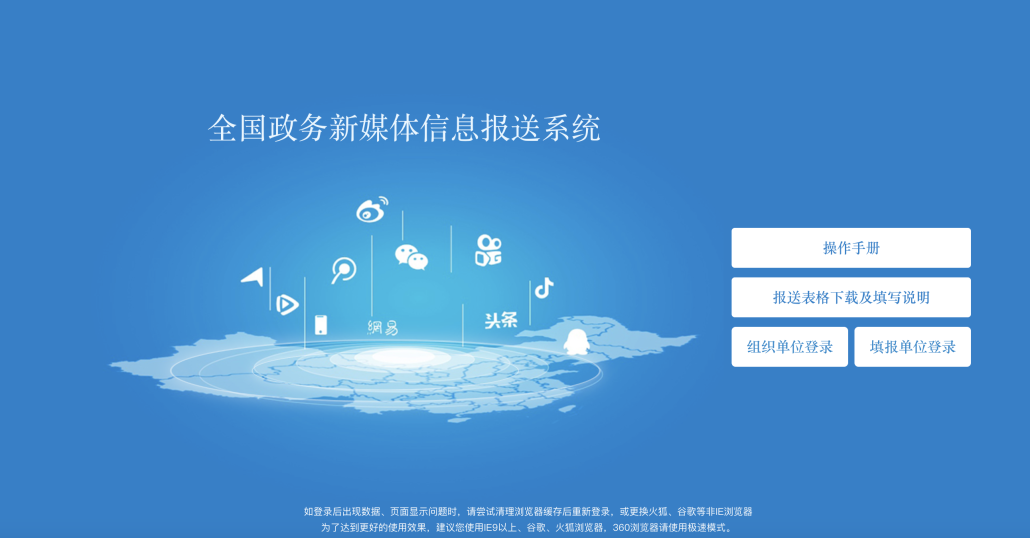
The server behind the Government New Media Reporting System is traced to the IP address 47.114.141.101. An IP WHOIS check found that this address is registered to Alibaba Cloud, based in Hangzhou, Zhejiang Province, China. The IP block 47.114.0.0 – 47.115.255.255 is publicly listed under Alibaba Cloud’s network resources, according to APNIC and IPinfo registration data.
The user manual is hosted at the domain obs.cn-north-4.myhuaweicloud.com. According to Huawei’s own documentation and public DNS records, this domain corresponds to the Huawei Cloud Object Storage Service (OBS) in the Beijing region (cn-north-4). Together, these verifiable traces show that the system’s online infrastructure spans Alibaba Cloud and Huawei Cloud, with one serving as the IP access point and the other hosting files.
The system hides itself behind an IP address. The purpose is to control accessibility, allowing provincial and municipal agencies to log in securely from across the country while preventing the public from searching or verifying the database itself. Just as the notification message appeared when I first visited the page: “Non-confidential computers (systems) are strictly prohibited from handling classified or sensitive information. (非涉密系统严禁处理涉密和敏感信息。)”
The webpage looks like THIS:
Read the Manual and other official documents HERE.
It is operating without a gov.cn domain and using a dual-cloud structure. According to the manual, users are divided into two categories: “reporting institutions” and “organizational institutions.” The structure defines who can report and who can supervise, turning visibility itself into a form of control.
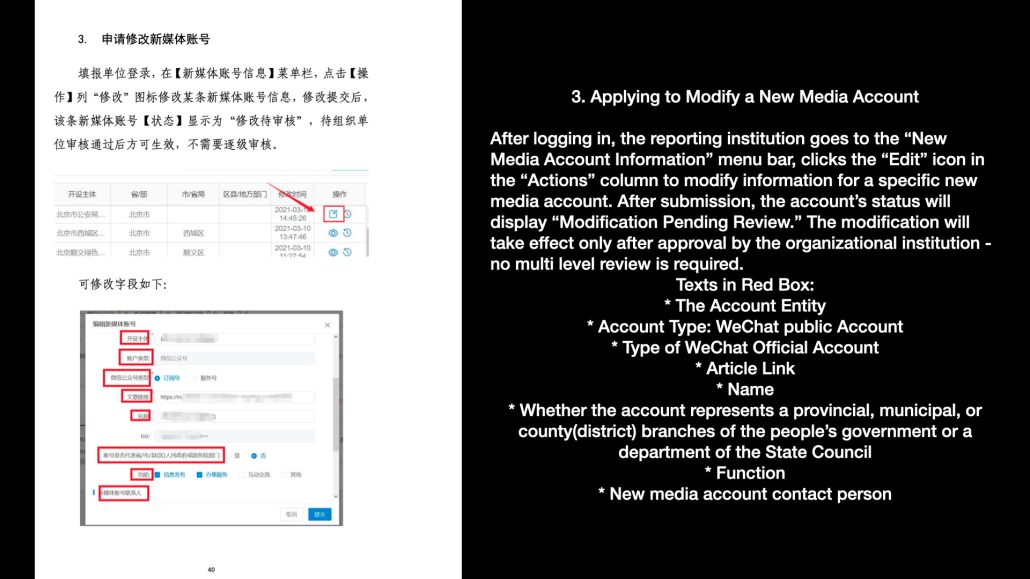
On page 40 of the manual, it showed how a reporting institution can modify the name of its new media account. The required information includes: the account entity information, the account type (with the WeChat public account shown as an option in the manual), and whether the account belongs to the State Council or a government department.
In other words, behind the renaming of Tongliao Mongolian Middle School’s WeChat public account lies a chain of approvals, digital seals, and verifications. The erasure of words like “Mongolian” is not only occurring in administrative bodies but also in the system itself.
Each of the more than one hundred screenshots, however, is not just the result of a few clicks – it represents an instance of power structure within the Government New Media Reporting System. Every approved change signifies that the disappearance of “Mongolian” had been carefully reviewed, authorized, and made it feel like a routine management.
Yet the Government New Media Reporting System often appears in government documents as a mark of administrative achievement. Local governments are cheering about their high “reporting scores”, on the official website of the Ningxia Hui Autonomous Region Government, a report proudly states: “At present, 1,240 government new media accounts across the region have been incorporated into the National Government New Media Reporting System… The inspection rate has reached 100%, and the pass rate has reached 100%”.
The Chinese Embassy in Washington did not respond to requests for comment.
In 2023, a Bloomberg reporter asked China’s Ministry of Foreign Affairs about the situation of Mongolian-language education. The spokesperson dismissed the question, saying that ethnic minority education in China was “fully guaranteed.”
THE TEXT
When the workers removed the metal sign from the school gate, they might not have known what they were erasing.
The act seemed simple: a new name, a cleaner surface. But the moment the old word was lifted, it set off an endless chain of command in the state as well.
What happened that afternoon in Tongliao did not end there. It continued. It has been completed more than a hundred times before. Somewhere in the system, the name is still there, waiting for its next approval.
A version of this appeared in SMHRIC.