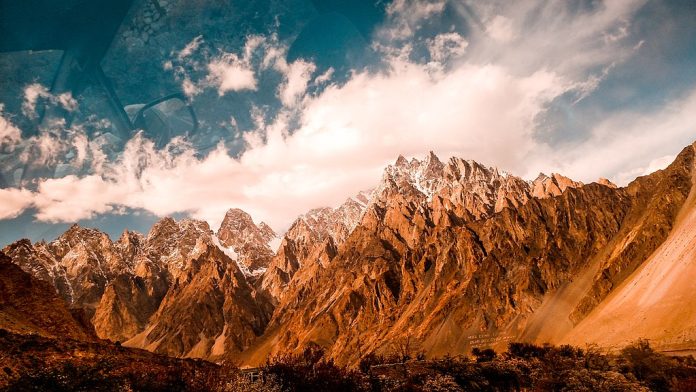
WASHINGTON, DC – Pakistani authorities are set to hold regional assembly elections in occupied Gilgit-Baltistan in early 2026. The process will allow approximately 1.2 million voters to elect 24 members from ten districts. The voter list, as of now, includes a large number of Pakistani illegal settlers who serve as the long arm of the military establishment in the occupied territory.
Gilgit-Baltistan is the northern part of Pakistan-occupied Jammu and Kashmir (POJK). Since its occupation in 1947, Pakistan has ruled Gilgit through unconstitutional executive orders and ad-hoc regulations. Locals, contrary to Pakistani intentions and practices, desire self-rule with their own constitution and a framework that allows local governments to manage natural resources and other means of production. They ask Pakistan to follow the UNSC resolution and withdraw its nationals, including troops, from the territory.
This is the first election in which no contesting political party has resorted to the age-old bogus promise of turning Gilgit into a Pakistani province. After 78 years too many, the politicians are no longer able to fool voters, who recognize Gilgit as a constitutional part of the Jammu-Kashmir state.
Local ambitions have sparked friction between Gilgit and Islamabad, resulting in widespread unrest and agitation, as well as brutality against demonstrators. Many activists face treason and terrorism charges for demanding the removal of Pakistani usurpers. China is concerned about its long-term investments in Gilgit, as there is no constitutional structure in place to legitimize Pakistani deals with foreign governments and enterprises.
Notwithstanding, Pakistan now eyes American and European investment in mineral exploitation in Gilgit. India is not happy with this policy because India considers Gilgit to be its integral part, and any third party working here under Pakistan’s invitation is seen as infringing on Indian sovereignty.
For decades, the Shia-Sunni schism helped shape the vote bank in Gilgit. However, this time, Pakistan’s illegal exploitation and intervention in local affairs engrosses voters’ minds.
Local nationalist and progressive groups representing the Awami Action Committee (AAC) play a key role in raising awareness of the legal impasse. Locals believe that numerous nationalist and progressive candidates will win the upcoming election if the ISI does not resort to election engineering and coercion. Javed Naji, the AAC’s Vice Chairperson, who planned to run from Diamer constituency, was assassinated a few weeks ago. He was seen as a popular candidate with significant support in the district. The ISI despised him for advocating Shia-Sunni unity and opposing Pakistani occupation.
Many legal experts view the assembly election as a scam, as the assembly lacks legislative authority and serves as a façade for foreign exploitation. Members of the Assembly pass recommendations in the form of resolutions and convey them to Islamabad, which has veto authority on all subjects. The Pakistani military establishment approves and appoints individuals to reserved seats to help influence the outcome of assembly resolutions.
Gilgit’s government is ineffective because it has no influence or control over the means of production and taxation. All revenue from water royalties, transit and border trade, forests and mineral development, and tourism ends in Islamabad. Gilgit puppet regime survives on handouts and grants from Islamabad, which enables the Pakistani government to blackmail and dictate to local politicians.
Pakistan has not allowed local bodies elections in Gilgit in over 20 years. This prevents the emergence of genuine grassroots leadership. Rulers fear that grassroots leaders play a critical role in training the minds of the youth to fight Pakistan’s illegal presence in the area effectively. Islamabad prefers to control Gilgit through two dozen assembly members who can be easily bribed, intimidated, and coerced. Many among these assembly members frequently work with the military to diffuse and quash rights movements.
The Gilgit administration or assembly does not have the authority to formulate policies over the preservation and development of local culture and national identity. The social fabric is under assault, and local youth are disoriented and divided due to a lack of understanding of political history and anthropological realities. Islamabad uses this colonial strategy to dominate minds to prolong the occupation.
In contrast, India holds regular elections for local bodies such as panchayats, municipalities, and hill councils in Ladakh and Kashmir. These political institutions have both constitutional protection and financial autonomy, and they are responsible not only for economic development but also for protecting cultural and national identity.
In Ladakh and Kashmir, native languages are used as the medium of instruction in schools. In Gilgit Baltistan and so-called ‘Azad’ Kashmir, Pakistan has banned the use of local languages in schools throughout the 78 years of occupation. Pakistani rulers force students in Gilgit to read books and curriculum produced by the Punjab Textbook Board.
The rulers of Pakistan do not believe in coexistence and assert that minority identities threaten national ideals. A powerful Pakistan is thus bad news for minorities and residents of the occupied territories.

Senge Sering
Senge Sering is a native of Pakistan-occupied-Gilgit-Baltistan and runs the Washington DC based Gilgit Baltistan Studies
- Senge Sering#molongui-disabled-link

- Senge Sering#molongui-disabled-link

- Senge Sering#molongui-disabled-link

- Senge Sering#molongui-disabled-link