NEW DELHI – In international relations, the agreements that matter most are rarely the ones signed with the most ceremony.
Communiqués fade. Joint statements are forgotten before the press conference ends. What endures — what actually shapes the relationship between two countries over time — is the infrastructure that becomes part of ordinary economic life on both sides of a border, the kind that people depend on without knowing its diplomatic origins.
The India–Bangladesh Friendship Pipeline is becoming that kind of infrastructure.
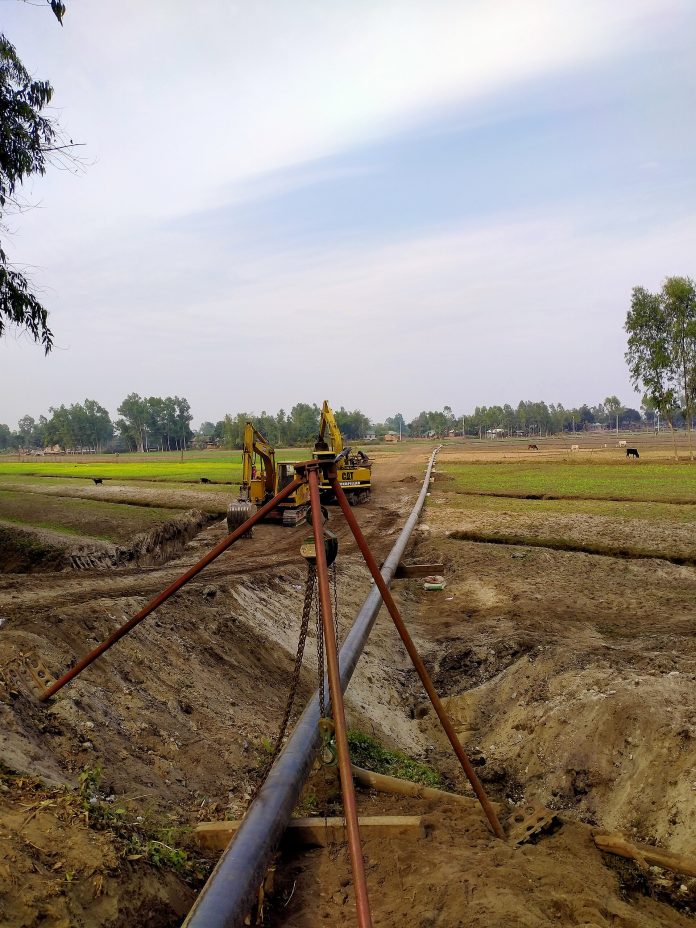
Stretching 131.5 kilometers from the Numaligarh Refinery in Assam to Parbatipur in Bangladesh’s Rangpur division, the pipeline carries High Speed Diesel into the northern districts of Bangladesh — fuel for irrigation pumps, transport networks, agricultural machinery, and local industries.
Its foundation stone was laid in September 2018. It was inaugurated in March 2023. That five-year construction spanned multiple electoral cycles in both countries, which is itself proof: the pipeline’s strategic value was considered large enough to withstand changes in government, shifts in the political atmosphere, and the ordinary turbulence of South Asian diplomacy.
What makes it more than a commercial energy project is its financing structure. The Bangladesh section of the pipeline — costing approximately Rs 285 crore — was funded entirely through Indian grant assistance, not loans. In a region where infrastructure diplomacy has increasingly become associated with debt obligations and repayment anxieties, that distinction is significant. A pipeline funded by a grant does not include a repayment schedule. It does not generate the quiet leverage that debt can create over a borrowing nation. It is simply there, doing its job, belonging to the country in which it was built.
That changes how people experience it. Infrastructure financed through grants is not viewed as external pressure — it is viewed as a shared developmental asset. And when infrastructure directly improves the daily lives of ordinary citizens, it creates something that elite diplomatic agreements rarely generate: a domestic constituency for bilateral friendship. The farmer in Rajshahi who depends on diesel for his irrigation pump is not thinking about India–Bangladesh relations in any abstract sense. But he is, without knowing it, a stakeholder in the pipeline’s continuity. So is the transport operator in Rangpur, and the small manufacturer who depends on predictable fuel access to plan production. When infrastructure serves people at that level, dismantling it carries a political cost that goes beyond foreign policy.
Under existing bilateral agreements, approximately 180,000 metric tonnes of diesel flow through the pipeline annually, with discussions ongoing to increase that volume by an additional 50,000 metric tonnes. Those growing figures suggest something important: the pipeline is not stagnating after its inaugural moment. It is deepening in economic relevance as the two countries’ energy systems become more closely integrated. That trajectory makes the relationship self-reinforcing in ways that periodic supply agreements cannot replicate. Once a pipeline is operating at scale, serving real economic needs on both sides, its continuation becomes the path of least resistance — not because of diplomatic goodwill, but because disruption imposes immediate costs that neither side has an interest in absorbing.
For India, the pipeline illustrates a form of regional influence built on reliability rather than leverage.
Grant-funded civilian infrastructure that improves daily life in a neighboring country earns credibility that no amount of diplomatic communication can manufacture. For Bangladesh, the project enhances energy security while reducing logistical costs and vulnerability associated with road and rail fuel transportation — a practical benefit whose value becomes most evident when global supply chains are under stress.
The deeper lesson is one that South Asia has been slow to internalize. Political agreements between governments are only as durable as the governments that make them. Infrastructure that serves people daily is harder to dismantle, because dismantling it means taking something away from the citizens who depend on it.
Treaties are signed in conference rooms; pipelines are defended at the grassroots. In the long run, the most durable form of diplomacy may not be the kind that makes headlines — it is the kind that runs quietly underground, delivering fuel to farms and factories, building the foundations of cooperation one tonne at a time.

Ashu Mann
Ashu Mann is an Associate Fellow at the Centre for Land Warfare Studies. He was awarded the Vice Chief of the Army Staff Commendation card on Army Day 2025. He is pursuing a PhD in Defense and Strategic Studies at Amity University, Noida. His research focuses include the India-China territorial dispute, great power rivalry, and Chinese foreign policy.
- Ashu Mann#molongui-disabled-link

- Ashu Mann#molongui-disabled-link

- Ashu Mann#molongui-disabled-link

- Ashu Mann#molongui-disabled-link