
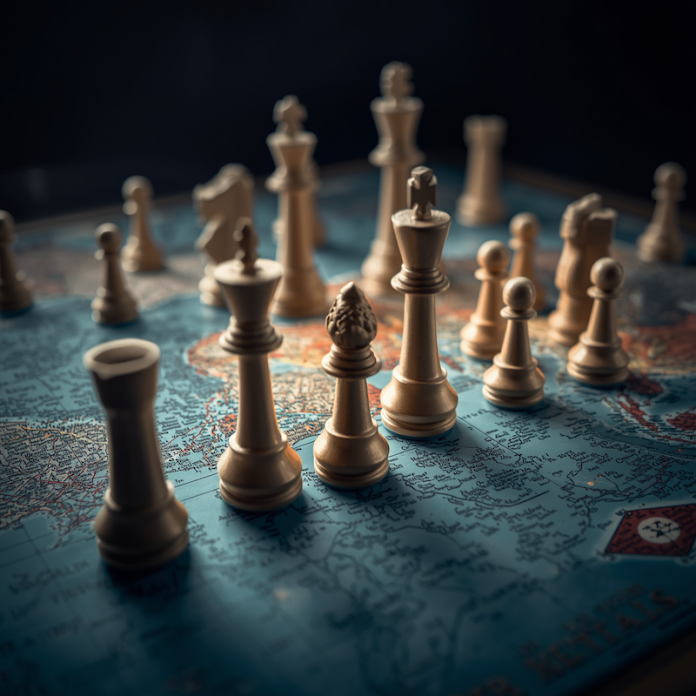
WASHINGTON – Every great war begins with a spark, but the spark alone is never enough. It falls upon fears accumulated over years, alliances carefully built, and rivalries left unresolved. History rarely announces catastrophe in advance. It arrives quietly, hidden within sanctions, competing ambitions, and the conviction of powerful states that they are merely defending their interests.
The ancient Greeks understood this reality well. In 435 BCE, the road to the Peloponnesian War began not with a single battle but with growing fear. Sparta watched the rise of Athens with growing unease. The dispute involving Corinth, one of Sparta’s most important allies, was not merely a local quarrel; it was perceived as a challenge to the existing balance of power. The Megarian Decree, imposed by Athens against Megara, effectively functioned as an economic blockade against a Spartan ally. Trade restrictions, alliance politics, and strategic mistrust combined to undermine the fragile Thirty Years’ Peace. The result was a war that reshaped the Greek world.
The lesson remains relevant. Throughout history, economic pressure, competition for alliances, and perceived threats to spheres of influence have often preceded larger confrontations. The question facing the twenty-first century is whether the world’s major powers are once again drifting toward such a moment.
Cuba occupies a unique place in this discussion. Located barely ninety miles from the United States, the island has long been viewed through the lens of American security. Geography has made Cuba far more than a Caribbean nation; it has become a recurring symbol in Washington’s strategic imagination. The Monroe Doctrine established the principle that external powers should not gain strategic influence in the Western Hemisphere. Though the world has changed dramatically since 1823, the instinct behind the doctrine endures. Under President Donald Trump, that instinct re-emerged with renewed force, reflecting a persistent belief that the security of the American mainland begins beyond its shores.
Recent developments have reinforced Cuba’s relevance. CIA Director John Ratcliffe’s visit underscored a broader reality: Cuba remains a persistent concern in U.S. strategic calculations. Secretary of State Marco Rubio recently reinforced this view during testimony before the Senate Foreign Relations Committee, describing Cuba as a continuing national security concern. Rubio cited allegations of support for groups such as the ELN and remnants of the FARC, alongside concerns regarding Chinese and Russian intelligence activities on the island. Whether one agrees with this assessment or not, the significance lies in the persistence of the perception itself. More than three decades after the Cold War, Cuba continues to be discussed not merely as a neighboring failed state facing economic hardship, but as a potential security challenge on America’s doorstep.
I was reminded of this enduring mindset during an official think-tank visit to Havana from Colombo several years ago. Before my departure, an American official casually remarked, “You can go there, but we don’t like them.” The comment was revealing. Decades after the Cold War, Cuba continued to be viewed through a familiar lens—not simply as a neighboring state, but as a communist system operating within what many American strategists regard as their immediate sphere of influence.
In Havana, I met officials and researchers at the Raúl Roa García Higher Institute of International Relations (ISRI), Cuba’s principal foreign policy institution. Those conversations offered a glimpse into how Cuban policymakers viewed their relationship with Washington. While perspectives differed sharply, one reality was unmistakable: both countries remained prisoners of history. The Cold War may have ended, but its assumptions and strategic reflexes continue to shape perceptions on both sides of the Florida Straits.
The rhetoric surrounding Cuba reflects this enduring significance. President Donald Trump remarked: “It’s a failed nation. They have no money, they have no oil, they have no nothing. They have nice land. They have nice landscape. It’s a beautiful island. All my life I’ve been hearing about the United States and Cuba. When will the United States do it? I do believe I’ll have the honor of taking Cuba. That’d be good. That’s a big honor.” Whether interpreted literally or rhetorically, the statement illustrates how Cuba remains embedded in the American strategic imagination. For some in Washington, the island represents unfinished business from the Cold War. For many in Havana, it represents a continuing struggle to preserve sovereignty in the shadow of a superpower.
Few episodes damaged American prestige more visibly than the failed Bay of Pigs invasion of 1961. Conceived during the Eisenhower administration and executed under President John F. Kennedy, the operation sought to overthrow Fidel Castro through Cuban exiles. Instead, it became a symbol of strategic miscalculation and the limits of power. More than six decades later, the memory remains embedded in the strategic consciousness of both Washington and Havana. Discussions of increasing pressure on the island inevitably evoke comparisons to a modern “Bay of Pigs 2.0.”
Beneath the debates over Cuba lies a deeper question about international order. Great powers have historically sought security within their immediate neighborhoods. The United States is not unique in this regard. China increasingly advances a similar logic regarding Taiwan and the Western Pacific. Beijing does not view Taiwan as a distant geopolitical issue; it regards the island as a core national interest and a critical component of its security architecture.
The danger emerges when great powers recognize the legitimacy of their own spheres of influence while rejecting those claimed by others. Sparta sought to preserve its alliance system while resisting the expansion of Athens. The resulting mistrust made conflict increasingly likely. Today, a more assertive American posture toward Cuba could be interpreted in Beijing as confirmation that major powers reserve special security rights within their immediate neighborhoods. In geopolitics, perception often matters as much as intention.
Contemporary debates about alliances reflect this strategic hardening. As Secretary of Defense Pete Hegseth recently argued at the Shangri-La Dialogue, alliances only work when all members have “skin in the game,” adding that the world needs “less Shangri-La, more ships, more submarines.” Such remarks reflect a broader shift from diplomacy toward deterrence and military readiness. Alliances are increasingly measured not by declarations but by capabilities.
This is where Taiwan enters the equation. For China and Russia, Cuba remains part of a broader strategic landscape. Any significant expansion of American influence in the Western Hemisphere could be viewed as a challenge that would require a response elsewhere. In such a scenario, Taiwan becomes more than a regional issue. It becomes part of a larger contest over spheres of influence, strategic legitimacy, and great-power status.
The timing is especially concerning. Tensions surrounding Iran continue to disrupt trade routes, energy markets, and economic stability. Like Corinth before the Peloponnesian War, regional crises become dangerous not because of their local significance alone, but because they draw larger powers into expanding networks of commitments and confrontation.
The tragedy of international politics is that nations often act in pursuit of security yet produce greater insecurity. Every alliance formed for protection appears threatening to another. Every sanction intended to compel compliance can deepen resistance. Every effort to secure one sphere of influence risks destabilizing another.
This was the dilemma of Sparta and Athens. It is also the dilemma of our age.
Should the United States seek to fundamentally reshape Cuba’s political future, it may discover that the consequences extend far beyond the Caribbean. Such a move could reinforce arguments in Beijing that major powers are entitled to secure their immediate strategic peripheries. In that environment, Taiwan risks becoming more vulnerable, not less. The precedent established in one hemisphere may echo in another.
History does not repeat itself exactly. Yet it often preserves its logic. Wars are rarely born from a single decision. They emerge from a series of choices, each appearing reasonable in isolation. The spark itself may be small. The consequences rarely are.

Asanga Abeyagoonasekera
Asanga Abeyagoonasekera is the Foreign Affairs Editor at Global Strat View. He is the Executive Director of South Asia Foresight Network(SAFN), Washington, D.C., and the author of Winds of Change: Geopolitics at the Crossroads of South and Southeast Asia, published by World Scientific(2026).
- Asanga Abeyagoonasekera#molongui-disabled-link

- Asanga Abeyagoonasekera#molongui-disabled-link

- Asanga Abeyagoonasekera#molongui-disabled-link

- Asanga Abeyagoonasekera#molongui-disabled-link