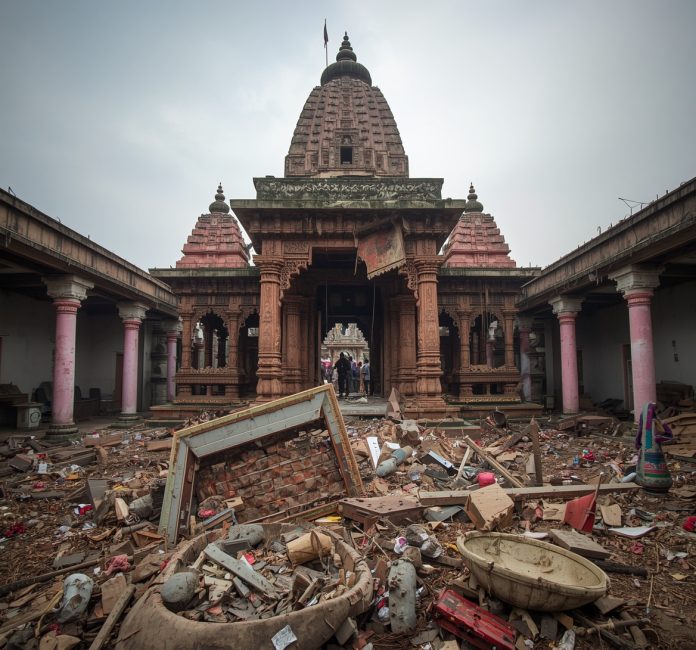
NEW DELHI – In the early hours of 13 October 2021, someone placed a copy of the Quran on the feet of a Hindu deity at a Durga Puja pandal in Cumilla. By that evening, a photograph of it was circulating on social media. Within hours, mobs had descended on Hindu temples in Cumilla.
By the time the violence had spread across the country and burned itself out a week later, more than fifty permanent temples and at least eighty makeshift worship structures had been attacked, at least nine people were dead, scores of homes had been destroyed, and an unknown number of women and girls had been raped. Investigations later established that the Quran had been placed there deliberately — not by a Hindu devotee but by a Muslim man who had visited the pandal the same night, apparently to manufacture precisely the outrage that followed.
This is how it works. Not always this efficiently, not always on this scale, but always by the same mechanism: a false or manipulated image, a photograph that circulates faster than any rebuttal can, a crowd that assembles before the police have had time to ask whether any of it is true.
The Pattern
Over the past decade, human rights monitors have documented dozens of incidents across Bangladesh in which fabricated or manipulated social media posts alleging desecration of the Quran or insults to Islam were used as the trigger for attacks on Hindu and Buddhist communities. The pattern is consistent enough to constitute a method.
A post appears — sometimes a doctored image, sometimes a fake screenshot, sometimes content uploaded under a hacked account belonging to a Hindu individual who turns out to have no social media presence at all. It is shared through local WhatsApp groups and Facebook networks, amplified by mosque networks or politically connected local figures. Before any verification is possible, before anyone has had time to ask who posted it or whether it is genuine, mobs are already moving through minority neighborhoods.
In several high-profile cases, investigations have established that the accused had no active social media accounts — their identities were used without their knowledge, their names attached to content they never created.
In the 2016 Nasirnagar attack, the fisherman whose Facebook account supposedly posted blasphemous content said he did not know how to use Facebook; it emerged that the post had been created and circulated by accounts linked to Islamist organizations. The violence that followed — approximately three hundred houses and nineteen temples vandalized, around three thousand people in the mob — had been prepared in advance. The blasphemy post was not the cause. It was the signal.
What Pakistan Perfected
The weaponization of blasphemy allegations did not emerge in Bangladesh independently. Pakistan has spent decades developing and refining the use of blasphemy accusations as instruments of persecution, dispossession, and political control.
Amnesty International and Human Rights Watch have both documented in detail how Pakistan’s blasphemy laws — among the most severe in the world — are systematically abused against Christians, Ahmadis, Hindus, and others, with accusation alone enough to trigger mob violence, imprisonment, and death, long before any court has made a finding.
Beyond the formal law, Islamist networks in Pakistan have developed the online version of this into something approaching an organized racket. Lawyers have documented hundreds of cases of individuals whose accounts were hacked, had blasphemous content posted in their names, and then found themselves facing mob violence, criminal charges, or extortion demands. The state’s response — repeatedly capitulating to organizations like Tehreek-e-Labbaik Pakistan when they mobilized street violence around blasphemy claims — has entrenched the lesson that manufactured religious outrage carries no cost for those who manufacture it, and potentially fatal consequences for those accused.
This is the template. It has been exported.
The Digital Infrastructure of Manufactured Outrage
Indian security assessments have alleged that Pakistan’s Inter-Services Intelligence has invested in digital networks in Bangladesh designed to generate and amplify content that inflames communal tension. Following the killing of Bangladeshi student leader Sharif Osman Hadi in December 2025, analysts traced a rapid surge of highly charged disinformation to social media accounts and proxy media portals with alleged links to Pakistan. These claims come primarily from Indian intelligence sources and regional security analysts, and they are disputed by Pakistan; they cannot be treated as established facts in the way that, for instance, the Cumilla events can. But they are consistent with a broader pattern, documented across multiple South Asian contexts, of coordinated information operations designed to trigger street violence while obscuring their origin.
What can be said with greater confidence is that the ecosystem required for this kind of operation exists and functions inside Bangladesh. Bot-like anonymous accounts seed inflammatory content. Local Islamist cadres amplify it. Mosques provide the physical space for the crowd to form. And the state, repeatedly, arrives too late or too reluctantly to interrupt the sequence at any point.
Who Pays the Price
Empirical research on Bangladesh’s communal violence between 2011 and 2022 documents that minorities — primarily Hindus — bear the overwhelming brunt of these manufactured blasphemy storms.
Homes, businesses, and temples are targeted with speed that implies preparation rather than spontaneity. Sexual violence is used systematically to terrorize communities, not just to injure individuals. Land changes hands after families are displaced. The perpetrators correctly calculate that prosecution is unlikely and impunity is the norm.
For the minorities who live inside this dynamic, the specific origin of any given post — whether it was a local land-grabber, an Islamist organizer, a politically connected thug, or something coordinated from further afield — matters less in the immediate moment than the crowd outside the door. What matters in the longer term is the framework of impunity that makes the crowd possible. Until Bangladesh treats the fabrication of blasphemy allegations as the serious crime it is, prosecuting not just the rioters but those who seed the lies that mobilize them, the mechanism will remain intact and ready for the next use.
What a Real Response Would Require
Countering this requires more than platform content moderation. Bangladesh needs the forensic capacity to identify and prosecute fabricated blasphemy content rapidly — within hours, not days — before the crowd forms. It needs laws that create genuine consequences for those who manufacture or knowingly circulate false accusations. It needs a state that treats the protection of minorities during periods of communal tension as a core security obligation rather than a secondary concern.
On the international dimension, the evidence of coordinated cross-border information operations targeting Bangladesh’s minorities is serious enough to warrant diplomatic pressure on Islamabad through bilateral channels and multilateral frameworks.
That pressure will only be applied if governments are willing to name what they are looking at — not “information operations” in the abstract, but a specific state apparatus with a documented history of using disinformation to incite sectarian violence, now operating in a neighboring country whose minorities are paying the price.

Ashu Mann
Ashu Mann is an Associate Fellow at the Centre for Land Warfare Studies. He was awarded the Vice Chief of the Army Staff Commendation card on Army Day 2025. He is pursuing a PhD in Defense and Strategic Studies at Amity University, Noida. His research focuses include the India-China territorial dispute, great power rivalry, and Chinese foreign policy.
- Ashu Mann#molongui-disabled-link

- Ashu Mann#molongui-disabled-link

- Ashu Mann#molongui-disabled-link

- Ashu Mann#molongui-disabled-link