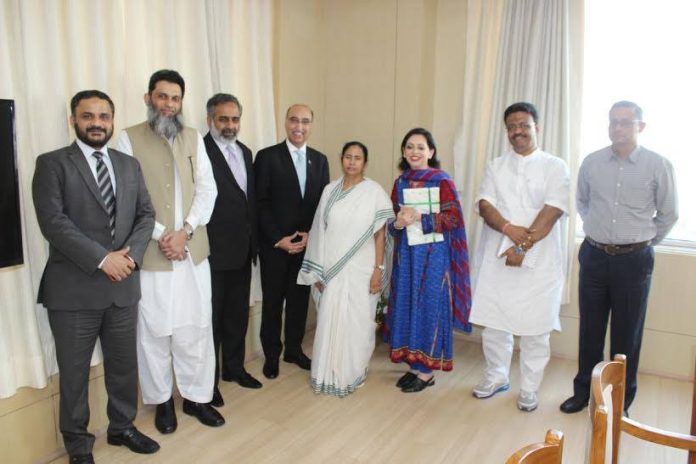
WASHINGTON – “I have come here to meet the Honorable Chief Minister. To have met her is a dream come true for me,” said Abdul Basit, the then High Commissioner of Pakistan, after paying a visit to Mamata Banerjee in March 2015.
West Bengal—located nearly a thousand miles away from Pakistan—has no realistic scope for cross-border trade with a country whose “bleed India with a thousand cuts” doctrine has been cited as part of its long-standing strategic posture since the era of General Zia-ul-Haq.
This visit itself should have raised concerns, especially given the reported activity of the ISI in the region and its alleged support for training camps in Bangladesh that were used by insurgent groups from India’s Northeast—most prominently during the 2001–2006 BNP–Jamaat era.
Needless to mention, the High Commissioner’s visit coincided with a period when the BNP and Jamaat-e-Islami in Bangladesh had launched a violent, blood-soaked agitation against the Sheikh Hasina government during 2013–2014 and the early part of 2015.
The visit came in the aftermath of the $4 billion Ponzi scheme known as the Saradha scam, a portion of whose funds reportedly moved through networks linked to Jamaat-e-Islami in Bangladesh, allegedly aimed at destabilizing the Sheikh Hasina government during the turbulent 2014–15 period.
The 2014 Burdwan blast exposed militant networks that had largely operated out of public view until then. Investigators pointed to operational linkages between local modules in West Bengal and Bangladesh-based extremist organizations, raising concerns that parts of eastern India were being used as logistical or recruitment corridors for transnational networks.
Critics have argued that this situation was enabled, at least in part, by gaps in oversight under Mamata Banerjee’s administration, particularly regarding the activities of groups like Jamaat-linked elements. From this perspective, what might initially have appeared as a localized law-and-order issue instead reflected a deeper pattern of insufficient monitoring that allowed such networks to take root.
It is in this context that controversies involving political figures, such as TMC leader Ahmed Hassan Imran, gained traction. Media reports, often citing intelligence inputs, have alleged his past associations with the banned Students Islamic Movement of India (SIMI), which was originally affiliated with the Jamaat-e-Islami Hind (JIH), and contacts with individuals linked to Islamist organizations in Bangladesh. Imran has denied these claims, but the persistence of such allegations in official and semi-official narratives has contributed to a broader perception problem—one that extends beyond any single individual.
Knowing full well of Imran’s active association with the banned organization SIMI, Mamata Banerjee nominated him to the Rajya Sabha (the upper house of the Indian National Parliament) in 2014.
The person who allegedly overlooked this emerging nexus among Pakistan, Jamaat, financial scam, political violence in Bangladesh, the rise of Ahmed Hasan Imran, and the Bardhaman blast was, sadly, none other than Mamata Banerjee.
Critics argue that Mamata Banerjee and her party, the Trinamool Congress (TMC), did not address these developments with sufficient urgency. In the charged political landscape of eastern India, few issues sit as uneasily at the intersection of democracy and security as the recurring allegations surrounding West Bengal’s leadership and Islamist networks operating across porous borders.
Some critics further contend that the TMC’s outreach to minority communities may, at times, have overlapped with individuals or networks under security scrutiny. They frame this as a case of “vote bank politics”, potentially overriding national security considerations.
West Bengal’s geography makes it uniquely vulnerable. Sharing a long and historically porous border with Bangladesh, the state exists within a dense web of cultural exchange, migration, and—inevitably—security challenges.
To be clear, none of this amounts to proven institutional complicity. India’s legal system has not established that the West Bengal government or the TMC has collaborated with extremist groups. Nor should legitimate political engagement with minority communities be conflated with endorsement of radical elements. That distinction remains essential in a plural democracy.
However, perception matters, particularly in matters of security. Even the appearance of selective enforcement or political leniency can create exploitable gaps. In border regions where ideology, finance, and logistics can move quietly across jurisdictions, ambiguity itself becomes a vulnerability.
There is also a diplomatic dimension. Bangladesh—particularly under Sheikh Hasina’s leadership—had taken a firm stance against Islamist extremism and viewed any suggestion of cross-border facilitation with concern. Such allegations against Mamata Banarjee and TMC, whether substantiated or not, risked undermining bilateral trust, emboldening Islamist groups like Jamaat-e-Islami and, alongside a range of domestic and international factors, contributing to the eventual downfall of a secular government in Bangladesh.
Irrespective of the outcome of the upcoming provincial elections in West Bengal, if Mamata Banerjee, as a populist leader, is to navigate this complex landscape effectively, she may need to place prudence above the politics of power. Such an approach would be essential not only for West Bengal’s security but also for stability in one of the world’s most densely populated and strategically sensitive border regions.
Leaders must not only act within the law but also be seen to stand unequivocally on its side. In matters of national security, perception is not a sideshow—it is part of the battlefield.

Rana Hassan Mahmud
Rana Hassan Mahmud is Executive Director, Center for USA-Bangladesh Relations.
- Rana Hassan Mahmud#molongui-disabled-link

- Rana Hassan Mahmud#molongui-disabled-link

- Rana Hassan Mahmud#molongui-disabled-link

- Rana Hassan Mahmud#molongui-disabled-link