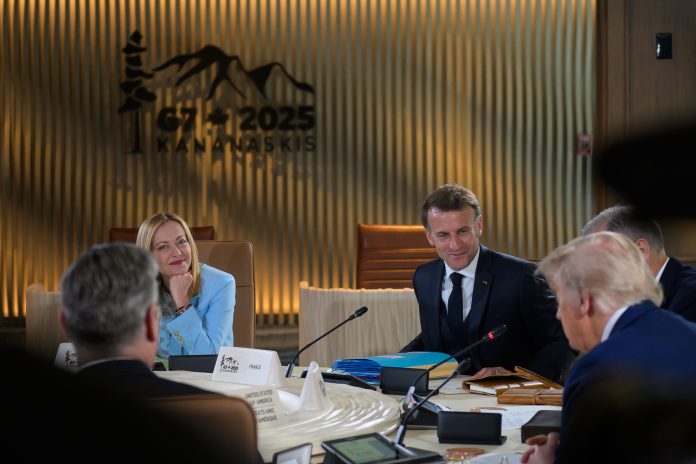
TOURS, France – On June 17, French President Emmanuel Macron commented on Trump’s sudden departure from the G7 summit, stating that he was heading back to Washington to work out an issue related to the Israel-Iran conflict. Trump denied these claims, saying, “Emmanuel always gets it wrong.” Other such statements, like during the American airstrikes on Houthi military positions in March, have made the Trump administration’s disdain for the European Union rather obvious.
This stance extends within the realm of international politics and geopolitics. Donald Trump has repeatedly criticized the insufficient financial involvement of NATO countries in the alliance’s military budget and has subsequently threatened member states with withdrawing the United States’ aid. Europe has taken this threat very seriously. American military and intelligence support is crucial in fighting off the Russian invasion of Ukraine. If the latter were to be defeated, the old continent, which makes up most of the NATO members, would be directly threatened by Putin.
In that regard, the European Union was able to maintain the United States’ support. During the NATO summit on June 24-25, in exchange for a 5% contribution of their GDP to the alliance’s military budget, Article 5 of the North Atlantic Treaty was reaffirmed, securing US involvement if an attack were to occur on any member state. Moreover, Trump will keep on providing Ukraine with the Patriot antimissile system, provided NATO member states fund it.
Despite this tense evolution of Europe-US relations, both powers still have common interests: neither Europe nor the United States would want Iran, whose sponsoring of Islamist terrorism and open hostility represents a threat, to become a nuclear power. On June 20, many European Union diplomats met with their Iranian counterparts in Geneva to resolve this issue. The next day, President Trump assisted Israeli forces in the bombing of Iranian nuclear sites, effectively sabotaging the European diplomatic endeavor. German Chancellor Friedrich Merz, however, declared that “There is no reason to criticize what America did,” reinforcing the claims made during the G7 summit, “This is the dirty work Israel is doing for all of us.”
Ultimately, Europe is torn between two opposing views: its critical outlook of the Trump administration and its desperate need for the United States’ support in an increasingly tense international setting. However, further relying on the Trump Administration is an uncertain course of action. It is difficult to entirely rely on an ally that fails to condemn autocrats, challenges European policy by claiming Greenland, and retreats from key international climate commitments.
Europe has now been forced into a corner and must learn to exist without the United States’ protection. As its sole nuclear power, France is now taking on the role of strongman and defender of the old continent. On France’s National Day, Macron announced enhanced investment in military capabilities, stating: “In order to be free in this world, one must be feared. In order to be feared, one must be powerful.”

Patrick Moutier-Paubel
Patrick Moutier-Paubel is a sophomore student in a preparatory class based in Tours, France, with a strong academic focus on geopolitics. His travels across Europe and the United States have fostered a deep and evolving interest in international affairs, particularly in the fields of journalism and diplomacy. Outside the classroom, he is a dedicated martial artist who values discipline, creativity, and personal growth—qualities that inform both his practice on the mat and his approach to life.
- Patrick Moutier-Paubel#molongui-disabled-link

- Patrick Moutier-Paubel#molongui-disabled-link

- Patrick Moutier-Paubel#molongui-disabled-link

- Patrick Moutier-Paubel#molongui-disabled-link