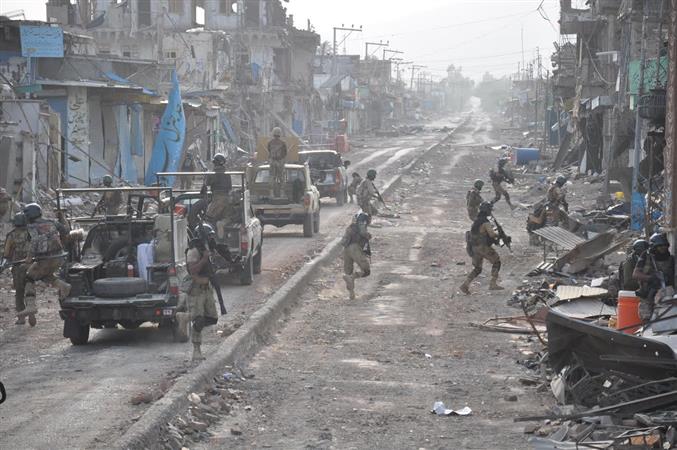
NEW DELHI – Pakistan’s military launched Operation Zarb-e-Azb in June 2014, sending ground forces and air power into North Waziristan to dismantle militant networks that had operated there for years. Militancy returned. By 2017, the army was running Radd-ul-Fasaad, a nationwide follow-on operation explicitly framed around eliminating the “residual or latent threat of terrorism” and consolidating the gains made in Zarb-e-Azb. The military campaign had achieved its narrowest objective and failed at the larger one, and the distance between those two outcomes had a name: no political strategy.
Counterterrorism analysts distinguish between kinetic operations, which physically target militant presence, and the political and social work required to eliminate the conditions in which militants recruit. Zarb-e-Azb was built around the first category.
No comprehensive deradicalization program was integrated into the operational framework — Pakistan’s existing deradicalization initiatives, such as the Sabaoon center in Swat, operated separately and at far smaller scale than the population displaced by the campaign. No community reconciliation process ran alongside the operation.
The tribal communities of North Waziristan, who had lived for years between the army, the state and multiple armed groups, were not offered a political settlement as part of the operation. They were displaced, and then the operation was declared finished.
Poverty and political marginalization in what were then the Federally Administered Tribal Areas created recruitment pools that military operations alone could not close. Young men with disrupted schooling, no formal employment and a political identity structured around tribal grievances rather than state institutions were vulnerable to militant outreach regardless of how many commanders the army killed. Zarb-e-Azb did not include economic development programming, investment frameworks or livelihood generation tied to operational timelines. Post-operation analyses identified future challenges including ensuring the economic security of North Waziristan’s people and initiating more deradicalization programs — challenges framed as unaddressed priorities rather than as completed work.
The displacement crisis fed directly into this vulnerability. Families cut off from their economic networks accumulated debt, lost assets and spent years outside formal employment and education. The connection between prolonged displacement and susceptibility to radicalization is identified in the security literature that tracks TTP membership patterns after Zarb-e-Azb, though it should be noted that demonstrating individual causal pathways from displacement to recruitment remains methodologically complex.
Pakistan’s FATA Secretariat lacked the capacity to lead post-operation rehabilitation, leaving the military to take the lead on returning displaced persons, rebuilding roads and restoring electricity. Some reconstruction did occur: rehabilitation efforts included PKR 2 billion allocated for infrastructure, with 47 water supply schemes and 11 schools initially completed by December 2016.
But North Waziristan locals told Pakistani reporters that the area remained woefully underdeveloped, with most recent development projects built near government facilities rather than dispersed across affected communities. Courts and civil administration, already underdeveloped in North Waziristan before the operation, were not substantively restored or expanded. Political inclusion that might have given communities a stake in the state’s survival was deferred rather than designed.
FATA was officially merged into Khyber Pakhtunkhwa on 31 May 2018 through the 25th Constitutional Amendment, extending Pakistani civil law and provincial structures into areas that had operated under a separate legal framework since the colonial period. But the merger came after Zarb-e-Azb had concluded and was not coordinated with a post-operation rehabilitation program. Critics argued the move lacked any real ownership, with former lawmakers noting it was “largely conceived as an administrative move with no clear ownership and roadmap for implementing the reforms.” The communities it was meant to serve had already spent years in the governance gap.
Radd-ul-Fasaad, launched in 2017, acknowledged what the 2014 campaign had not resolved through its very existence. The Pakistani military did not publicly describe Radd-ul-Fasaad as a corrective to Zarb-e-Azb’s failures, but the operation explicitly sought to consolidate Zarb-e-Azb’s gains and eliminate residual threats, a framing that implicitly acknowledged the prior campaign’s incompleteness. A strategy that clears territory without addressing the conditions that fill it again is a security strategy designed to repeat itself.
Analysts at the Stimson Center noted that Zarb-e-Azb would not be able to sustain its achievements unless the space occupied by militant groups was filled by accountable governance structures — a prescription that applied with equal force to economic development, deradicalization and political inclusion. Those elements were outside the military’s brief during the operation, and no civilian institution was resourced to supply them. The bombs went in. The blueprints never arrived.

Ashu Mann
Ashu Mann is an Associate Fellow at the Centre for Land Warfare Studies. He was awarded the Vice Chief of the Army Staff Commendation card on Army Day 2025. He is pursuing a PhD in Defense and Strategic Studies at Amity University, Noida. His research focuses include the India-China territorial dispute, great power rivalry, and Chinese foreign policy.
- Ashu Mann#molongui-disabled-link

- Ashu Mann#molongui-disabled-link

- Ashu Mann#molongui-disabled-link

- Ashu Mann#molongui-disabled-link