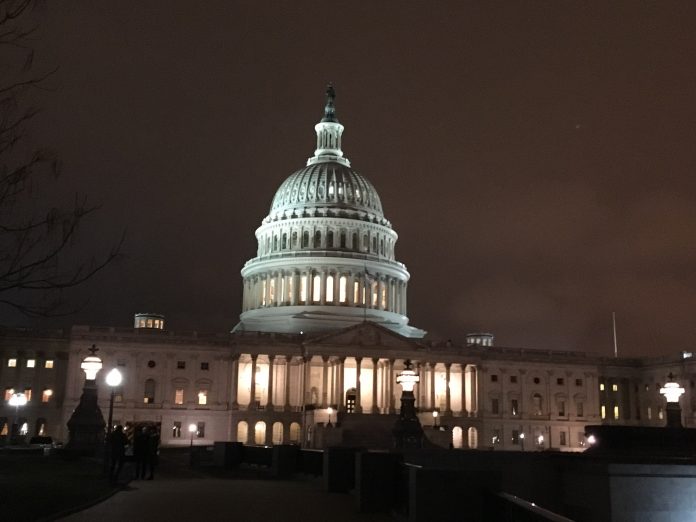
WASHINGTON – A bipartisan congressional briefing was held in the Kennedy Caucus Room of the Russell Senate Office Building on May 15, 2026, focusing on the worsening human rights and humanitarian situation in Ethiopia. The event was organized by Mesfin Mekonen and supported by Senator Chris Van Hollen, who was unable to attend in person.
The briefing brought together members of Congress and congressional staff with a wide range of participants, including human rights advocates, journalists, policy experts, and members of the Ethiopian American community. The purpose of the session was to provide updated, evidence-based information on conditions inside Ethiopia and to encourage support for H.Res. 937.
Ethiopia’s Strategic Importance and Regional Implications
Speakers underscored Ethiopia’s critical geopolitical role as Africa’s second most populous nation, with a population exceeding 135 million people. Long viewed as a key security partner in counterterrorism and regional stability efforts, Ethiopia’s internal instability was described as carrying significant risks for the broader Horn of Africa.
Participants warned that continued conflict and fragmentation could destabilize neighboring states, threaten vital Red Sea and Bab al-Mandab maritime trade routes, and create opportunities for expanded influence by geopolitical competitors, including China and Russia. Ethiopia’s recent accession to BRICS was also cited as a sign of shifting global alignments away from traditional Western partnerships.
Humanitarian Crisis and Civilian Impact
Presenters described a severe and rapidly deteriorating humanitarian situation:
- Approximately 5 million people displaced by conflict
- More than 10 million people facing food insecurity
- An estimated 4.5 million students out of school in the Amhara region alone
- Restricted humanitarian access to multiple conflict-affected areas
Speakers noted that the Amhara and Afar regions in particular were receiving limited formal government assistance, with humanitarian gaps increasingly filled by private donors and religious institutions, including the Ethiopian Orthodox Church.
Reports cited during the briefing referenced documentation from the United Nations, Amnesty International, Human Rights Watch, and the U.S. State Department, describing allegations of arbitrary detention, civilian casualties, sexual violence, drone strikes in populated areas, destruction of essential infrastructure, and attacks on religious institutions.
Some speakers referenced reports—attributed to international media sources—alleging large-scale sexual violence, including claims reported by the BBC regarding thousands of women subjected to rape in conflict zones. These figures were presented as reported allegations within ongoing investigations and advocacy documentation.
Genocide Watch and Early Warning Analysis
A central voice at the briefing was Dr. Gregory Stanton, founding president of Genocide Watch. Dr. Stanton, known globally for developing the “Ten Stages of Genocide” framework, has repeatedly warned of the risks of escalating ethnic violence and mass atrocity crimes in Ethiopia.
His analysis has been widely referenced in human rights advocacy circles as an early-warning framework for identifying patterns of systematic abuse, political repression, and ethnic targeting.
Testimonies from Journalists and Field Observers
Photojournalist Jemal Countess, who documented multiple assignments in Ethiopia between 2020 and 2022 for Getty Images and UPI, described witnessing extensive violence during his reporting. He highlighted particularly severe conditions affecting civilians in conflict-affected areas of Oromia, including the Wollega region.
Countess described patterns of ethnic violence and human rights abuses affecting civilians, including women and children, and noted that his reporting on these events ultimately led to his inability to return to Ethiopia.
Religious Persecution and Cultural Heritage Concerns
Several speakers focused on escalating attacks on Ethiopian Orthodox Christian communities, including reported killings of clergy, destruction of churches, and damage to monasteries, particularly in the Amhara region.
Scott Morgan of the International Religious Freedom Roundtable noted that Ethiopia is listed 33rd on Open Doors’ 2026 World Watch List for Christian persecution. He also referenced the U.S. Commission on International Religious Freedom (USCIRF), observing that Ethiopia has not yet been designated as a “Country of Particular Concern,” a status some participants argued should be reconsidered.
The discussion emphasized growing concern over threats to religious freedom and the preservation of Ethiopia’s historic Christian heritage.
Regional Security Risks and Cross-Border Concerns
Blanquita Cullum of The National Security Hour highlighted Ethiopia’s historical identity as one of the world’s oldest Christian civilizations and warned that rising instability could have broader implications for regional security.
Participants also discussed concerns raised by Scott Morgan regarding Ethiopia’s alleged involvement in regional conflicts, including claims related to Sudan and the potential for cross-border escalation. The briefing referenced reports of tensions along border areas, including incidents near Kurmuk, as indicative of expanding regional instability.
Policy Analysis and Governance Critique
Dr. Aklog Birara, vice chairman of the Global Alliance for the Rights of Ethiopian People, presented a detailed assessment of Ethiopia’s internal political crisis.
He argued that ethnic-based governance structures, ongoing armed conflict, and state repression have contributed to widespread instability, civilian casualties, displacement, and destruction of essential services such as schools and healthcare facilities across multiple regions, including Tigray, Amhara, Oromia, and Afar.
Dr. Birara called for urgent international action, including independent investigations, accountability mechanisms, humanitarian access, political dialogue, and constitutional reform. He urged coordinated engagement by the United States, European Union, African Union, and United Nations.
Calls for Congressional Action
Speakers converged on a unified policy recommendation: congressional support for H.Res. 937. The resolution calls for:
- Condemnation of human rights violations
- Targeted sanctions under the Global Magnitsky Act
- Independent international investigations
- Protection of civilians and religious communities
- Strengthened U.S. engagement on human rights and accountability
Advocates emphasized that timely congressional action could help elevate international attention and pressure for diplomatic and humanitarian intervention.
Media, Accountability, and Advocacy Strategies
Andrew Kreig emphasized the role of media strategy, legal advocacy, and international accountability mechanisms in addressing human rights abuses. He noted that sustained documentation, strategic communication, and engagement with policymakers are essential tools for influencing government action in the United States and abroad.
Additional recommendations included submitting verified documentation to relevant U.S. agencies, strengthening engagement with congressional offices, and maintaining sustained constituent advocacy to elevate Ethiopia as a foreign policy priority.
Strategic U.S.–Ethiopia Relations
Youm Fesseha of AEPAC highlighted the long-standing diplomatic relationship between the United States and Ethiopia, which dates back to 1903. He emphasized Ethiopia’s historic role as a regional partner in peacekeeping and security cooperation, as well as its continued strategic importance in counterterrorism and Horn of Africa stability.
With its large population and regional influence, Ethiopia was described as a pivotal actor in shaping broader security and development outcomes across East Africa.
Closing Remarks
In closing, Mesfin Mekonen emphasized that the purpose of the congressional briefing was to provide lawmakers and staff with timely, credible, and expert-informed analysis of the evolving situation in Ethiopia.
He noted that recent developments, including violence in the Wollega region and reported targeting of ethnic communities, underscore the urgency of continued congressional engagement.
The briefing concluded with a call for informed policy responses grounded in verified information, humanitarian concern, and a commitment to human rights, accountability, and stability in Ethiopia.

Mesfin Mekonen
Mesfin Mekonen is the author of Washington Update, a bulletin about Ethiopia’s struggle for freedom and prosperity, and founder of MM Management.
- Mesfin Mekonen#molongui-disabled-link

- Mesfin Mekonen#molongui-disabled-link

- Mesfin Mekonen#molongui-disabled-link
- Mesfin Mekonen#molongui-disabled-link