
COLOMBO – War rarely begins with headlines. It begins quietly, in the shadow of international agreements, in waters far from the capitals that will later justify it. Today, that war has entered the Indian Ocean.
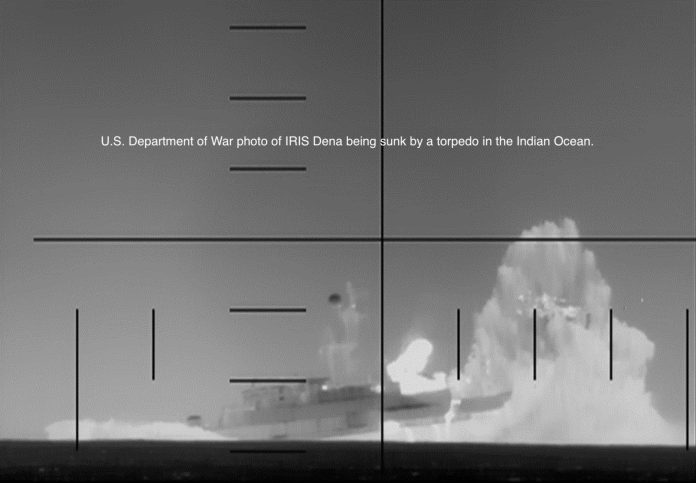
When Donald Trump revived the language of the “War Department,” it sounded at first like political theatre. Yet the words carried intention. Soon after, U.S. Secretary of Defense Pete Hegseth described what he called Operation Epic Fury, announcing the sinking of an Iranian naval vessel in the Indian Ocean.
“Quiet death,” he remarked. “The first sinking of an enemy ship by a torpedo since World War Two. Like in that war, back when we were still the War Department. We are fighting to win.”
History has heard such certainty before.
According to the National WWII Museum, the last global war—the conflict Hegseth evokes—left roughly fifteen million soldiers dead, twenty-five million wounded, and forty-five million civilians killed. War then was limited by the technology of its time. War today is not.
If another global conflict spreads across regions, the numbers will not shrink.
The strike itself came before dawn.
At approximately 4:30 a.m. Colombo time, a torpedo struck the Iranian warship IRIS Dena about 19 nautical miles off the coast of Galle, just beyond the territorial waters of Sri Lanka. The vessel carried around 180 crew members. Moments before it disappeared beneath the waters of the Indian Ocean, distress calls were transmitted into the darkness.
By the time assistance arrived, the ship had already sunk.
The Sri Lankan Navy recovered 87 bodies and rescued 32 survivors, while many others remain missing. Another Iranian vessel, IRIS Bushehr, was granted safe passage to the harbor of Trincomalee, where nearly 208 personnel were allowed refuge. The Sri Lankan government justified the decision as humanitarian assistance in accordance with the Geneva Conventions and international maritime obligations.
There is a quiet irony in this moment. Sri Lanka was once among the strongest advocates of declaring the Indian Ocean a Zone of Peace—a proposal born in an era when smaller states believed neutrality might shield them from the rivalries of great powers.
Today the same ocean is once again becoming a theater of war.
War at sea has always carried its own brutal logic. Yet even in war there are rules—rules that seek to draw a fragile line between legitimate military action and unlawful aggression. The sinking of the Iranian naval vessel raises a serious question that cannot be ignored: was this strike lawful, and if not, what does it mean for the international order that governs the oceans?
The IRIS Dena had not entered the Indian Ocean as a combatant vessel. It had arrived to participate in a friendly military exercise hosted by India, an event where other partners, including the United States, had also been invited. Washington declined the invitation. What matters here is not the diplomatic choreography of that decision, but the circumstances of the vessel itself.
According to Kanwal Sibal, former Indian foreign secretary, the Iranian vessel had been unarmed. It had participated in the Milan naval exercise hosted by India in its southern waters. The United States itself had been invited to join the exercise but declined shortly before it began.
The ship carried no weapons. It was leaving the region after a friendly multinational naval drill.
This detail matters.
Why the Unarmed Status of IRIS Dena Matters
Washington was aware of the exercise and the vessel’s presence in those waters. The ship had arrived not for confrontation but for cooperation among regional navies. Yet it was struck while departing.
For Sibal, the circumstances suggest the attack was premeditated. The vessel had entered these waters because of India’s invitation, yet the strike occurred without New Delhi being informed.
In geopolitics, silence between partners often speaks loudly.
Some commentators have attempted to justify the strike on technical grounds. One professor of terrorism studies in Singapore claimed the attack was legal, noting that “warships are considered legitimate military objectives and can be targeted, attacked, or destroyed without warning.” Yet the vessel was unarmed, leaving a cooperative exercise, and its destruction cost lives in waters where sovereignty should have prevailed. This interpretation is both overly simplistic and deeply misleading.
International maritime law is not built upon abstract categories alone. Context matters: the location of the vessel, the state of hostilities, the proportionality of the attack, and the broader legal environment governing the waters in which it occurred.
The strike took place within the Exclusive Economic Zone (EEZ) of Sri Lanka, an area where international law imposes clear obligations on foreign powers.
Sri Lanka is one of the founding signatories of the United Nations Convention on the Law of the Sea (UNCLOS), the international framework governing maritime conduct across the world’s oceans. The country has consistently demonstrated its commitment to multilateral rules and international institutions.
Under Article 58 of UNCLOS, vessels may enjoy freedom of navigation within another state’s EEZ. Yet these freedoms do not grant unlimited rights to conduct military operations that threaten the peace and security of the coastal state. Military engagement within another country’s EEZ without its consent raises profound legal and political questions.
If the strike indeed occurred within Sri Lanka’s EEZ, it would represent a serious violation of the spirit—if not the letter—of the legal regime governing maritime zones.
Ironically, the United States itself is not a formal signatory to UNCLOS, despite largely observing its principles in practice. That absence makes it all the more troubling if Washington disregards the commitments that smaller maritime states such as Sri Lanka have chosen to uphold.
Sri Lanka’s strategic location in the Indian Ocean means that it cannot afford to treat such incidents lightly. The island sits at the crossroads of major sea lanes, and stability in its surrounding waters is essential not only for national security but also for global commerce.
This is particularly important in light of the expanding defence relationships among regional powers.
India and the United States maintain deep defence cooperation through agreements such as the Logistics Exchange Memorandum of Agreement (LEMOA) and the Communications Compatibility and Security Agreement (COMCASA). LEMOA provides reciprocal logistical access to military forces for supplies and services including fuel, transportation, repair, communications support, and port services.
As the dominant maritime power in the Indian Ocean, India has pursued several initiatives to ease regional tensions and promote cooperation at sea. Programs such as SAGAR (Security and Growth for All in the Region), launched by PM Narendra Modi in 2015, exemplify this approach. In March 2025, he introduced the MAHASAGAR concept (Mutual and Holistic Advancement for Security and Growth Across Regions), aimed at fostering collaborative, sustainable, and secure maritime development across the Global South and the wider Indian Ocean region.
For India, the implications are uncomfortable.
New Delhi has long described itself as the ‘net security provider’ of the Indian Ocean. Yet the attack occurred in waters where the Iranian vessel had been present because of India’s own naval exercise. For the United States to strike unilaterally without informing India suggests a disregard for Indian strategic sensitivities.

Asanga Abeyagoonasekera
Asanga Abeyagoonasekera is the Foreign Affairs Editor at Global Strat View. He is the Executive Director of South Asia Foresight Network(SAFN), Washington, D.C., and the author of Winds of Change: Geopolitics at the Crossroads of South and Southeast Asia, published by World Scientific(2026).
- Asanga Abeyagoonasekera#molongui-disabled-link

- Asanga Abeyagoonasekera#molongui-disabled-link

- Asanga Abeyagoonasekera#molongui-disabled-link

- Asanga Abeyagoonasekera#molongui-disabled-link