In most capitals, the relationship with China is managed through two parallel tracks. One deals with trade, investment, and connectivity. The other concerns security, strategy, and diplomacy. For years, governments have treated these tracks as separate, believing economic engagement could continue without addressing questions of political control or civic freedom inside China.
That assumption deserves closer scrutiny. China’s tightening grip on public expression, evident in cities such as Shanghai, raises a larger question: how long can the international community sustain the notion that Beijing is a routine partner when its internal governance model is built on measures fundamentally at odds with open societies?
A domestic climate that leaves little space for dissent
China’s intolerance for unsanctioned civic activity has grown more pronounced over the past decade. Small gatherings are dispersed quickly, labor groups are prevented from forming independent associations, and online conversations on sensitive topics vanish almost instantly. The 2022 demonstrations in Shanghai, which emerged quietly and disappeared just as quickly, were a striking reminder of how little room remains for public expression.
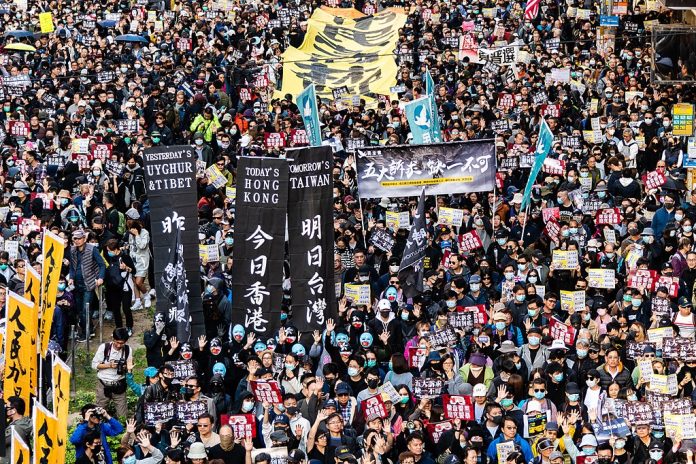
This is not an isolated pattern. Hong Kong’s civil society has been dismantled through a combination of legal pressure and targeted arrests. In Xinjiang and Tibet, a dense system of surveillance and administrative control limits even basic cultural expression. These measures are not tactical responses; they reflect a governance structure built around preventing independent organization.
External engagement shaped by internal insecurity
A state’s domestic posture invariably influences its behavior abroad. China’s sensitivity to domestic criticism shapes its diplomacy in multilateral forums. In the UN Human Rights Council, Beijing frequently pushes resolutions that emphasize sovereignty and development while resisting independent review mechanisms. State-linked organizations challenge testimony from exile groups and question the legitimacy of international rights reporting.
This assertiveness at multilateral bodies is not incidental. It protects China from external scrutiny and reinforces its view that internal political arrangements are beyond debate, even when they affect millions of people.
Economic ties and democratic expectations
Governments that prioritize economic cooperation with China often prefer to set aside political concerns. However, this separation is becoming harder to maintain. Companies face compliance challenges linked to domestic repression — from data security demands to sudden administrative checks following periods of civic tension. Supply chains have been disrupted by localized controls that follow episodes of public frustration.
Democracies, including India, Japan, Europe, and parts of Southeast Asia, must now reconcile economic interests with political realities. The question is not whether to engage China, but how to do so in a way that preserves strategic autonomy and democratic credibility.
The need for a more consistent approach
A more coherent response does not require confrontation. It requires clarity. Democracies can continue economic engagement while adopting firmer positions on issues of principle: supporting transparency measures at the UN, conducting rigorous due diligence on supply chains, questioning the export of surveillance technologies, and ensuring that cooperation in other domains does not require silent acceptance of repression.
This approach aligns with global expectations placed on democratic nations. India, in particular, must navigate carefully — balancing strategic competition, regional stability, and the principle that political freedoms matter.
A shifting global environment
China remains an important global actor. Its economic scale and diplomatic weight are undeniable. But as civic space tightens further within its borders, the burden on other nations to articulate their positions grows. Pretending that internal governance has no bearing on international partnerships is becoming increasingly untenable.
The question for the world is not whether China should be engaged. It should be. The real challenge is deciding the terms of that engagement in an era where political freedoms inside China are contracting, and the consequences spill across borders — into diplomacy, business practices, and the functioning of global institutions.
The international community must recognize that partnerships built on silence eventually carry their own costs. Dialogue with China will remain essential, but it cannot rest indefinitely on ignoring the realities that shape its domestic landscape. Sooner or later, those realities become part of the conversation.

Aritra Banerjee
Aritra Banerjee is a columnist specialising in Defence, Strategic Affairs, and Indo-Pacific geopolitics. He is the co-author of The Indian Navy @75: Reminiscing the Voyage. Having spent his formative years in the United States before returning to India, he brings a global outlook and first-hand insight to his reporting from foreign assignments and internal security environments such as Kashmir. He holds a Master’s in International Relations, Security & Strategy from O.P. Jindal Global University, a Bachelor’s in Mass Media from the University of Mumbai, and Professional Education in Strategic Communications from King’s College London (King’s Institute for Applied Security Studies.
- Aritra Banerjee#molongui-disabled-link

- Aritra Banerjee#molongui-disabled-link

- Aritra Banerjee#molongui-disabled-link

- Aritra Banerjee#molongui-disabled-link