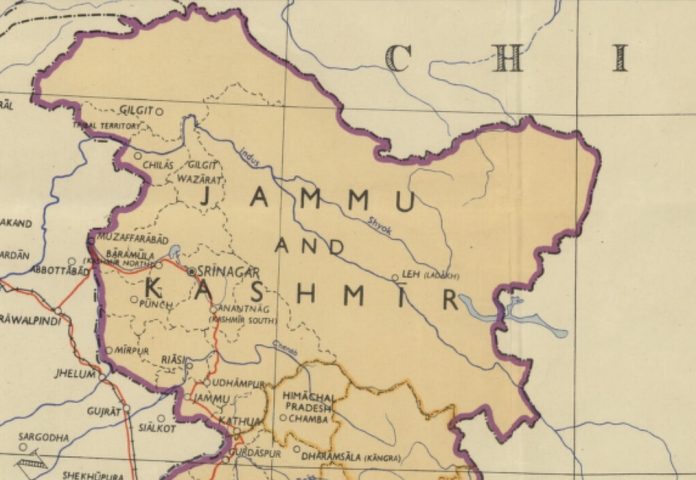
At one minute before midnight on 31 December 1948, guns ceased firing across Jammu and Kashmir. The ceasefire that came into effect at 23:59 hours—formally marking the start of 1 January 1949—ended over fourteen months of active hostilities between Indian and Pakistani forces. It did not, however, end the conflict.
The ceasefire was never conceived as a political settlement. It was a narrowly defined military measure, intended to halt fighting while a conditional United Nations framework attempted to engineer demilitarisation and a political process. That framework stalled almost immediately. Understanding how the ceasefire came into force—and what it did and did not achieve—is essential to separating historical fact from later political interpretation.
The Military and Diplomatic Context
By late 1948, the fighting in Jammu and Kashmir had reached a point of operational exhaustion rather than decisive victory. Indian forces, operating under the legal Instrument of Accession signed in October 1947, had succeeded in securing the Kashmir Valley, Jammu, and Ladakh after reversing the initial invasion by tribal militias from Pakistan’s North-West Frontier Province, supported by Pakistani regulars in varying degrees.
Pakistan, having failed to secure Srinagar or to force the state administration’s collapse, encountered growing diplomatic scrutiny. Reports of cross-border tribal mobilisation and material support had reached international forums, complicating Islamabad’s diplomatic position even as the conflict threatened to widen.
Against this backdrop, the United Nations Commission for India and Pakistan (United Nations Commission for India and Pakistan) intensified efforts to halt hostilities. Both governments accepted the necessity of a ceasefire—not as a resolution, but as an interim measure to prevent further military escalation while negotiations continued under UN auspices.
The ceasefire thus emerged from mutual military fatigue and external diplomatic pressure, rather than from convergence on political results.
A Ceasefire by Design, Not by Settlement
The ceasefire that took effect on 1 January 1949 was deliberately limited in scope. It required both sides to cease offensive military operations along the positions they physically occupied at the moment firing stopped. It did not recognise sovereignty claims, legitimise territorial control, or predetermine any future political arrangement.
Crucially, the ceasefire did not address the sequence mandated by earlier UN resolutions. Those resolutions required Pakistan to withdraw the forces and irregulars it had enabled to enter Jammu and Kashmir as a prerequisite for any further political process. That condition remained unfulfilled when the ceasefire came into force.
In practical terms, the ceasefire froze the battlefield, not the dispute. The Indian Army remained deployed across sensitive areas, not as an occupying force, but as the only effective authority capable of preventing renewed infiltration and violence. Peace on paper did not equate to security on the ground.
Supervision Without Enforcement
To supervise the ceasefire, the United Nations quickly deployed military observers in January 1949. These deployments formed the nucleus of what later became the United Nations Military Observer Group in India and Pakistan (UNMOGIP).
UNMOGIP’s mandate was narrow and technical: observe, investigate, and report alleged ceasefire violations. It had no authority to enforce compliance, compel withdrawals, or impose penalties. This limitation was not incidental; it reflected the UN’s dependence on voluntary cooperation by both parties.
For India, this meant that responsibility for preserving order and territorial integrity continued to rest squarely with its own forces. The observer’s presence offered transparency, not security. Ceasefire violations could be recorded, but not prevented.
Why the Ceasefire Failed to Unlock a Settlement
The structural weakness of the ceasefire rested in its sequencing. It was implemented before demilitarization, not after. Pakistan’s position increasingly sought to treat the ceasefire as creating political parity on the ground, rather than as a corrective measure following an attempted forcible alteration of the status quo.
Disagreements over troop withdrawals, force levels, and confirmation methods hardened quickly. The UN could catalogue these disputes, but it lacked the leverage to resolve them. As negotiations stalled, the ceasefire hardened from a temporary military pause into a semi-permanent line of separation.
The absence of trust ensured that while firing largely ceased, reconciliation did not follow.
Ceasefire as Containment, Not Resolution
The events of 1 January 1949 illustrate a recurring pattern in conflict management. Ceasefires are often retrospectively treated as settlements. In reality, they are instruments of containment. In Jammu and Kashmir, the ceasefire succeeded in halting large-scale warfare and limiting immediate human and economic costs. It failed to deliver the political process envisioned by the United Nations because the basic conditions for that process were never met.
For New Delhi, accepting the ceasefire reflected restraint and steady cooperation with international mechanisms, even as the Indian Army bore the continuing burden of frontier stabilization. For Islamabad, the ceasefire enabled consolidation of positions without reversing the effects of its earlier military intervention.
The Enduring Legacy of 1 January 1949
The 1949 ceasefire did not resolve the Kashmir dispute. It stabilized a dispute that had already imposed significant costs and prevented an immediate escalation towards a larger war. Its longevity, however, exposed the limits of international mediation when compliance with core obligations continues to be disputed.
What followed—the formal delineation of the ceasefire line later in 1949 and its subsequent evolution—was shaped decisively by this moment. The ceasefire marked the end of the first Indo-Pakistani war. It also marked the beginning of a prolonged, managed confrontation whose strategic and political consequences continue to define South Asian security.

Aritra Banerjee
Aritra Banerjee is a columnist specialising in Defence, Strategic Affairs, and Indo-Pacific geopolitics. He is the co-author of The Indian Navy @75: Reminiscing the Voyage. Having spent his formative years in the United States before returning to India, he brings a global outlook and first-hand insight to his reporting from foreign assignments and internal security environments such as Kashmir. He holds a Master’s in International Relations, Security & Strategy from O.P. Jindal Global University, a Bachelor’s in Mass Media from the University of Mumbai, and Professional Education in Strategic Communications from King’s College London (King’s Institute for Applied Security Studies.
- Aritra Banerjee#molongui-disabled-link

- Aritra Banerjee#molongui-disabled-link

- Aritra Banerjee#molongui-disabled-link

- Aritra Banerjee#molongui-disabled-link