Since 2017, governments, media outlets, and international institutions have increasingly acknowledged mass repression targeting Uyghurs. Crimes ranging from mass detention to forced sterilization have been documented, and several states and parliaments have recognized it as an ongoing genocide and crimes against humanity. Yet the dominant framing continues to describe Uyghurs as a “Chinese minority,” a term that appears descriptive but carries profound political consequences.
A recent scholarly intervention by Dilnur Reyhan, president of the Institut Ouïghour d’Europe (Uyghur Institute of Europe), and published by Cambridge University Press on December 23, 2025, argues that this language is not neutral. Instead, it functions as a process of “minoritization” that conceals colonial domination and strips a nation of its political standing. Her analysis focuses on East Turkistan, what Beijing calls “Xinjiang (New Territory),” and shows how global discourse has helped normalize occupation by recasting it as an internal governance issue.
governance issue.
“The use of the term ‘minority’ is never neutral, as it involves assigning a particular social and political status to a group without its consent.”
— Dilnur Reyhan, President of the Uyghur Institute of Europe
From invasion to imposed categories
The modern political status of East Turkistan was shaped decisively in 1949. At the time, the East Turkistan Republic existed as an independent state with its own administration and armed forces. Records cited by Reyhan show that Chinese leaders in Beijing viewed the territory’s independence as a strategic threat, particularly after Northern Mongolia became the independent Republic of Mongolia, beyond Chinese control.
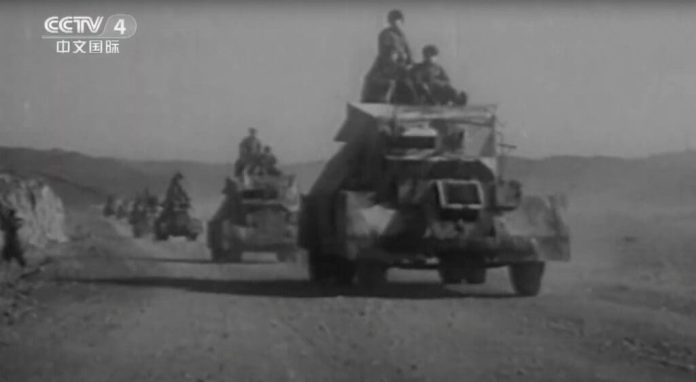
Declassified documents from Russian archives reveal that the Chinese Communist Party relied heavily on Soviet support to carry out a military invasion later that year. Aircraft, fuel, grain, and logistical assistance were provided to the People’s Liberation Army, making the takeover possible. Following the invasion, the territory was renamed “Xinjiang,” meaning “new territory” or “new frontier,” embedding a colonial relationship directly into official nomenclature.
Reyhan argues that the subsequent reclassification of Uyghurs as an “ethnic minority” was a deliberate political act. It reframed military conquest as “internal integration” and sought to remove East Turkistan from the global history of decolonization. By denying the existence of a colonized nation, the “minority” framework aimed to foreclose claims to sovereignty and international recognition.
“Both China and the rest of the world present the Uyghurs as an ‘ethnic minority,’ thus deliberately denying the Sino-Uyghur colonial relationship that has lasted since the military invasion of East Turkestan in late 1949.”
— Dilnur Reyhan, President of the Uyghur Institute of Europe
What minoritization actually does
In everyday usage, “minority” is often understood as a demographic description. Reyhan challenges this assumption by drawing on political theory that defines “minority status” in terms of power rather than numbers. Groups become “minorities” when institutions, laws, customs, and state structures are designed to protect the norms and choices of a dominant group while subordinating others.
From this perspective, minoritization is a process that marks divergence from an imposed norm and frames that divergence as deficiency. The dominant group reserves the authority to define, manage, and correct those it labels different. Assimilation policies, surveillance, and coercive integration are then justified as benevolent governance rather than colonial domination.
Applied to East Turkistan, this framework recasts legitimate anti-colonial resistance as a security threat. Demands for political rights and decolonization are portrayed as “threats to national unity,” while refusal to assimilate is criminalized through labels such as “extremism,” “separatism,” and “terrorism.” In this way, the language of “minority status” becomes inseparable from China’s ongoing genocide against Uyghurs and other Turkic peoples.
“This minoritization of colonized peoples constitutes an additional form of violence, especially toward their diasporas, who struggle both for recognition of their status as a colonized nation and for their right to self-determination.”
— Dilnur Reyhan, President of the Uyghur Institute of Europe
Indigenous frameworks and a contested designation
Reyhan frequently uses the concept of “indigenous” to examine the Uyghur condition under settler colonialism, drawing parallels with other colonized peoples whose sovereignty has been dismantled by state settlement and demographic engineering. In academic contexts, this framework is often used to highlight prior presence and dispossession.
However, the application of the “indigenous” designation to Uyghurs is politically contested within the East Turkistan movement itself. In 2021, the East Turkistan Government-in-Exile stated that the majority of Uyghurs in the diaspora reject being labeled “indigenous peoples,” arguing that the category is incompatible with their fundamental goal of restoring East Turkistan’s independence.
“By respecting our people’s democratic choice, we declare that Uyghurs and other Turkic peoples of East Turkistan are not ‘indigenous peoples,’ as this designation is completely incompatible with our nation’s fundamental goal of restoring our independence.”
— Ghulam Yaghma, then president of the East Turkistan Government-in-Exile, 2021
The government-in-exile warned that international legal frameworks governing indigenous rights allow internal self-determination or autonomy while excluding claims to external self-determination, specifically independence and sovereignty. It pointed to provisions in the UN Declaration on the Rights of Indigenous Peoples that limit the scope of political self-determination.
According to the government-in-exile, a public social media poll of more than 2,200 diaspora participants found that roughly 90 percent opposed adopting the “indigenous peoples” designation. The ETGE argued that while the term may describe conditions of colonization, accepting it risks locking East Turkistan into a legal framework that forecloses independence.
This debate underscores a critical distinction between analytical categories used in scholarship and political goals articulated by a national movement. While Reyhan employs the “indigenous” terminology to expose settler colonial structures, East Turkistani institutions emphasize that terminology must align with the pursuit of complete independence.
For years, the East Turkistan Government-in-Exile has rejected the labeling of Uyghurs as a “minority.” In statements, the ETGE has maintained that “minority” frameworks treat the occupation of East Turkistan as lawful and permanent, reducing genocide to a question of cultural protection rather than colonial domination. From this perspective, the ETGE argues that decolonization and independence are not aspirational demands but necessary legal remedies to foreign rule, and abandoning the language of minoritization is a prerequisite for pursuing external self-determination under international law.
Neo-orientalism and global complicity
Reyhan also critiques what she describes as “neo-orientalism”: a tendency among scholars and commentators to treat imperialism as an exclusively Western phenomenon. In this framework, China is positioned primarily as a victim of Western domination, allowing its colonial practices in East Turkistan, Tibet, and Southern Mongolia to escape decolonial critique.
This blind spot has practical consequences. It encourages the uncritical adoption of Chinese state vocabulary and frames repression as a matter of internal administration rather than occupation. As a result, even when genocide is acknowledged, responses are confined to documentation and statements rather than protection and accountability.
Academic and policy institutions play a central role in sustaining this inversion. By privileging stability and state sovereignty over decolonization, they reinforce a system in which recognition never leads to remedy, and the voices of the colonized are marginalized or dismissed.
Why language determines outcomes
The stakes of this debate are not semantic. How Uyghurs are named determines what remedies are considered legitimate. “Minority protections” emphasize cultural rights within existing states and are structurally incapable of addressing situations where the state itself is the perpetrator of mass violence.
Recognizing Uyghurs as a colonized people situates East Turkistan within international law on self-determination and decolonization. It reframes genocide not as an excess of domestic policy, but as an outcome of foreign domination with international legal consequences.
Reyhan’s intervention calls on scholars, journalists, and policymakers to abandon inherited vocabularies that conceal power relations. Continuing to describe Uyghurs as a “minority” is not a neutral analytical choice; it is a political act that aligns with the interests of a colonial power.
Decolonization begins with naming. Refusing the language of minoritization is a first step toward recognizing East Turkistan as a country under occupation and its people as a nation with the right to decide their own future.