
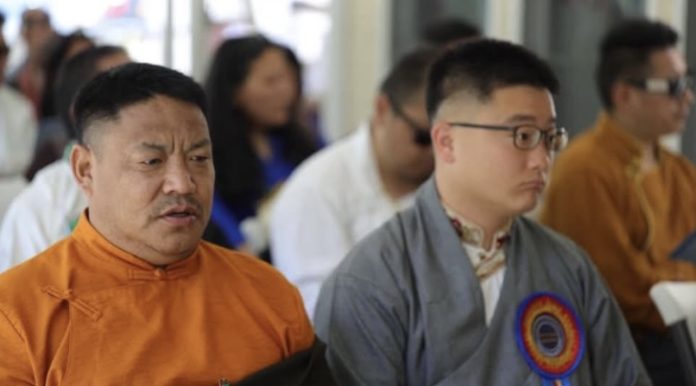
New York – On July 2, I lost one of my closest friends.
The Tibetan community lost one of its strongest voices. The cause of freedom lost one of its most faithful defenders. And I lost my brother.
Lobga Rangzen, also known as Lobsang Palden, died after self-immolating in front of the United Nations headquarters in New York. Even now, writing those words doesn’t feel real.
For more than twelve years, Lobga was a constant part of my life. We stood together at rallies that drew thousands and at protests where only a handful of people showed up. We walked the halls of Congress, attended conferences, traveled together, shared meals, argued over politics, laughed until late at night, and talked endlessly about Tibet, history, faith, and freedom.
Those are the memories I keep coming back to.
A Gentle Soul with Unshakable Principles
To the world, he was a Tibetan activist.
To me, he was simply Lobga.
He was one of the kindest people I have ever known. Gentle in the way he treated people, but absolutely unshakable when it came to his principles. He never chased headlines or recognition. He wasn’t interested in being famous. What mattered to him was making sure that one more person learned about Tibet before the day was over.
Carrying Tibet’s Message to the World
He carried Tibet with him everywhere he went.
Long before I truly understood Tibet’s history, Lobga patiently taught me. He didn’t lecture. He shared stories. He spoke about his homeland with both heartbreak and hope. He helped me understand what it means to watch your culture, your language, your religion, and your identity slowly come under pressure, and yet refuse to give up believing they can survive.
The more I learned from him, the more I realized that Tibet was never just a place on a map.
It was home.
It was family.
It was a people fighting not to disappear.
But if you knew Lobga, you also knew that his message reached beyond Tibet.
He believed Americans needed to understand what authoritarianism looks like before it reaches their own doorstep. He often told me that what had happened in Tibet should serve as a warning, not just a tragedy remembered from afar. He worried that too many people viewed the Chinese Communist Party only through economics or diplomacy, while overlooking the countless lives forever changed by repression, censorship, religious persecution, and the systematic destruction of culture.
He wasn’t trying to spread fear.
He was trying to protect freedom.
To Lobga, the fight for Tibet and the defense of democracy were inseparable.
Whether he was standing outside the United Nations, protesting in front of a consulate, or handing a flyer to someone hurrying down a New York sidewalk, he treated every conversation as if it mattered, because to him, it did. He believed hearts changed one person at a time.
The Growing Urgency: Resisting the ‘Ethnic Unity Law’
He never gave up on people.
In recent months, though, I noticed something different.
There was a deeper urgency in his voice.
He spoke often about China’s so-called “Ethnic Unity Law.” He feared it would accelerate the erosion of Tibetan language, religion, and identity. What haunted him wasn’t only the suffering of today, it was the possibility that one day there would be generations of Tibetans who could no longer fully know the culture their ancestors had fought to preserve.
That thought broke his heart.
Yet he never stopped believing.
He constantly urged Tibetans to stand together despite political differences or regional divisions. He believed unity was their greatest strength. He believed Tibet’s future depended on it.
People were free to disagree with his politics.
No one who knew him could ever doubt the sincerity of his heart.
Everything he did came from love.
Love for Tibet.
Love for his people.
Love for freedom.
When I learned what had happened, I couldn’t believe it.
Even now, part of me doesn’t want to.
I want one more phone call.
One more protest together.
One more cup of coffee where we’d spend hours talking about the future he hoped to see.
Remembering How He Lived
I know many people will focus on how Lobga died.
I hope they spend even more time remembering how he lived.
Nothing in this tragedy should ever be seen as encouraging self-immolation. Every life is precious, and no family should endure this kind of loss. I wish with all my heart that my friend were still here.
But to understand his final act, we must also understand the pain that came before it.
For many Tibetans, self-immolation has become the most desperate cry of a people who feel they have exhausted every peaceful way of asking the world to pay attention. It reflects profound anguish, not a celebration of death. It speaks to the fear that an ancient civilization could slowly disappear while much of the world looks away.
That is the tragedy Lobga wanted people to see.
When I think of him, I don’t see his final moments.
I see the smile that greeted everyone.
I hear his laugh.
I remember the countless hours we spent standing together in the cold because he believed even a small protest mattered.
I remember how he welcomed strangers like old friends.
I remember how impossible it was to discourage him.
Most of all, I remember a man who never stopped believing that Tibet would one day be free.
If Lobga leaves us with anything, I hope it is not simply sorrow.
I hope it is courage.
The courage to care about people we have never met.
The courage to defend freedom even when it is inconvenient.
The courage to speak when silence is easier.
Lobga believed that the struggles of Tibetans, Uyghurs, Hong Kongers, Southern Mongolians, and all people living under authoritarian rule were connected because freedom itself is connected. He believed that what happens to one people eventually matters to us all.
That belief shaped his life.
It will continue to shape mine.
My friend, my brother…
I wish you could have seen the day Tibet was finally free.
I wish we could have stood together beneath a free Tibetan flag, smiling because the long struggle was finally over.
That day did not come in your lifetime.
But I promise you this.
We will keep telling the world about Tibet.
And I will never let people forget the man who gave so much because he loved his people so deeply.
Rest in peace, my brother.
Until Tibet is Free….

Se Hoon Kim
Se Hoon Kim is the Managing Editor and White House Correspondent for Global Strat View. A U.S. Army veteran, he covers the White House, national security, foreign policy, and U.S. politics.
- Se Hoon Kim#molongui-disabled-link

- Se Hoon Kim#molongui-disabled-link

- Se Hoon Kim#molongui-disabled-link

- Se Hoon Kim#molongui-disabled-link