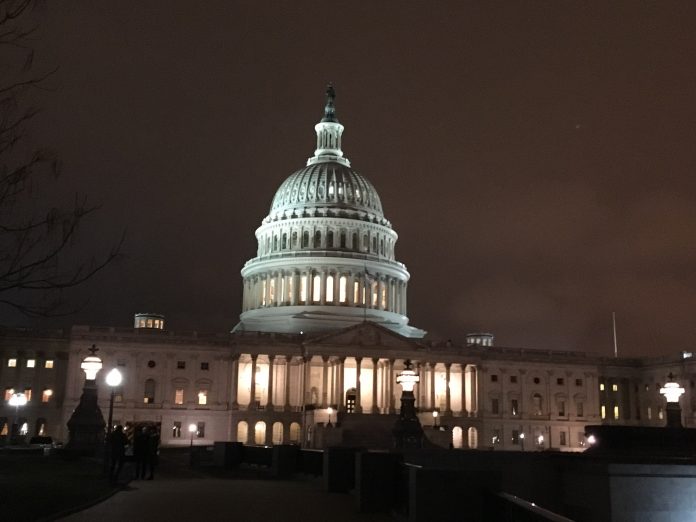
WASHINGTON – On Friday, May 15, 2026, distinguished guests, policymakers, human rights advocates, scholars, journalists, and members of the Ethiopian American community gathered at the historic Kennedy Caucus Room in the Russell Senate Office Building for an important conference addressing the ongoing Human Rights Crisis in Ethiopia and attacks on religious freedom.
The conference was organized by Mesfin Mekonen — Ethiopian American, author of Washington Update, champion of human rights and constitutional democracy in Ethiopia, Manager at the National Press Club, and founder of MM Management, Ltd. — together with Aklog Birara, Vice Chairman of the Global Alliance for the Rights of Ethiopians, commentator, author, and former Senior Advisor at the World Bank.
The organizers expressed sincere gratitude to Senator Chris Van Hollen and his dedicated staff for their generous assistance in securing the conference venue at the United States Congress. Although Senator Van Hollen was unable to attend due to a prior commitment, his support and concern for human rights and democratic values were greatly appreciated.
The conference served as an urgent platform to discuss the deteriorating humanitarian, political, and human rights conditions throughout Ethiopia. Participants emphasized that the political stability and economic prosperity of Ethiopia are critically important not only for Ethiopians, but also for the stability of the Horn of Africa and broader international security interests.
Speakers warned that instability in Africa’s second-most populous nation risks creating devastating regional consequences. While international attention remains focused on crises in the Middle East, Ukraine, and elsewhere, participants stressed that ignoring the escalating catastrophe in Ethiopia would be a grave mistake.
The forum brought together community leaders, policy experts, religious representatives, journalists, and human rights advocates to discuss widespread atrocities, systematic human rights violations, ethnic violence, restrictions on civil liberties, and the growing persecution of Ethiopian Orthodox Christians. Particular attention was given to reported abuses against the Amhara people, the suppression of political opposition, arbitrary arrests, and violations of freedom of expression.
Participants called for the immediate release of all political prisoners and detainees, including prominent prisoners such as Tadios Tantu and Christian Tadele, along with hundreds of others detained for political reasons.
The conference emphasized that holding this event within the United States Congress underscored the urgent need for stronger international engagement and action to promote peace, justice, democracy, religious freedom, and respect for international human rights law in Ethiopia.
Speakers noted that the conference aimed to amplify the voices of oppressed and marginalized Ethiopians by bringing global attention to the suffering experienced across the country. Discussions focused on constitutional reform, national reconciliation, democratic governance, accountability, and long-term peace and stability.
Several presenters argued that Ethiopia currently stands at a critical crossroads. They expressed concern that the country is increasingly descending into political instability, economic hardship, armed conflict, and widespread lawlessness. Corruption, economic mismanagement, and ongoing violence have contributed to worsening humanitarian conditions and declining public trust in government institutions.
Conference participants voiced strong concern regarding the leadership of Prime Minister Abiy Ahmed, arguing that democratic principles, accountability, and respect for human rights have significantly eroded under his administration. Speakers warned that authoritarian practices, intimidation of opposition voices, and restrictions on freedom of expression threaten Ethiopia’s democratic future.
Particular attention was also given to the suppression of artistic and cultural expression in Ethiopia. Participants discussed concerns surrounding internationally known Ethiopian artist Teddy Afro and reports of censorship connected to his recently released album, Etorika. Speakers argued that artistic expression plays a vital role in reflecting the conscience and aspirations of society and warned against attempts to silence cultural voices.
The conference further highlighted concerns raised by international human rights organizations, including reports of forced displacement, shrinking civic space, intimidation of journalists, detention of activists, and increasing restrictions on independent media and civil society organizations.
Participants also expressed serious concerns regarding the credibility of Ethiopia’s upcoming elections, arguing that free and fair democratic processes cannot exist without independent institutions, freedom of the press, political pluralism, and the protection of opposition voices.
Despite the many challenges discussed, speakers also emphasized hope and resilience. Ethiopia’s long history, cultural richness, and enduring spirit were repeatedly cited as reasons to believe that democratic transformation and peaceful reconciliation remain possible.
Throughout the conference, participants reaffirmed a shared vision of an Ethiopia governed by democratic principles, constitutional rule, respect for human rights, and equal justice for all citizens regardless of ethnicity, religion, or political affiliation.
The conference concluded with several recommendations directed to the United States Congress, the Administration, and the international community:
- Call for an immediate cessation of hostilities and an end to drone strikes and military operations targeting civilians.
- Support urgent and inclusive national dialogue, reconciliation, and peaceful conflict resolution.
- Encourage constitutional reform aimed at establishing a more inclusive and democratic political system.
- Promote accountability for individuals responsible for ethnic violence, crimes against civilians, and violations of religious freedom.
- Consider targeted sanctions under the Global Magnitsky Human Rights Accountability Act against officials implicated in serious human rights abuses.
- Advocate for the immediate release of all political prisoners, journalists, and detainees imprisoned for peacefully expressing their political views.
- Support independent investigations into alleged human rights violations and crimes against civilians.
The organizers concluded by emphasizing that lasting peace and stability in Ethiopia can only be achieved through justice, accountability, democratic governance, reconciliation, and respect for the fundamental human rights and dignity of all Ethiopians.
Dr. Aklog Birara, Vice Chairman of the Global Alliance for the Rights of Ethiopians, commentator, author, and former Senior Advisor at the World Bank. His speech at the Conference Senate Kennedy Caucus Room
Urgency of Now—Ethiopia’s Human Rights Crisis Requires an International Response
Speech presented by Dr. Aklog Birara, May 15, 2026, Kenedy Caucus Room, the Capitol, USA, “The Urgency of Now: Ethiopia’s Human Rights Crisis Requires an International Response,” argues that Ethiopia is facing a profound and escalating human rights catastrophe driven by ethnicized governance, state-sponsored violence, institutional decay, and democratic breakdown.
Dr. Aklog frames the crisis as both a moral tragedy and a growing international threat, emphasizing that atrocities committed against civilians—particularly in Tigray, Amhara, Oromia, Afar, and other regions—have resulted in massive human suffering, displacement, destruction of institutions, and loss of life estimated in the hundreds of thousands to over one million people.
His speech stresses that: The Ethiopian government has failed in its fundamental duty to protect citizens. Ethnic-based governance has distorted institutions and deepened repression. Violence, impunity, drone strikes, mass detention, disappearances, and destruction of health and education systems are recurring patterns.
Democratic legitimacy has eroded due to conflict, exclusion, restrictions on opposition, and suppression of civil society and media.
Ethiopia’s instability threatens regional security, migration systems, international human rights norms, and geopolitical stability in the Red Sea corridor.
Dr. Aklog supports his arguments by citing findings from organizations including:
- Human Rights Watch
- Amnesty International
- Lemkin Institute to Prevent Genocide
- United States Department of State
- Office of the High Commissioner for Human Rights
- Global Centre for the Responsibility to Protect
Dr. Aklog concludes by urging the international community, especially friends of Ethiopia that grant aid to recognize the notion that Ethiopia’s crisis has become a test of whether the international community is willing to respond decisively to large-scale and sustained human suffering.
Dr. Aklog makes the following key Recommendations.
1. Accountability and Justice, He calls for:
- A UN-mandated independent investigative mechanism.
- International or hybrid tribunals if domestic justice fails.
- Expanded Global Magnitsky sanctions on officials, commanders, and financiers.
- Public human-rights benchmarks tied to international engagement.
2. Immediate Civilian Protection
- An immediate end to air strikes and explosive attacks in civilian areas.
- Independent monitoring of civilian harm.
- Conditioning security cooperation on compliance with international humanitarian law.
- Unrestricted humanitarian access.
- Emergency funding for healthcare, schools, and education recovery.
- Support for NGOs operating in conflict zones.
3. Political and Structural Reform. He advocates:
- An inclusive national dialogue and reconciliation process.
- Restorative justice and peacebuilding.
- Strengthening of the rules of law and independent national institutions.
- Constitutional and governance reforms to address structural causes of conflict.
4. International Coordination. Dr. Aklog urges coordinated action among:
- The United States
- European Union
- African Union
- United Nations
- Gulf Cooperation Council states
In this regard, Dr. Aklog emphasizes the notion that geopolitical interests in the Horn and Eastern Africa should not override human rights accountability. The lives of tens of millions of people are at stake.

Mesfin Mekonen
Mesfin Mekonen is the author of Washington Update, a bulletin about Ethiopia’s struggle for freedom and prosperity, and founder of MM Management.
- Mesfin Mekonen#molongui-disabled-link

- Mesfin Mekonen#molongui-disabled-link

- Mesfin Mekonen#molongui-disabled-link
- Mesfin Mekonen#molongui-disabled-link