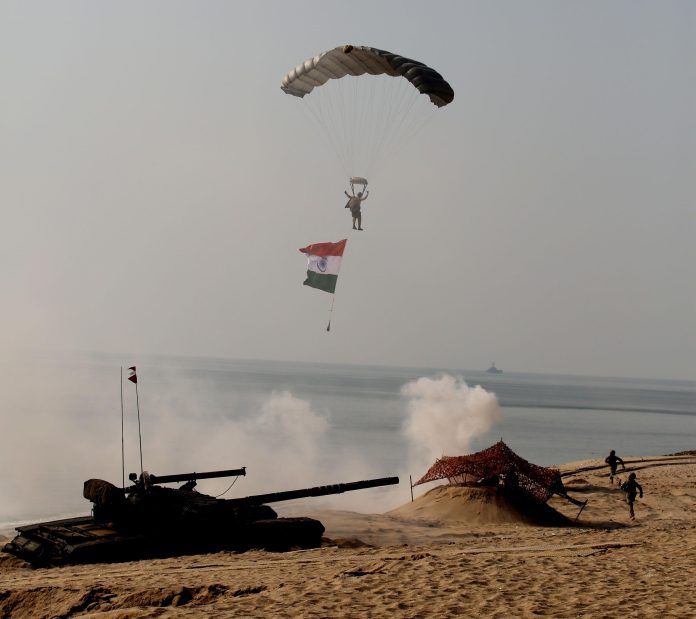
The idea of unifying India’s military under theatre commands is sometimes described as a technical reform. Yet, anyone who has watched real contingencies unfold knows the impulse comes from something deeper. Modern conflict does not respect the neat lines that organizational charts still cling to. A discussion may begin with airspace, shift suddenly to armor mobility, and then pivot to maritime signaling that alters the tempo of decision-making on land. Theatre commands attempt to capture this volatility within a single operational frame, ensuring that no commander is left to knit together fragments when the environment has already accelerated beyond the plan.
India’s strategic community has long accepted that its security challenges rarely emerge in isolation, yet the command structures confronting them still echo a legacy of service-segmented planning. The theatre model proposes a different architecture—one in which a single commander holds the map, the tempo, and the burden of decisions across an entire front. The logic is direct: if the threat behaves as one front, the response cannot be split into three interpretations of urgency. Translating this logic into practice, however, demands moving through institutional habits that have matured over decades.
Geography strengthens the argument more than any doctrinal paper could. Along the northern borders, the demands of altitude, infrastructure, and a technologically capable adversary place immense weight on ground posture. Air support, ISR integration, logistics, and infantry endurance form a single bundle of requirements—yet the centre of gravity remains unmistakably land-forward. The Western Front compresses time even further. Here, escalation windows are narrow, retaliation cycles must be computed instantly, and precision fires must be aligned seamlessly with manoeuvre forces. Even the maritime domain, seemingly distant, feeds back into both fronts by shaping deterrence, securing energy and trade routes, and influencing the sustainability of any long-duration land contingency. Layered together, these pressures create not three separate theatres of thought but a single operational picture, with land considerations running through its core.
This is the space in which theatre commands claim relevance. They promise a unity of effort by granting one commander the authority to harmonise sensors, shooters, logistics, and manoeuvre—particularly where land contingencies demand uninterrupted sequencing of effects. The goal is not administrative neatness but operational coherence. Yet beneath that promise lie essential questions about how autonomy built over decades adapts to an architecture designed to centralise responsibility. Airpower planners worry about dilution of centralised control, army leadership stresses the need for area-based authority, and the Navy evaluates how maritime priorities will be interpreted within theatres where land pressures naturally dominate. These hesitations reveal the depth of adaptation required: theaterisation is not a redrawing of boxes but a reorientation of responsibility.
Global Experience: What Western Militaries Learned the Hard Way
For a Washington audience, the trajectory of Western theatre reforms is instructive because it illustrates how jointness became a structural necessity rather than an intellectual preference.
The United States operates the world’s most mature theatre system, shaped by the Goldwater-Nichols reforms of 1986. Unified Combatant Commands—INDOPACOM, CENTCOM, EUCOM, AFRICOM, NORTHCOM, SOUTHCOM—give each combatant commander operational control over all services in their area of responsibility. Services train and equip; combatant commanders fight. This single-point authority resolved decades of inter-service rivalry. It enabled the U.S. to conduct complex land-dominated campaigns in Iraq and Afghanistan while synchronising air, cyber, special operations, and logistics at speed.
The United Kingdom’s Permanent Joint Headquarters (PJHQ) offers a smaller but similarly integrated model. From peacekeeping to counter-terrorism operations, the PJHQ ensures that land, air, and maritime contributions are coordinated under one operational commander—an arrangement that India’s planners often study because it suits a medium-power military with global responsibilities.
NATO provides another instructive example. Through Joint Force Commands in Brunssum, Naples, and Norfolk, NATO integrates 30 sovereign militaries into a single warfighting system. The complexity is far greater than what India faces internally. Yet, NATO’s ability to synchronise land, air, maritime, cyber, and logistics across borders emphasises why modern operations require unified operational leadership.
Australia’s HQ Joint Operations Command (HQJOC) demonstrates how a theatre-like architecture can serve a country with a dispersed geography and limited force size. France and Germany provide further illustrations of how medium powers centralise operational control while leaving force generation to the services.
Across these Western cases—large and small, continental and maritime—the principle is consistent: when warfare accelerates across domains, command lines must not multiply. And in land-dominant theatres, unified command becomes indispensable.
India’s Adaptation: Jointness Built Around Its Operational Realities
India is attempting to digest these lessons while tailoring them to its own environment. A northern theatre would require a commander capable of balancing air effects with the inescapable demands of terrain, logistics, and land posture. A western theatre would need a design that can manage rapid escalation cycles, again shaped primarily by land considerations. A maritime theatre would require autonomy in securing vast sea lines without waiting for layered approvals that originate in land-centric contingencies.
These ambitions are clear and long overdue. The challenge lies in designing structures that close old seams without creating new ones—and in ensuring that theatre commanders receive the domain expertise required to make informed decisions. Authority cannot be concentrated without strengthening the advisory ecosystem beneath it.
Critics correctly point out that command architecture is only one part of the problem. ISR fusion, logistics integration, modernisation gaps, and communication patterns all shape the quality of jointness. Theatre commands will not fix these issues by decree; they instead create a framework in which solving them becomes more coherent—particularly for land-heavy contingencies where timing, supply, and situational awareness determine the early course of conflict.
The Reform as Signal
Theaterisation carries a signalling function as well. It tells adversaries that India is preparing to remove internal bottlenecks. It reassures partners—including the United States—that India intends to build a military architecture capable of multi-domain operations. And it informs India’s services that the structures of yesterday cannot define the readiness of tomorrow.
The Moment of Redefinition
Whether one fully embraces theatre commands or watches them cautiously, India stands at a moment of military redefinition. At their best, the reforms provide unity of purpose anchored in the operational realities of India’s land-driven security environment. At their worst, they risk devolving into administrative debate without addressing the deeper operational seams.
The outcome will depend on whether India can align clarity with collaboration, authority with expertise, and joint structures with the land-heavy pressures that continue to shape its strategic frontiers. Modern conflict no longer tolerates fragmented command. India’s ability to adapt may well determine its ability to deter.

Aritra Banerjee
Aritra Banerjee is a columnist specialising in Defence, Strategic Affairs, and Indo-Pacific geopolitics. He is the co-author of The Indian Navy @75: Reminiscing the Voyage. Having spent his formative years in the United States before returning to India, he brings a global outlook and first-hand insight to his reporting from foreign assignments and internal security environments such as Kashmir. He holds a Master’s in International Relations, Security & Strategy from O.P. Jindal Global University, a Bachelor’s in Mass Media from the University of Mumbai, and Professional Education in Strategic Communications from King’s College London (King’s Institute for Applied Security Studies.
- Aritra Banerjee#molongui-disabled-link

- Aritra Banerjee#molongui-disabled-link

- Aritra Banerjee#molongui-disabled-link

- Aritra Banerjee#molongui-disabled-link