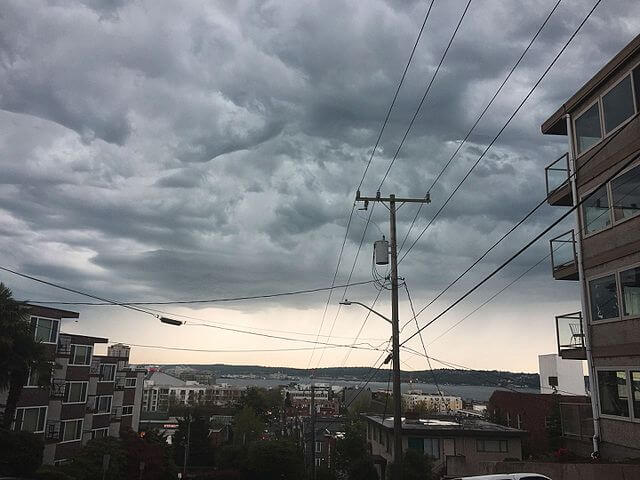
Not as dark as an eclipse, but two dark clouds, under-mentioned by politicians, are forming on America’s horizon. They are the housing crisis and the growing threat of electricity shortages.
The housing crisis hasn’t caught fire as the issue one would have expected it to be among politicians. Electricity shortages are awkward for President Biden because he has staked his reputation on electrifying the country with alternative energy.
Neither the housing crisis nor the electricity challenge has garnered high recognition in the presidential election. Biden has touched on the housing crisis, and former president Donald Trump has denigrated alternative energy. Both are complex issues and need urgent attention. And both defy simple, declarative political statements, which may be why they are lying there, untouched but with lethality.
Housing hurts in obvious ways, including homelessness, a reduction in the birthrate and a freeze on the mobility of labor, once one of the great economic strengths of the United States. Where there was work, workers went.
Less so during the current housing crunch: When Americans cannot find housing where the work is, they won’t move. The consequence: European-type labor immobility.
Another consequence is that if the free movement of workers and their families stops, it contributes to the splintering of America: The New South goes back to being the Old South, and the rigidity of elitism in the North hardens. The East Coast and the West Coast start to think differently: the East Coast looking to Europe and the West Coast looking to Asia. Those developments aren’t good for the body politic. Intra-nationalism is a challenge to a country of continental dimension.
For those lucky enough to have shelter, nothing delivered to it is more important than electricity. We can do without pizza delivery, mail delivery and telephone service, but we can’t survive without electricity.
If it is extremely hot for months, as it was last summer in some regions, people die. Around Phoenix, according to Arizona data, more than 500 people died of heat-related causes.
In Texas, during Ice Storm Uri in 2021, 246 people froze to death by official count. Try to imagine those people, including children, freezing to death in their homes in America!
The homeless die all the time from exposure.
A chorus of voices, led by the American Public Power Association and the National Rural Electric Cooperative Association, has been sounding the electricity alarm for several years. However, the crisis continues to form because there is no quick fix for electricity generation and transmission any more than for housing development.
Demand is rising because of a national movement to electrify everything, especially transportation, and the growth of data centers. Rudy Garza, president of CPS Energy, the municipally owned natural gas and electric utility in San Antonio, said eight data centers are planned there and “20 more waiting in the wings.”
Utilities don’t say no. They have a history of planning for demand, but the end of that may be in sight if the data center demand, fed by artificial intelligence, continues to grow. While national electricity growth is about 2 percent annually, it is 3 percent in high-growth areas like San Antonio and around Dallas.
David Naylor, president of Rayburn Electric Cooperative, northeast of Dallas, said his area is experiencing explosive growth in demand of 3 percent or more yearly without yet accommodating data-center growth, although that is coming.
Technology will help solve the future of housing with better construction techniques. Also, while national standards would give new housing a boost, the core of the problem remains local ordinances and resistance in the suburbs and other “desirable” areas.
Some of the same not-where-we-live attitude frustrates utilities in moving renewable energy from the sunny and windy areas — mainly in the West — to where it is needed.
The not-where-we-live syndrome is stunting America’s future growth. In housing, the crunch is here. In electricity, it is coming.
This article first appeared on White House Chronicle.

Llewellyn King
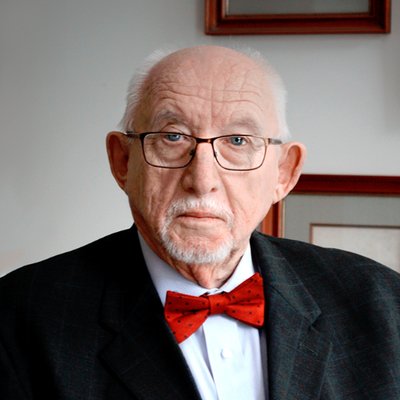
Llewellyn King is executive producer and host of "White House Chronicle" on PBS.
- Llewellyn King#molongui-disabled-link

- Llewellyn King#molongui-disabled-link

- Llewellyn King#molongui-disabled-link

- Llewellyn King#molongui-disabled-link