The European Union and Azerbaijan reconfirmed their strategic energy partnership this week in Baku as the EU continues to reduce its dependencies on Russian gas, and attempts to deal with a new energy crisis following the suspension of Liquified Natural Gas (LNG) production from Qatar, an important energy supplier, and the ongoing tensions in the Middle East, disrupting global markets.
European Energy Commissioner Dan Jørgensen noted that “the EU will remain a reliable purchaser of Azerbaijani gas for the foreseeable future, underpinning structural transformation in the Azerbaijani economy.”
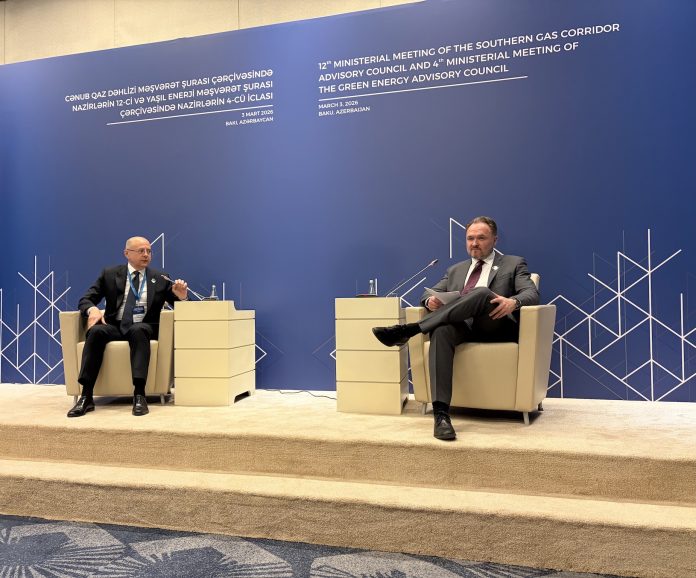
The Commissioner was in Baku to participate in the Southern Gas Corridor Advisory Council 12th Ministerial Meeting and the Green Energy Advisory Council 4th Ministerial Meeting on March 3, which brought together 27 countries, 60 institutions, and energy companies to promote the balanced development of natural gas and renewable energy, as well as to further diversify regional energy connectivity. Delegations from participating countries, company representatives and financing institutions held bilateral talks at the rooms around the plenary conference hall at the Baku Congress Center throughout the day,
Elchin Amirbayov, Representative of the President of the Republic of Azerbaijan on Special Assignments, told NE Global on March 4, “At a time when tensions in the Middle East continue to inject uncertainty into global energy markets, the Southern Gas Corridor serves as a critical pillar of stability for Europe’s energy security. It not only diversifies supply routes and sources, but also reduces exposure to geopolitical shocks. At the same time, investments in green energy across the wider Caspian region reinforce this resilience by gradually decoupling energy security from geopolitical volatility.”
Analysts point out that Azerbaijan is well placed to help with the Gulf disruptions but has very limited additional export capacity because of slow production growth and limited pipeline capacity via the Trans-Adriatic Pipeline (TAP) and the Trans-Anatolian Natural Gas Pipeline (TANAP), which are the core infrastructure components of the Southern Gas Corridor (SGC).
Azerbaijan expands gas exports to 16 countries
On 3 March, at the annual Advisory Council review, Azerbaijan President Ilham Aliyev said, “Last time I was addressing the audience, saying that we supply gas to 12 countries. Now the number of countries where Azerbaijani gas has reached its consumers has reached 16.”
The President of Azerbaijan said his country wants to increase its presence in the European energy market. “We have already started to supply two more countries in Europe — Germany and Austria. Thus, today, 10 members of the EU receive gas from Azerbaijan. In the coming years, with respect to the new production of gas from Azerbaijani fields, we may increase the output. But for that, definitely — and we spoke about that last time — we need to think about the expansion of the existing gas transportation infrastructure, because today the Southern Gas Corridor is already fully packed,” Aliyev said. He noted that Azerbaijan is looking for other extensions and interconnections in order to be able to supply as much as the market needs and probably will need even more, considering the current situation in the world, and in order to be able to export as much as it can.
Speaking at the Ministerial Meeting , Energy Minister Parviz Shahbazov said Azerbaijan is a reliable supplier to Europe, and demand for our gas remains strong, however, institutional and financial support for expansion from the demand side is still insufficient. “We are advancing four upstream projects for launch between 2026 and 2029, with first non-associated gas from Azeri-Chirag-Gunashli expected this year, alongside four new onshore and offshore exploration efforts. The UAE’s ADNOC (XRG) becoming a shareholder in the Southern Gas Corridor is another great news. Yet despite such positive developments, a substantial increase in volumes to Europe will require a clear, long-term policy framework supported by concrete financial mechanisms,” he said.

Jørgensen noted that Azerbaijan helps Europe replace Russian energy, significantly increasing natural gas deliveries through the Southern Gas Corridor. “Since late 2020, the Trans-Adriatic Pipeline has already delivered more than 50 billion cubic meters of Caspian gas to Europe.”
With the help of Caspian gas, the EU’s dependency on Russian gas fell from 45 percent of overall imports in 2022 to 12 percent in 2025, and these numbers will continue to fall. In less than two years, the remaining 35 billion cubic meters of Russian gas that we are still importing every year will be out of our markets. The 10 billion euros per year that the EU spends on this gas bill will no longer finance Russia nor its aggression against Ukraine,” the EU Energy Commissioner said.
Analysts have long been generating charts highlighting the glaring contrast between EU aid to Ukraine and EU energy purchases from Russia, which in fact show the contrast between high minded statements from Brussels and the facts on the ground. Finally it seems that EU Member States have gotten the message and EU energy purchases are sharply declining, but not fast enough for many.
“We continue to reduce our dependencies on Russian gas, and the importance of our partnership with Azerbaijan will increase, bringing benefits for Europe’s energy security and Azerbaijan’s economy. Since TAP started commercial deliveries, Azerbaijan has earned around 24 billion euros in natural gas export revenues from EU buyers through 2024. My visit today is an opportunity to make it very clear. Azerbaijan’s gas supplies will remain an important backbone of the EU’s energy security,” Jørgensen said.
Azerbaijan as a transit hub for oil from Kazakhstan and Turkmenistan
Aliyev also stressed that Azerbaijan plays an important role as a reliable transit country for energy resources. “We provide important oil transit for Kazakhstan and Turkmenistan, and year after year, the volume of oil transported through our system is growing. We are capable and have the infrastructure to receive more oil from the eastern shores of the Caspian,” he said.
Kazakhstan’s Deputy Minister of Energy Sanzhar Zharkeshov said his country highly values its strategic partnership with Azerbaijan in the field of energy and sees substantial potential for elevating this cooperation to a qualitatively new level. “In particular, I would like to highlight the agreements reached between Kazakhstan, Azerbaijan, and Uzbekistan regarding a large-scale project for the generation and transmission of green energy. The agreement signed by the Heads of State not only strengthens the resilience of our national energy systems, but also directly contributes to the achievement of our environmental objectives aimed at reducing emissions through the attraction of green investments. Through joint efforts and the development of new routes, we are laying the foundation for strengthening the region’s energy independence and security,” Zharkeshov said.
Clean transition and electrification
Azerbaijan and the European Commission confirmed their readiness to advance a global electrification agenda. “I know that Azerbaijan also foresees electrification as a catalyst to reduce domestic fossil fuel consumption, therefore opening additional opportunities for gas export revenues, Jørgensen said. “Moreover, I know that there is enormous potential for electrification throughout the whole region, especially when it comes to heating in households and industries,” he said, adding that with a view to COP31 in Türkiye, let us therefore put the electrification higher on the agenda and identify concrete areas for closer collaboration.
Shahbazov said his country plans to develop 8 GW of renewable capacity for domestic use, export, and data centers. He also highlighted progress related to the establishment of the Caspian-Black Sea-Europe, Azerbaijan-Türkiye-Europe routes both directly from Nakhchivan and via Armenia, as well as the Trans-Caspian and East-West green energy corridors. It was emphasized that through these interregional energy links and electricity, Azerbaijan will further strengthen its role in the energy security of Europe.
Regional connectivity
In the Black Sea Strategy, the EU committed to a connectivity agenda, aiming to improve transport, energy, and digital connections with the Black Sea region, Türkiye, the South Caucasus, and Central Asia, Jørgensen said. “It is great to see the plans for cross-border electricity interconnections that have been announced over the last years. Considering the number of initiatives announced, it is important that these projects are implemented based on sound economic and system integration analysis. I look forward to the results of the feasibility studies currently being implemented,” he said.
This article first appeared in NE Europe.

Kostis Geropoulos
Kostis is Co-founder / Director of Energy & Climate Policy and Security at NE Global Media. Follow him @energyinsider for deep analysis of Energy, Europe and Global Affairs.
- Kostis Geropoulos#molongui-disabled-link

- Kostis Geropoulos#molongui-disabled-link

- Kostis Geropoulos#molongui-disabled-link

- Kostis Geropoulos#molongui-disabled-link