WASHINGTON – Pakistan’s strategic vulnerabilities are increasing as its involvement in the Iran-Arab conflict intensifies. China, Pakistan’s closest strategic and economic partner, is vehemently opposed to regime change in Iran. The Iranian parties supporting regime change will most likely assist the United States in limiting China’s influence in the Middle East. Under such conditions, China wants Pakistan to refrain from participating in any military campaign against the Islamic regime.
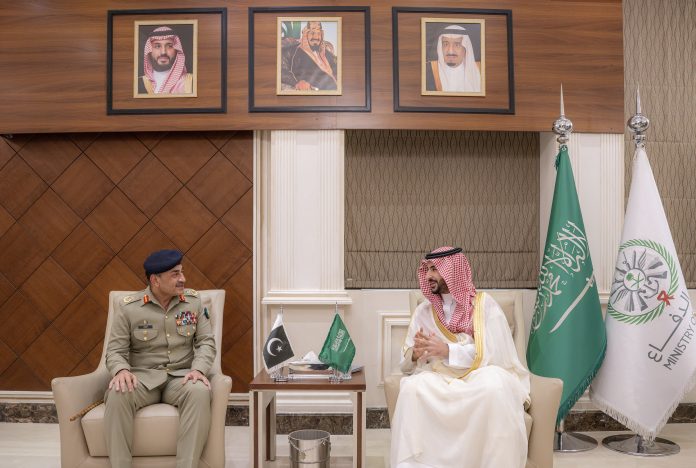
Transitioning to Pakistan’s relationship with Saudi Arabia, the dynamics become more complex. Saudi Arabia, Pakistan’s second-most important ally, regards the Iranian government as an existential threat to the Gulf States and seeks its immediate dissolution. Saudi Arabia pressures Pakistan to stand with it against Iran, particularly given the existence of the Strategic Mutual Defense Agreement between the two nations. Riyadh invoked this agreement after Iran launched missiles and drones toward the Kingdom, with some Saudi analysts believing that the accord guarantees a nuclear umbrella against mutual adversaries.
Saudi Arabia is the religious hub of two billion Muslims worldwide, and the majority of Pakistanis have great veneration for Saudi rulers in their hearts. While Pakistan is ostensibly committed to safeguarding Saudi security, it has so far tried to avoid direct, offensive military action against Iran due to Chinese pressure, domestic sectarian tensions, and border conflicts. Pakistan finds itself in a classic catch-22, as it relies heavily on both China and Saudi Arabia for its economic and geopolitical survival. Some observers, however, believe Pakistan’s current role as a peacemaker is a ruse to stave off Iran’s military and diplomatic maneuvers while trying to advance Saudi objectives.
Domestically, the inhabitants of Gilgit Baltistan oppose Pakistan’s involvement in the conflict with Iran. Four facts regarding the occupied territory of Gilgit Baltistan are worth knowing. First and foremost, it is predominantly Shia. Second, it borders China and serves as the only land bridge between the two allied nations. Third, the majority of locals demand independence from Pakistan. Fourth, Gilgit Baltistan is a constitutional part of India, and a UN Security Council resolution has called on Pakistan to withdraw from it. That means neither China nor Pakistan owns the only land bridge they rely on for economic and strategic superiority in Asia.
Given Gilgit Baltistan’s strategic vulnerabilities, Pakistan has wielded an iron fist over this soft underbelly and chokepoint for the past 78 years, pursuing illegal demographic engineering as policy and harassing and imprisoning locals who campaign for freedoms and equal rights.
The torture, incarceration, and killing of Gilgit Baltistan residents, including children, have increased threefold since the start of the Iran War. With no letup in state-led brutality, the local families are coming forward and filing police cases against the Pakistani military for the murders of their loved ones. Last week, the police department sacked dozens of its personnel for suspected passivity against pro-Iran demonstrators. However, locals in Skardo believe that the officers were discharged because of their Shia faith.
To quell further tensions, authorities have imprisoned prominent leaders of the Awami Action Committee, journalists, Shia religious activists, nationalists, social workers, and members of Imran Khan’s Tehrik-e-Insaf or the Justice Party. A few days ago, authorities also arrested Aun Muhammad, the president of the Baltistan Students Federation (Balti Slob-phrug yi Thsokspa) and his two brothers for making incendiary statements.
Gilgit Baltistan and Ladakh enjoy common geography, language, culture, and historical and political ties. Before Pakistan annexed Baltistan in 1948, it was a sub-district (tehsil) of Ladakh. The people of Ladakh in India continue to seek the removal of Pakistan from Gilgit Baltistan and the reunification of both areas. China expects Pakistan to maintain cordial relations with Gilgit-Baltistan; otherwise, Beijing will lose safe access to Pakistani ports on the Arabian Sea. Pakistan will take all of these variables into account before deciding on its final move in the Arab-Iranian conflict.
While there are concerns about a Shia uprising in the north, in the south, Baloch Sarmachars seeking independence for Balochistan have pushed the Pakistani army to retreat in numerous districts. The scenario in Pashtunistan is no different, with the Taliban and Pakistan Army fighting for control over border territories.
During a recent meeting with the foreign minister, Ishaq Dar, China has pressed Pakistan to negotiate a cease-fire with the Taliban since the upheaval in Afghanistan harms its investments and bolsters its enemies like the militants of the East Turkestan Freedom Movement. The media reports that Pakistan has approached China for financial assistance to settle an old debt with the United Arab Emirates. Pakistan has a long-standing habit of borrowing from one friend to repay another.
Pakistan’s persistent attempts to appease powerful allies while exploiting their rivalries have severely undermined its international reputation. Unless it learns to resolve its fundamental strategic dilemmas, Pakistan risks territorial disintegration.

Senge Sering
Senge Sering is a native of Pakistan-occupied-Gilgit-Baltistan and runs the Washington DC based Gilgit Baltistan Studies
- Senge Sering#molongui-disabled-link

- Senge Sering#molongui-disabled-link

- Senge Sering#molongui-disabled-link

- Senge Sering#molongui-disabled-link