NEW DELHI – Nepal’s total external debt has grown steadily in recent years, reaching approximately $10 billion by 2024, according to World Bank data. As a share of GDP, external debt stood at around 22% in fiscal year 2023-24 — a level the IMF currently classifies as low risk. That assessment, however, depends on conditions that Nepal does not fully control: export revenues that grow, remittances that hold, and bilateral creditors that remain willing to work with Kathmandu when fiscal conditions tighten.
An important structural feature of Nepal’s debt portfolio is often overlooked in coverage that focuses on Chinese lending. Multilateral creditors — primarily the World Bank’s International Development Association and the Asian Development Bank — account for around 87% of Nepal’s external debt, carrying average interest rates of about 1% and maturities of roughly 36 years. Nepal’s overall external borrowing is heavily concessional. This matters: Nepal’s debt risk profile is substantially different from that of countries like Sri Lanka or Zambia, which had large commercial exposures.
Remittances are the structural foundation of Nepal’s external accounts. In 2023, they amounted to approximately $11 billion — around 26% to 27% of GDP, making Nepal one of the most remittance-dependent economies in the world. The source is the labor of Nepali workers in the Gulf states, Malaysia, and increasingly South Korea and Japan. None of this income originates from China. When remittances fluctuate, as they did during the pandemic, Nepal’s capacity to service external obligations and finance imports fluctuates with them.
The continued outmigration of working-age Nepalis, while financially stabilizing in the short term, hollows out the domestic labor supply and delays the development of a productive economy capable of generating revenue independently. Chinese loans for infrastructure projects do introduce a different set of risks from Nepal’s predominantly multilateral debt.
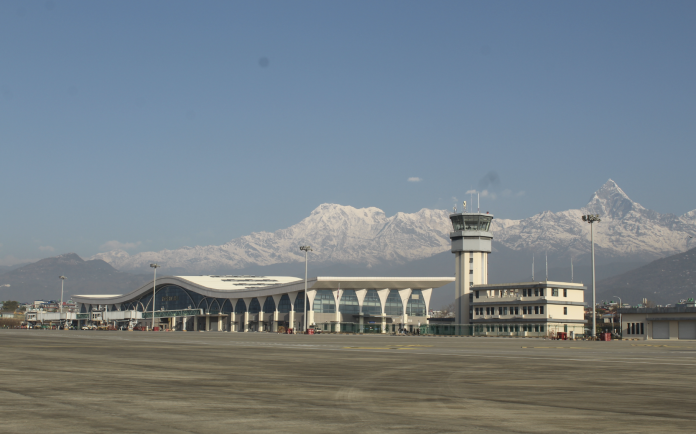
The Pokhara International Airport illustrates the structural problem. Nepal secured a $215.96 million loan from China’s EXIM Bank in 2016 at a 2% annual interest rate, with a 7-year grace period and a 20-year repayment timeline — terms that are more expensive than comparable multilateral financing but structured as concessional lending. The problem is not primarily the loan terms; it is the revenue performance. The airport has attracted almost no scheduled international flights since its inauguration in January 2023.
A parliamentary committee investigation in 2025 exposed serious financial irregularities in the construction process. Nepal has since publicly requested that China convert the loan into a grant — a sign that renegotiation has already entered the political conversation, even if formal restructuring has not yet been initiated. Nepal has limited tools for managing a genuine debt service shortfall.
It cannot print foreign currency. Its central bank reserves, while currently adequate, came under pressure during the 2022 import surge. Access to international capital markets is minimal, meaning that in a serious debt service crisis, the realistic options are renegotiation with existing creditors or IMF support — and Nepal is already operating under an IMF Extended Credit Facility arrangement, which brings its own conditionalities. The record on Chinese BRI loan renegotiation elsewhere is mixed and frequently mischaracterized. China has renegotiated loans with countries in genuine distress, but the pattern is one of timeline extensions rather than principal reductions, and China’s banks have consistently resisted accepting haircuts even in multilateral restructuring frameworks.
The Hambantota case in Sri Lanka — often cited as a template for Chinese debt-for-equity conversion — involved a commercial lease rather than a true asset seizure, though the distinction is contested, and the practical effect on Sri Lanka’s sovereignty over the facility remains significant.
For Nepal, the risk is not imminent default. The IMF’s own debt sustainability analysis classifies Nepal as having a low risk of debt distress. The more plausible concern is a slower, structural one: that borrowing for projects with weak revenue performance, combined with an economy structurally dependent on remittances that could contract with any Gulf or Southeast Asian labor market shock, leaves the country with narrowing fiscal space and diminishing ability to dictate the terms of future financing relationships.

Ashu Mann
Ashu Mann is an Associate Fellow at the Centre for Land Warfare Studies. He was awarded the Vice Chief of the Army Staff Commendation card on Army Day 2025. He is pursuing a PhD in Defense and Strategic Studies at Amity University, Noida. His research focuses include the India-China territorial dispute, great power rivalry, and Chinese foreign policy.
- Ashu Mann#molongui-disabled-link

- Ashu Mann#molongui-disabled-link

- Ashu Mann#molongui-disabled-link

- Ashu Mann#molongui-disabled-link