NEW DELHI – Pakistan’s recent claims projecting an impending water crisis in the Indus Basin and attributing river flow variations to upstream actions fail to withstand scrutiny when examined against Pakistan’s own hydrological data, reservoir records, and operational realities. A closer assessment of the evidence reveals a markedly different picture—one defined not by systemic scarcity, but by abundant inflows, significant downstream escapages, and longstanding structural limitations in water management.
The 2025 Hydrological Reality: Surplus Over Scarcity
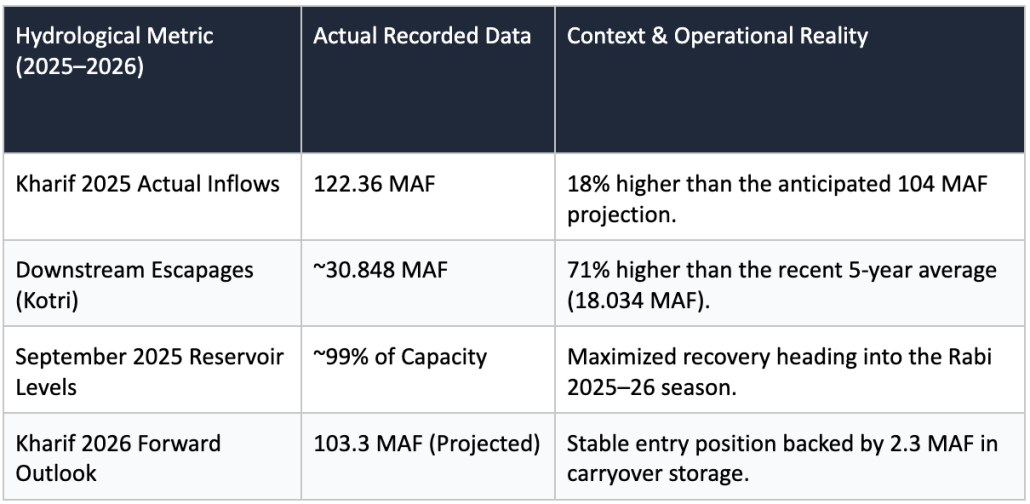
The most striking feature of the 2025 hydrological cycle was the substantial surplus in water availability during the Kharif season (April to September). As per Pakistan’s Indus River System Authority (IRSA) data, actual inflows reached approximately 122.36 MAF, almost 18 percent higher than the anticipated inflows of nearly 104 million acre-feet (MAF) for Kharif 2025. Heavy rainfall across the basin further reduced irrigation demand and eased pressure on provincial allocations, reinforcing the inconsistency of claims of acute or engineered water shortages.
Downstream Escapages: Why Sea Runoff Disproves the Scarcity Narrative
An even stronger contradiction to the scarcity narrative lies in the extraordinary quantity of water that ultimately flowed downstream of Kotri into the Arabian Sea. During Kharif 2025, escapages below Kotri amounted to nearly 30.848 MAF—around 71 percent higher than the recent five-year average of 18.034 MAF. Significant downstream escapages to sea (about 3.6 MAF) also continued during the lower-flow Rabi 2025 season (October to March). If the basin were genuinely facing severe scarcity supposedly due to upstream interference, such large volumes of water would not have remained unused and flowed into the sea. The data instead points to limitations in storage infrastructure, flood management, and distribution efficiency within the lower basin itself.
Reservoir behavior during the same period further undermines claims of sustained hydrological distress. As expected, the Kharif season began with relatively low storage levels, a normal phenomenon unless the reservoirs are designed for carryover storage. Subsequently, the combination of higher inflows and flood events rapidly replenished major reservoirs. By September 2025, storage levels had risen to nearly 99 percent of capacity, which created a significantly stronger water availability position for Rabi 2025–26.
The outlook for Kharif 2026 also remains stable. Projected rim-station inflows of approximately 103.3 MAF for Kharif 2026, coupled with carryover storage estimated at around 2.3 MAF—higher than both the previous year and long-term averages—indicate that the basin enters the new cycle from a position of relative hydrological comfort rather than crisis.
The Science of Run-of-the-River Hydropower: The Baglihar Framework
At the same time, recent attempts by Pakistan to portray fluctuations in the Chenab River as evidence of upstream manipulation ignore both hydrological realities and the established operational practices of run-of-the-river hydropower projects. River flows at downstream locations such as Marala are inherently influenced by seasonal snowmelt patterns in the Himalayas. Variations in winter snowfall, delayed melting, or cooler spring temperatures naturally affect early-season discharge levels, making such fluctuations a routine feature of Himalayan river systems rather than evidence of deliberate interference.
Operational dynamics of hydropower projects, such as the Baglihar Hydroelectric Project, have also been repeatedly mischaracterized. Reservoir management in run-of-the-river systems necessarily involves variable releases linked to sediment flushing, maintenance requirements, hydropower optimization, technical safety considerations, and flood management protocols. Because sediment management is particularly critical in Himalayan rivers with heavy silt loads, temporary operational adjustments during flushing or maintenance cycles are intrinsic to the project’s functioning.
Importantly, the Baglihar project has already undergone extensive international scrutiny. Pakistan itself invoked the dispute resolution provisions of the Indus Waters Treaty, leading to the appointment of a Neutral Expert under Article IX and Appendix F. The Neutral Expert’s 2007 determination upheld the project’s essential design and operational parameters, rejecting most objections regarding pondage and freeboard. The project was therefore confirmed to be consistent with treaty provisions governing run-of-the-river hydropower development.
Equally significant is the absence of any demonstration of tangible downstream harm arising from the alleged flow variations. Allegations have largely relied on selective snapshots, isolated observations, and media narratives rather than rigorous hydrological analysis to establish causation, economic damage, or quantifiable agricultural impact. No concrete evidence has been produced linking operational variations at upstream projects to sustained downstream distress.
Moreover, allegations of politically motivated manipulation overlook an important practical reality: any deliberate meddling in hydropower operations would impose not only direct economic costs on the upstream operator itself through reduced power-generation efficiency, but also cause long-term harm to the plant. A single flushing cycle during the monsoon season at the Baglihar Dam may result in an estimated loss of around 150 million units of electricity generation and corresponding revenue. Such flushing operations are undertaken by the operator solely for technical and maintenance reasons. It is difficult to reconcile claims of intentional disruption with operational choices that simultaneously reduce energy production and impose financial losses.
Taken together, the evidence presents a clear conclusion. The Indus Basin has recently experienced higher-than-expected inflows, substantial downstream escapages, rapid reservoir recovery, and stable forward projections. These patterns place variations in river discharge well within the scope of natural hydrological processes and standard reservoir operations.
Structural Governance: The Real Challenge of the Indus Basin
The larger challenge facing the basin lies not in speculative claims of upstream deprivation, but in unresolved structural issues—limited storage capacity, sedimentation pressures, inefficient utilization, and broader water governance constraints. Because these internal management deficiencies remain unresolved, externalizing them through narratives of manufactured scarcity does little to address the real long-term challenges confronting the basin.

Atul Jain
Mr. Atul Jain is the former Chairman, Central Water Commission, India.