Sidelined at Versailles: The US-Iran Bilateral Reality
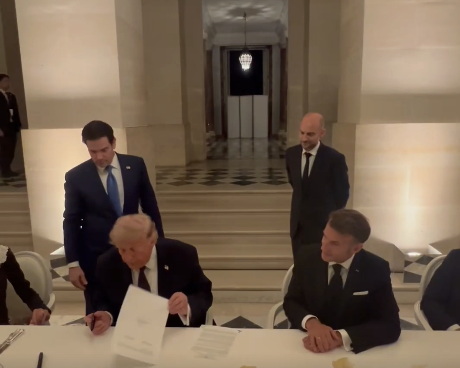
Near the end of the G7 meeting that was held last week in France, President Trump signed a Memorandum of Understanding (MoU) with Iran at the Palace of Versailles. Yet negotiations were mostly conducted bilaterally between Washington and Tehran.
In fact, since the start of the war led by Israel and the United States against Iran, in February of this year, the weaknesses of the Old Continent have been extensively illustrated.
Today, the Middle East is the theatre of many humanitarian disasters. Israeli actions in the Gaza Strip have shocked global opinion. In an attempt to mitigate what UN experts have qualified as a genocide, many European countries have therefore recognized the State of Palestine. To no effect, however, considering that the situation remains widely unchanged.
This issue sparks considerable controversy among Europeans. Polarization in the social and political landscapes fuels anger and distrust.
European diplomacy reacts. The UK’s Home Secretary, Yvette Cooper, has strongly condemned Israel’s Minister of National Security’s (Itamar Ben Gvir) X statement, which said that “All Lebanon Must Burn”. Germany’s Minister of Defense, Pistorius, has criticized the United States’ blockade of the Strait of Hormuz.
But as far as the Middle East is concerned, Europe’s influence is fading there. To blame are strong shortcomings in the military, logistical, and economic fields.
The Strategic Ledger: Gaps in European Defense Infrastructure
An IISS (International Institute for Strategic Studies) report from September 2025 explores the limitations of Europe’s defense. It points out major hardware and software gaps, as well as over-reliance on the United States. For example, “as of mid-2025, the US is the sole provider of exo-atmospheric mid-course interception capabilities in Europe”. As such, the Old Continent is distressed after President Trump has yet again questioned American engagement in NATO.
Europe’s choice not to fall in is costing it dearly. But it encourages the Old Continent to achieve autonomy. Spending in 2025 is more than 50 percent higher in nominal terms than in 2022. Countries like Germany have especially committed themselves to this. German defense spending has doubled since 2021.
The Inflation Toll: Energy Dependency on the Middle East
Since the Russian Invasion of Ukraine and the subsequent European sanctions on Russian gas, dependency on regions like the Middle East has increased. To illustrate this, fuel prices across the European Union increased by 20.7 percent between May 2025 and May 2026. The European Central Bank has raised its deposit rate by 25 basis points to avoid ensuing inflation.
European policies aim to address these strategic shortfalls, but often to the detriment of unprivileged populations. Many would prefer to spend money on national defense, education, social programs, and infrastructure.
Green Transition as a Geopolitical Shield
In this context, Europe’s net-zero emissions program, or Green, gains new significance. 97 percent of oil and 85 percent of gas are imported, and 330 billion euros were spent in 2025 to supply the European Union with these fossil fuels. Renewable energy and green infrastructure could reduce Europe’s long-term dependency while delivering clear, substantial social improvements by providing safe, clean energy and reducing pollution.

Patrick Moutier-Paubel
Patrick Moutier-Paubel is a sophomore student in a preparatory class based in Tours, France, with a strong academic focus on geopolitics. His travels across Europe and the United States have fostered a deep and evolving interest in international affairs, particularly in the fields of journalism and diplomacy. Outside the classroom, he is a dedicated martial artist who values discipline, creativity, and personal growth—qualities that inform both his practice on the mat and his approach to life.
- Patrick Moutier-Paubel#molongui-disabled-link

- Patrick Moutier-Paubel#molongui-disabled-link

- Patrick Moutier-Paubel#molongui-disabled-link

- Patrick Moutier-Paubel#molongui-disabled-link