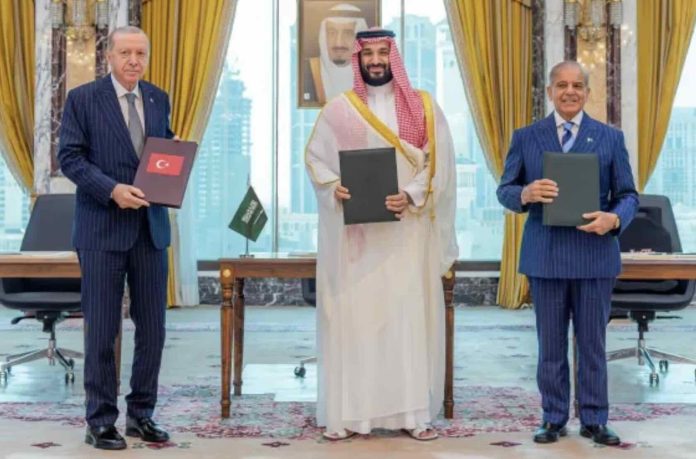
NEW DELHI – Pakistan signed a mutual defense treaty on Friday. By Tuesday, three of its citizens lay dead in the Bab al-Mandeb, a strategic waterway where Pakistan helps provide maritime security. The ceremony at Al-Safa Palace on 7 August 2026 was immaculate. Shehbaz Sharif, Mohammed bin Salman and Recep Tayyip Erdoğan signed the Makkah Joint Defense Agreement before the cameras. An armed attack on one, the text declared, would count as an attack on all. Islamabad called it historic.
Four days later, three Houthi ballistic missiles hit the cargo ship Tihamah — Tanzanian-flagged, owned by Egyptian and Yemeni-registered companies — in the Bab al-Mandeb Strait. All 11 crew members aboard were Pakistani or Indonesian nationals. Four died: three Pakistani seafarers and an Indonesian crewman who died alongside them. A second missile then struck the rescue party, killing two Yemeni rescuers. Six people were killed in total; seven of the surviving crew were injured. Nobody came. No frigate. No escort. No coalition response of any kind.
Command Without Cover
This is the part Islamabad cannot easily explain.
The Pakistan Navy is not a stranger to these waters. It took command of Combined Task Force 150 from the Royal Saudi Navy in January 2026, holding that command until late July — barely two weeks before the strike. Pakistan has commanded CTF-150 more times than almost any other member nation, and has periodically held command of CTF-151, the counter-piracy force operating in the Gulf of Aden. Bab al-Mandeb sits at the mouth of that very gulf.
Counter-piracy is not counter-missile. Granted. But the gap is the point. Pakistan has spent two decades accumulating command billets in the world’s largest naval partnership, and its press releases treat each rotation as evidence of maritime weight. Then the missiles flew, and the weight amounted to nothing for the men who needed it.
Presence is not protection. Islamabad has been selling the first as though it were the second.
Read The Fine Print
The treaties Pakistan celebrates protect states. They say nothing about citizens. The September 2025 agreement with Saudi Arabia speaks of “aggression against either country.” So does Makkah. Both formulations are territorial. Neither reaches a Pakistani rating working a foreign hull under a foreign flag.
That is not a technicality. It is the entire architecture. Roughly 12,000 Pakistani seafarers crew other nations’ ships — down from around 18,000 in the early 1990s — and Islamabad has been signing bilateral agreements, most recently with Norway, to try to rebuild that number. Yet every defense framework it signs stops at the waterline of the nation-state. Protection follows the flag. The passport buys nothing.
The Consular Reflex
Watch what Pakistan actually did. Deputy Prime Minister Ishaq Dar condemned the attack. He offered condolences. He directed Pakistan’s embassy in Riyadh to coordinate with Saudi and Yemeni authorities on repatriating the bodies and assisting the injured. The Foreign Office affirmed support for freedom of navigation.
Every one of those actions is administrative. Not one is naval. A state with genuine maritime reach responds to dead nationals with a deployment or a demand. Pakistan responded with a repatriation request.
A Pattern, Not An Accident
None of this is new, and that is the damning part. As the Atlantic Council observed, Saudi Arabia has held a mutual defense agreement with Pakistan since 2025 and with the Gulf Cooperation Council since 2000. In practice, neither has produced an Article 5-style response. The clauses accumulate. The mechanisms multiply. Ankara has now announced ministerial committees and joint military exercises under the Makkah framework.
Committees do not intercept missiles.
Pakistan has built a foreign policy on the appearance of strategic weight, MILGEM corvettes from Turkish yards, nuclear ambiguity for Riyadh, rotating command in Bahrain. It is an impressive portfolio. It is also, on the evidence of 11 August, a portfolio that cannot put a single hull between a Houthi missile and three of its own citizens.
The Reckoning
Three Pakistani families are burying their dead this week. They were merchant seafarers, not combatants, working a food coaster in a war they had no part in. Islamabad signed a collective defense treaty ninety-six hours before they died. It has since issued a statement.
Deterrence is measured in outcomes, not in communiqués. Until Pakistan can convert its ceremonies into escorts, its treaties remain what they have always been: documents about the dignity of states, silent on the lives of the people who sail for them.

Ashu Mann
Ashu Mann is an Associate Fellow at the Centre for Land Warfare Studies. He was awarded the Vice Chief of the Army Staff Commendation card on Army Day 2025. He is pursuing a PhD in Defense and Strategic Studies at Amity University, Noida. His research focuses include the India-China territorial dispute, great power rivalry, and Chinese foreign policy.
- Ashu Mann#molongui-disabled-link

- Ashu Mann#molongui-disabled-link

- Ashu Mann#molongui-disabled-link

- Ashu Mann#molongui-disabled-link