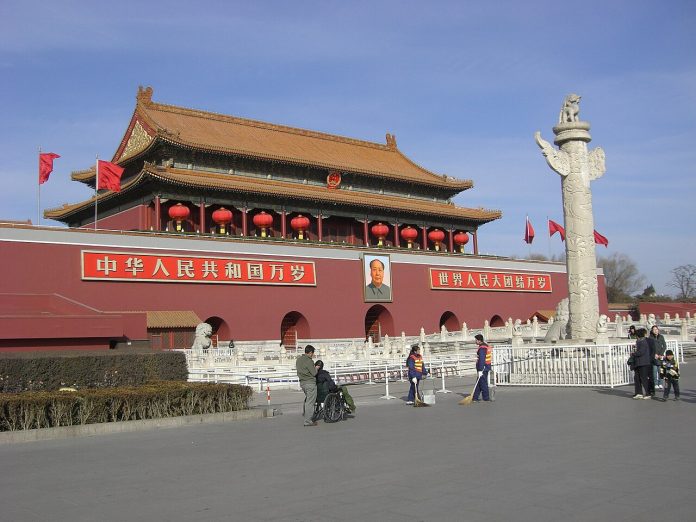
NEW DELHI – On the morning of April 6, 1976, China’s Central Committee issued a formal verdict on what had happened in Tiananmen Square over the previous two days: the gatherings to mourn Premier Zhou Enlai were a “counter-revolutionary incident.” State broadcasters repeated the classification. Deng Xiaoping was named its architect. The grief that had filled the square was, through official channels, reframed as treason.
Zhou Enlai died on January 8, 1976. The Gang of Four had directed party and media policy for years, working within Mao Zedong’s framework. During the Qingming Festival on April 4 and 5, hundreds of thousands gathered at the Monument to the People’s Heroes. They came to lay flowers and write poems for the dead premier. The leadership needed an official explanation quickly. They could not acknowledge the truth: ordinary citizens loved Zhou Enlai and resented the party’s treatment of his memory.
State media did not report the mourning; instead, they reported a riot. Coverage described the gatherings as violent and conspiratorial, driven by class hostility. Although up to 2 million people from all social classes, including the children of high-ranking cadres, attended, official accounts attributed the turnout to counterrevolutionary manipulation. Poems, many in traditional forms, were deemed subversive. Those who replaced the removed wreaths were photographed and identified.
Deng Xiaoping’s removal from all offices on April 7 completed the Gang of Four’s narrative. By naming him as the organizer, the state turned a public expression of grief into proof of conspiracy. This justified Deng’s removal. It also made sympathy for mourners legally dangerous. The verdict stayed in effect until Mao Zedong died in September 1976.
After the Gang of Four was arrested in October, views on the April Fifth Incident changed. Specifically, Hua Guofeng and Wang Dongxing—who led the crackdown—later stated the demonstrations were not counterrevolutionary. Subsequently, in 1978, the Central Government declared the April Fifth Incident a “revolutionary event.”
The rehabilitation was real. It reversed the classification and led to the release of those still imprisoned. Yet it was also a political tool from the start. By then, Deng Xiaoping was consolidating power. He pushed relentlessly for the reversal. His claim that suppressors had made a grave error pointed at Hua Guofeng, who served as Acting Premier and Minister of Public Security during the crackdown.
Thus, rehabilitating the mourners of 1976 was simultaneously an indictment of Deng’s political rivals.
The sequence of classification, suppression, rehabilitation, and reuse illustrates how comprehensively authoritarian systems treat history as operational material. The April Fifth Incident happened. Its official meaning was designed and redesigned according to who held power at the moment of production. The grief of the people in the square remained constant. The state’s account of what that grief represented changed twice in two years.
The poems from the square survived both cycles. In 1979, Beijing’s Foreign Languages Press published “The Tiananmen Poems” in English. Earlier, students from Beijing’s Number Two Foreign Language Institute had circulated over one thousand more poems in unofficial editions. The poems themselves stayed the same. The government’s interpretation changed.

Ashu Mann
Ashu Mann is an Associate Fellow at the Centre for Land Warfare Studies. He was awarded the Vice Chief of the Army Staff Commendation card on Army Day 2025. He is pursuing a PhD in Defense and Strategic Studies at Amity University, Noida. His research focuses include the India-China territorial dispute, great power rivalry, and Chinese foreign policy.
- Ashu Mann#molongui-disabled-link

- Ashu Mann#molongui-disabled-link

- Ashu Mann#molongui-disabled-link

- Ashu Mann#molongui-disabled-link