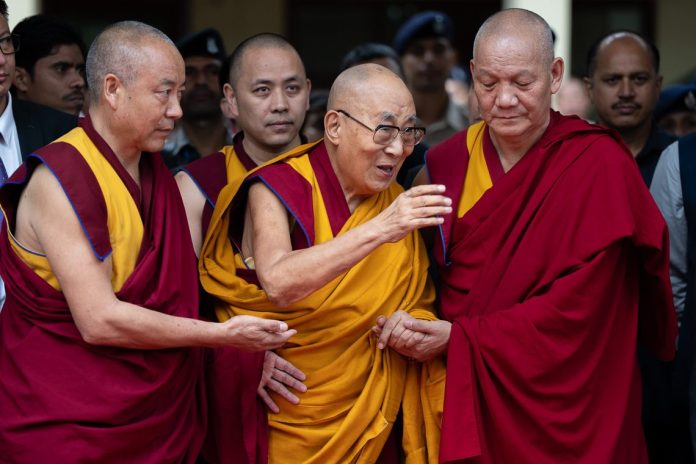
NEW DELHI – On the night of March 17, 1959, a young Tenzin Gyatso slipped out of the Norbulingka Palace in Lhasa in one of the most consequential great escapes from Communist China’s iron grip in modern Asian history.
That escape, now etched in history, was a silent revolution. The young Tibetan Buddhist monk is now known to the world as a global peace messenger, the 14th Dalai Lama, revered not just by Tibetan Buddhists but by all peace-loving people.
The young Dalai Lama was disguised as an ordinary soldier, hoodwinking the mighty authority of Communist China and the People’s Liberation Army.
The background to that escape by the Dalai Lama was Communist China’s sinister plans to capture and imprison him in the guise of an invitation to attend a cultural event at the PLA’s military headquarters in Lhasa.
Just as the escape took place, the PLA had been building its artillery batteries all over Lhasa, as their plans to arrest the Dalai Lama after luring him to the military garrison became the talking point among the Tibetans.
To defeat the Chinese plans, thousands of Tibetans had gathered around the Norbulingka Palace to protect their spiritual and political high figure.
But the PLA was planning to bombard the summer residence of the Dalai Lama, and if that had happened, not only the lives of the thousands of Tibetans shielding the Norbulingka Palace, but the life of the spiritual leader, too, would have been in peril.
As the plans reached the Tibetan Buddhist leadership, they decided to take the young Dalai Lama out of his home, not only to save his and his people’s lives but also to ensure the survival of the Tibetan religion, culture, governance, language, and identity.
The escape wasn’t easy at all. The young Dalai Lama and his small group of aides and family members had to endure a torturous journey across the unforgiving Himalayan terrain, amid inhospitable cold weather.
That escape was the defining moment of the 1950 Tibetan Uprising, saving the Dalai Lama’s life and helping preserve the Tibetan way of life, culture, religion, and language, all of which are unique and dear to the millions of Tibetans.
The escape was not sudden at all. It was preceded by rising tensions between the occupying forces of Communist China and the peace-loving Tibetan people.
Information spread quickly among the people of Lhasa that the Chinese authorities were planning to detain the Dalai Lama. Intelligence sources had provided this input to the Tibetan Buddhist leadership, forcing them to take action to safeguard the Dalai Lama and, in turn, Tibetan Buddhism itself.
What followed was right out of a Hollywood film, if you may. Tens of Thousands of Lhasa residents poured onto the streets of Tibet’s capital to stop their spiritual figure from attending the PLA’s military event.
What followed these defining events was a Chinese military crackdown on Lhasa’s people. That made the Dalai Lama’s escape not just dramatic, but also strategic. If not for the great escape, Tibet would have been pushed into an existential crisis.
The Dalai Lama and his small entourage exploited the darkness of the night of March 17, 1959, to escape the place, slip out of the Lhasa gates, cross the Kyichu River, and begin a grueling two-week trek southwards through treacherous mountain terrain.
The young Tenzin Gyatso was accompanied by just a handful of Tibetan officials and resistance fighters, and with the help of Tibetan guides, the Dalai Lama moved through the punishing mountain passes and snow-covered valleys.
The journey itself was brutal. Freezing temperatures, thin air, and the constant risk of detection by Chinese PLA patrols and surveillance teams didn’t deter the Dalai Lama or his small group of aides accompanying him on the trek.
That physical hardship of the journey marked the deeply significant historical events that defined the Tibetan resistance and fight back against Communist China’s oppression, repression, and occupation.
This escape was not some personal survival strategy of the Dalai Lama. He was not just fleet a danger to his own life. He was actually carrying on his puny shoulders the continuity of the Tibetan religion, culture, language, governance model, and spiritual leadership.
For centuries, the institution of the Dalai Lama embodied both spiritual and temporal roles for the Tibetan society. Had the Dalai Lama been captured before his escape, it would have meant the end of the Tibetan institutional leadership, dismantling what Tibet stood for just overnight.
But that was not to be. The Dalai Lama’s escape ensured that Tibet, Tibetans, Tibetan religion, culture, language, and society continue to thrive, even if it was outside Tibet itself in faraway India. This made sure that Tibet survives politically, even if extraterritorially.
A fortnight after a punishing trek, the Dalai Lama reached India. Soon after, India’s then Prime Minister Jawaharlal Nehru accorded the Tibetan Buddhist leader respect by granting him political asylum and facilitating the settlement of the young Tenzin Gyatso at Dharamsala in present-day Himachal Pradesh, where he set up the Tibetan government-in-exile.
This decision transformed Himalayan geopolitics forever. The new headquarters of the Tibetan government under the Dalai Lama in the quiet hill town in northern India transformed Dharamsala into the ‘Little Lhasa’ it is known as today.
Dharamsala is now the seat of the Central Tibetan Administration and the most important Tibetan Buddhism and cultural centre globally, after Lhasa.
From this hill town, the Dalai Lama and the Tibetan community in exile began rebuilding their nation extraterritorially. That became possible through the unlikely refuge that the spiritual leader sought in India.
The Tibetan community built schools, monasteries, and administrative buildings for the CTA that now preserve the Tibetan religion, culture, and language, continue centuries-old religious traditions, and build on old and new institutions.

Ashu Mann
Ashu Mann is an Associate Fellow at the Centre for Land Warfare Studies. He was awarded the Vice Chief of the Army Staff Commendation card on Army Day 2025. He is pursuing a PhD in Defense and Strategic Studies at Amity University, Noida. His research focuses include the India-China territorial dispute, great power rivalry, and Chinese foreign policy.
- Ashu Mann#molongui-disabled-link

- Ashu Mann#molongui-disabled-link

- Ashu Mann#molongui-disabled-link

- Ashu Mann#molongui-disabled-link