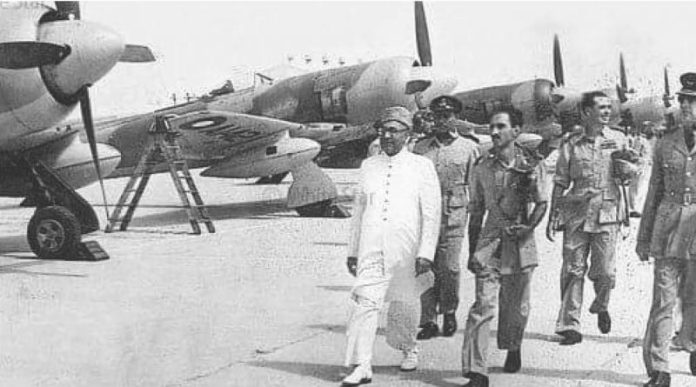
NEW DELHI – The Rawalpindi Conspiracy of 1951 marked Pakistan’s first attempted military coup and exposed the fragility of civil–military relations in the country’s formative years.
Orchestrated by Major General Akbar Khan against Prime Minister Liaquat Ali Khan, the failed plot revealed deep frustrations within sections of the armed forces over the handling of the 1947–48 Kashmir conflict, the United Nations-brokered ceasefire, and broader dissatisfaction with the direction of the newly formed state.
The unraveling of the conspiracy, its dramatic trials, and the eventual release of the accused offer critical insight into Pakistan’s early civil-military tensions.
The Exposure: A Tip-Off That Shook the State
Unlike later coups in Pakistan’s history, the Rawalpindi Conspiracy did not reach the execution stage. The plan was uncovered before troops could mobilize.
According to historical accounts, the government received information from within the conspirators’ circle about secret meetings taking place in Rawalpindi. Some narratives suggest that the wife of one of the civilian participants alerted authorities after learning of the discussions, though the precise circumstances of the tip-off remain debated among historians.
These meetings had reportedly brought together disillusioned mid-ranking military officers and prominent leftist intellectuals, including celebrated poet Faiz Ahmed Faiz and Progressive Writers’ Movement leader Sajjad Zaheer.
The swift exposure underscored the nascent Pakistani state’s vulnerability. Barely four years after independence in 1947, Pakistan was grappling with refugee resettlement, economic strain, and unresolved territorial disputes.
Within this uncertain environment, segments of the military believed that civilian leaders had mishandled the Kashmir war and accepted a ceasefire before securing a decisive military outcome. Akbar Khan, who had played an operational role in the conflict, was particularly critical of the ceasefire decision.
After receiving credible intelligence, the government moved quickly. Arrests were carried out in March 1951, targeting both military officers and civilian collaborators. The rapid crackdown ensured the plot collapsed before any attempt could be made to mobilize troops.
Special Tribunal and Secret Trials
Given the unprecedented nature of the case, Pakistan’s first attempted military coup, the government enacted the Rawalpindi Conspiracy Act, 1951, to establish a special tribunal for the trial of the accused.
The proceedings were held largely in camera, reflecting concerns about national security and the potential political repercussions of a public trial.
The tribunal prosecuted several military officers alongside civilian intellectuals. This unusual alliance between segments of the army and left-wing activists added an ideological dimension to the case.
The state framed the conspiracy not merely as a military rebellion but also as a threat involving radical political elements and armed insubordination.
In 1953, after prolonged proceedings, the tribunal delivered sentences ranging from four years to twelve years of rigorous imprisonment. Major General Akbar Khan received one of the harshest sentences, while Faiz Ahmed Faiz and Sajjad Zaheer were also given prison terms.
The convictions were presented as an assertion of civilian authority over the armed forces.
Amnesty and Early Release
However, the punitive phase proved relatively short-lived. In 1955, the Federal Court of Pakistan ruled that certain provisions of the Rawalpindi Conspiracy Act were unconstitutional, leading to the collapse of the tribunal framework.
Following this decision, most of the convicted conspirators were released earlier than their original sentences required.
The releases reflected both legal developments and political considerations. Pakistan’s leadership recognized that prolonged imprisonment of respected military officers and influential intellectuals could deepen divisions within society.
At the same time, the episode highlighted the limitations of civilian authority in a state where institutions were still consolidating.
Pakistan’s First Visible Civil-Military Rupture
The failure of the Rawalpindi Conspiracy did not eliminate civil-military tensions; instead, it exposed them.
It was the first clear indication that segments of Pakistan’s military were willing to contemplate direct intervention in politics. Although the coup attempt collapsed, the grievances that had motivated it, strategic frustration, distrust of politicians, and institutional ambition, remained unresolved.
These tensions foreshadowed later developments, most notably the successful 1958 coup led by General Ayub Khan, which ushered in Pakistan’s first prolonged period of military rule.
In retrospect, the Rawalpindi Conspiracy can be viewed as an early warning that the balance between civilian authority and military power in Pakistan was far from settled.
A Fragile Balance in the Early Republic
The Rawalpindi Conspiracy of 1951 stands as a pivotal moment in Pakistan’s political evolution. Its exposure through an internal tip-off, the establishment of a special tribunal, and the eventual release of the accused illustrate both the resilience and fragility of the early Pakistani state.
More importantly, the episode shows how quickly civil-military tensions surfaced in a country barely emerging from colonial rule.
By revealing cracks within the power structure just four years after independence, the conspiracy signaled that Pakistan’s civil-military balance was inherently unstable.
The lessons of 1951 would echo through subsequent decades, shaping a political landscape in which the shadow of military intervention would loom repeatedly over civilian governance.

Ashu Mann
Ashu Mann is an Associate Fellow at the Centre for Land Warfare Studies. He was awarded the Vice Chief of the Army Staff Commendation card on Army Day 2025. He is pursuing a PhD in Defense and Strategic Studies at Amity University, Noida. His research focuses include the India-China territorial dispute, great power rivalry, and Chinese foreign policy.
- Ashu Mann#molongui-disabled-link

- Ashu Mann#molongui-disabled-link

- Ashu Mann#molongui-disabled-link

- Ashu Mann#molongui-disabled-link