
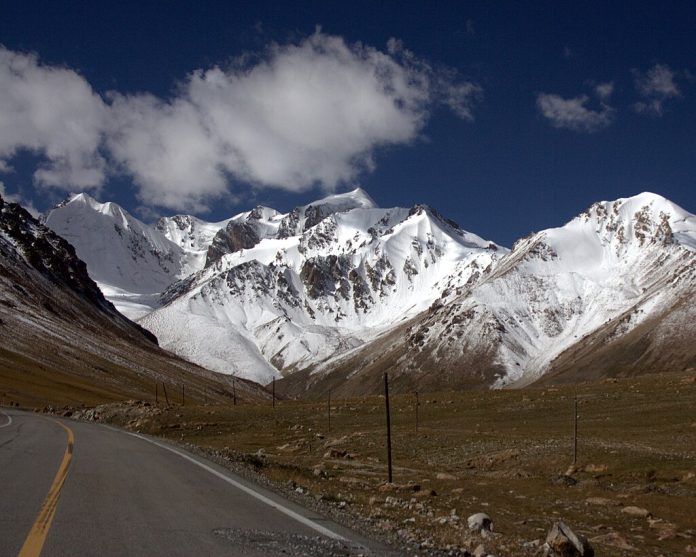
Washington, DC – In September 2025, Pakistani officials met with Chinese colleagues in Beijing to authorize the Karakorum Highway (KKH) upgradation project. This entails creating tunnels and bridges to shorten commuting times and keep the road operational during landslides and snowfalls. During the signing ceremony, Pakistani Minister Ehsan Iqbal said that the upgrade of the 241-kilometer-long section of the highway from Thakot to Raikot will cost two billion dollars, with the Chinese state-owned enterprise covering 85% of the expenditure.
The KKH modernization is part of China’s $ 90 billion China-Pakistan Economic Corridor (CPEC), which runs through Pakistan-occupied Gilgit Baltistan. India regards Gilgit Baltistan as part of Pakistan-occupied Jammu Kashmir (POJK) and objects to Chinese presence and investment in its territory.
Despite India’s objections, China has moved forward with the second phase of CPEC, accelerating mineral and gem exploration as well as industrial and agricultural land development. Excessive use and vehicular overload on the KKH over the decades have caused environmental disasters, increased greenhouse gas emissions, and polluted the narrow valleys of Gilgit Baltistan. The resultant glacier loss has progressed beyond the point of recovery.
Minister Ehsan Iqbal revealed that during their visit, the Chinese authorities asked Pakistan to expedite loan repayments. Pakistan is dealing with a significant $30 billion debt burden from China’s CPEC projects, which has thrown the country into a deep economic spin. As of now, Pakistan’s overall public debt has reached 80 trillion rupees, nearly 13% greater than the previous year, and accounts for 70% of the national GDP.
In addition to China, Russia and the Central Asian Republics use KKH for trade and transit to Pakistani ports. China also uses KKH for strategic and military interests, and the success of Gwadar port is critically dependent on land connectivity via Gilgit. The alternate route to Gwadar would take 28 days through the Malacca Strait, rather than the present two-day journey time.
A substantial stretch of the KKH will be out of service once China and Pakistan complete two mega dams in the Diamer and Kohistan districts. China has urged Pakistan to refrain from raising water levels in the dams until the inundated road patch is rebuilt. This demonstrates that KKH is critical to China, and Beijing will not hesitate to invest in this conduit even if Pakistan lacks the funds to service the debt.
Regardless of China’s objectives, local inhabitants demand that all foreigners leave their territory because the exploitation provides little or no benefit to them. According to the 2024 income report, Pakistan earned ten billion rupees from the Sost Dry Port. However, all this revenue ended up in Islamabad’s coffers. Pakistan developed the port in 2001 to collect customs duties and levies on goods traded with its northern neighbors. In 2025, residents blocked KKH and compelled the Sost Port authority to halt trade and transit operations with China in protest of Pakistan’s exploitative tactics.
According to local journalist Shabir Mir, residents argue that Pakistan lacks legal jurisdiction to collect taxes in Gilgit Baltistan because the region is not part of the country. In this context, China has frequently asked Pakistan to constitutionally integrate Gilgit with the rest of the country so that it does not have to deal with legal problems and local opposition. China believes that India and the United States will continue to oppose China’s presence in Gilgit Baltistan due to India’s claim to the region, and that Pakistan must amicably address this issue to ensure the success of CPEC. On the other side, Pakistan asserts that it cannot make a unilateral decision on Gilgit since changing the legal status would imperil its stance on Kashmir and boost India’s support among locals.
The Gilgit Baltistan Traders’ Union Action Committee proposes that Pakistan exclude Gilgit Baltistan from taxes and duties until the Kashmir problem is resolved. According to the Awami Action Committee, Pakistan gained temporary control of Gilgit from Kashmiri leaders in 1949 through the illegal Karachi Agreement. Since then, Pakistan has continually breached its commitment to the locals by acting like a colonial overlord.
Asif Sakhi of the Awami Worker Party (AWP) asserts that Gilgit Baltistan is a foreign land to Pakistan and Islamabad should not impose taxes on goods that locals trade with China. Furthermore, the income from border trade and transit, as well as the KKH toll, should be used to establish schools and hospitals.
In August 2025, police and paramilitary forces deployed baton charges and tear gas on demonstrators at the Sost port, injuring dozens. Police arrested some activists and charged them with terrorism and treason. Asif questions how locals may commit treason when they are neither citizens nor inhabitants of Pakistan.
According to Sherbaz Khan of the AWP, local leader Shabbir Mayar has been restricted to his village for demanding the withdrawal of Pakistani nationals and struggling for the union of both parts of Ladakh. With elections approaching, Pakistani authorities are pressuring local leaders, including Babajan, who calls for the unity of Jammu and Kashmir. The authorities may disqualify Babajan and other leaders from contesting due to their support for self-rule.
Asif states that commodities in neighboring Xinjiang are significantly cheaper and more affordable than Pakistani goods imported to Gilgit Baltistan. He thinks that Pakistan intends to bring the people to their knees through economic apartheid. Once poverty, overpricing, and unemployment force natives to abandon ancestral lands, the authorities would hand them over to Pakistanis to accelerate demographic engineering. However, the locals continue to fight Pakistani strategic fascism and colonialism.
According to journalist Shabir Mir, locals are outraged because Islamabad imposes socio-economic policies on Gilgit without much input from the Gilgit government. He stated that people also desire the reinstatement of the state subject rule, which denies outsiders automatic land ownership in Gilgit Baltistan.
Mumtaz Nagri is the President of the Karakoram National Movement, which calls for the withdrawal of all Pakistanis from Gilgit Baltistan. He asks that authorities release eight activists, including Azfar Jamshed, from incarceration. They were jailed and tortured because of their affiliation with the Awami Action Committee (AAC). The Awami Action Committee is running the campaign to bring residents together to reject the Pakistani colonial regime. AAC requests the United Nations representative in Gilgit to assist locals in escaping economic terrorism and cultural genocide.
While referencing the UNSC resolution on India and Pakistan, AAC reiterates that colonial rule in Gilgit cannot be toppled and the apartheid system cannot be abolished unless the international community compels all Pakistani citizens, including the military, to leave. Only then would Gilgit reunite with Jammu and Kashmir, and locals would be free to negotiate and settle political and constitutional issues with India.
For decades, Pakistan’s military utilized KKH to transport narcotics and terrorists. During the Soviet-American conflict, Pakistan and China used KKH to smuggle tens of thousands of Afghan and Uyghur Jihadi militants and weaponry to fight the Soviets. Today, instead of Uyghurs, Palestinian-Hamas terrorists have joined the Lashkar-e-Taiba and Jaish-e-Muhammad to resurrect bloodshed and loot in Gilgit and Kashmir.
The Karakorum highway is the principal means of delivering Pakistani law enforcement to Gilgit Baltistan to control and persecute inhabitants. This highway is the primary route for importing Pakistani squatters and settlers to occupy lands, and their presence has a negative impact on Gilgit Baltistan’s cultural identity. For the people of Gilgit Baltistan, KKH represents terrorism, colonialism, and socioeconomic and cultural annihilation rather than development.

Senge Sering
Senge Sering is a native of Pakistan-occupied-Gilgit-Baltistan and runs the Washington DC based Gilgit Baltistan Studies
- Senge Sering#molongui-disabled-link

- Senge Sering#molongui-disabled-link

- Senge Sering#molongui-disabled-link

- Senge Sering#molongui-disabled-link



, which runs through Pakistan-occupied Gilgit Baltistan.)