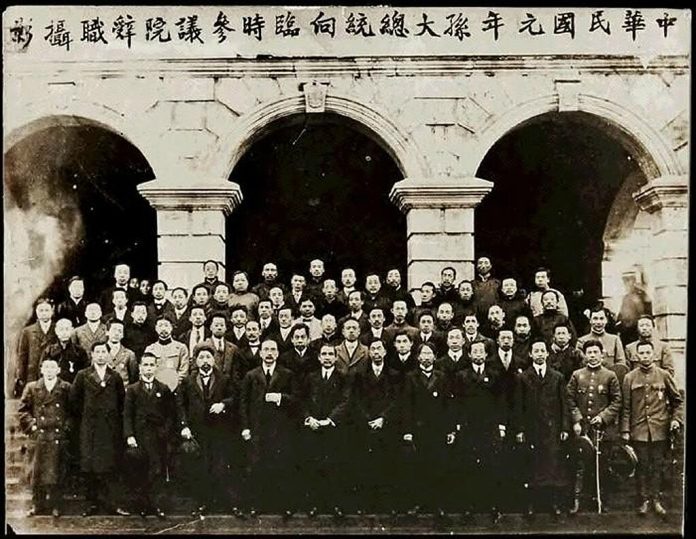
On 1 January 1912, Sun Yat-sen stood at the centre of a collapsing imperial order and declared the birth of the Republic of China. It was a moment heavy with ambition. The Qing dynasty had fallen, centuries of dynastic rule were over, and the idea of a modern republic—built on citizenship rather than empire—had finally taken root in China. Sun’s promise was not merely procedural. It was moral. China, he believed, would move away from coercion, hierarchy, and imperial domination toward popular sovereignty and self-determination.That promise did not survive the twentieth century.
The decisive rupture came in 1949, when the Chinese Communist Party consolidated power on the mainland. The founding of the People’s Republic of China was presented as a revolutionary rebirth, but in practice, it marked the end of the republican experiment that began in 1912. What followed was not the fulfilment of Sun Yat-sen’s vision, but its inversion: a new centralized authority that reasserted control over China’s frontiers through force, surveillance and ideological conformity.
The consequences of that break are still unfolding—most visibly in Tibet, Xinjiang, and Taiwan.
Tibet offers the clearest illustration of how the republican promise was abandoned. For decades after the Qing dynasty’s fall, Tibet functioned as a de facto independent entity. It maintained its own administration, currency, borders and diplomatic engagements. Beijing’s claim over Tibet rested on imperial inheritance, not republican consent. When the People’s Liberation Army entered Tibet in 1950, it did so not as a liberator invited by a republic, but as a conquering force imposing authority from the centre.
The language used at the time spoke of “peaceful liberation” and “autonomy,” but reality moved in the opposite direction. Tibetan institutions were dismantled, religious authority was criminalized, and dissent was met with punishment. Over time, surveillance replaced dialogue, demographic engineering replaced consent, and economic development was used to justify political erasure. Tibet was not integrated into a republic; it was absorbed into a state that behaved much like the empire Sun Yat-sen sought to dismantle.
A similar pattern emerged in Xinjiang.
Uyghurs, like Tibetans, were promised autonomy within a multi-ethnic state. What they received instead was one of the most intrusive systems of control in the modern world. Under the banner of counter-terrorism and development, the region has been transformed into a space of mass detention, cultural suppression and technological policing. Language, faith and identity—cornerstones of any republican citizenship—have been treated as security threats.
This is not the behaviour of a republic built on civic equality. It is the behaviour of a state that sees difference as danger and uniformity as strength.
Taiwan stands apart, not because it escaped China’s twentieth-century turmoil, but because it preserved the republican lineage that the mainland abandoned. When the Republic of China government relocated to Taiwan after 1949, it carried with it the constitutional framework established in 1912. Over time, that framework evolved. Martial law ended, democratic institutions deepened, and political power became subject to public consent.
Today, Taiwan’s existence poses an uncomfortable question for Beijing: if China is one civilization with multiple political paths, why has only one of those paths produced a functioning democracy rooted in Chinese society? The CCP’s insistence that Taiwan must be “reunified” is not about correcting a historical anomaly. It is about extinguishing an alternative model—one that traces its legitimacy directly back to the republican moment of 1912.
This is why Taiwan’s resistance is not merely territorial. It is ideological. It represents a continuation of a republican identity that the mainland suppressed rather than fulfilled.
The Chinese Communist Party often invokes history to justify its authority. It speaks of humiliation, fragmentation and the need for unity. But unity imposed through coercion is not republican unity. It is imperial consolidation by another name. The rhetoric of “national rejuvenation” echoes dynastic restoration more than modern citizenship. It centres the state above the individual and obedience above consent.
Sun Yat-sen’s republic was imperfect and short-lived, but its core idea was radical for its time: that legitimacy flows upward from the people, not downward from power. That idea was never given the chance to mature on the mainland. In 1949, it was replaced by a party-state that tolerated no rival sources of authority—political, cultural or spiritual.
Tibetans, Uyghurs and Taiwanese are often discussed as separate issues, each framed as a local dispute or security concern. They are not. A single historical fault line links them: the moment China turned away from republicanism and returned to centralized domination.
On 1 January 1912, the Republic of China was declared with the hope that China would finally step out of its imperial shadow. More than a century later, that hope survives—but only on the margins, in places that continue to resist being ruled as subjects rather than citizen

Ashu Mann
Ashu Mann is an Associate Fellow at the Centre for Land Warfare Studies. He was awarded the Vice Chief of the Army Staff Commendation card on Army Day 2025. He is pursuing a PhD in Defense and Strategic Studies at Amity University, Noida. His research focuses include the India-China territorial dispute, great power rivalry, and Chinese foreign policy.
- Ashu Mann#molongui-disabled-link

- Ashu Mann#molongui-disabled-link

- Ashu Mann#molongui-disabled-link

- Ashu Mann#molongui-disabled-link