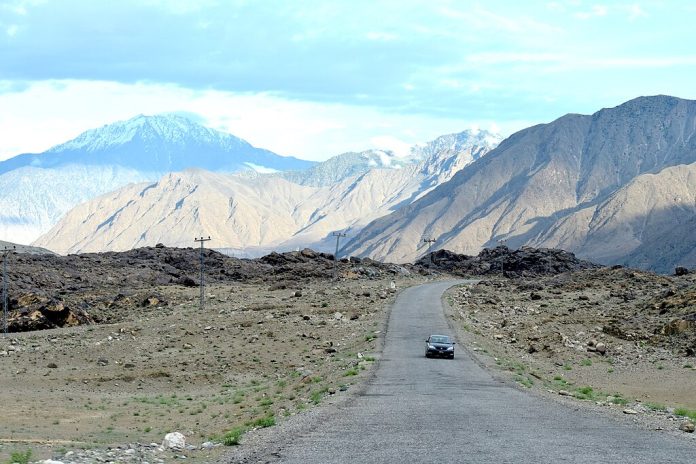
The presence of Pakistani and Chinese nationals in occupied Gilgit-Baltistan is an onslaught on the local land, culture, and religious identity. One such threat manifests as the China-Pakistan-Economic Corridor (CPEC), also known as the development conduit for territories south of the western Himalayas. On a map, CPEC appears as a T-junction projecting from the horizontally stretched Belt and Road Initiative (BRI), which connects China’s Pacific coast with West Asia and Europe. For China, CPEC is an economic lifeline for Pakistan and a geopolitical counterbalance to American influence in South Asia and the Indian Ocean.
Analysts offer divided opinions on the successes and failures of CPEC. Pakistan’s Board of Investment reports that CPEC-related energy projects have reduced the country’s chronic electricity shortages by 28%. The government asserts that the Allama Iqbal Industrial City, inaugurated in November 2024, and the Rashakai special economic zone, operational since December 2023, have brought in over a billion dollars in investment from China, resulting in the creation of thousands of manufacturing jobs. The government also says that the China-owned Gwadar Port generated $3.4 billion in 2024.
Pakistan’s Foreign Office reported in February 2025 that $1.3 billion in trade passed through Gilgit in 2024. According to recent Pakistani sources, over 50,000 Chinese citizens are interested in investing in Gilgit-Baltistan. China is also developing an agricultural technology park and a special economic zone near Gilgit city.
Critics call CPEC an underperforming initiative with a lower investor confidence index. The dream enterprise that promised an alternative to China’s Malacca Strait bottleneck has turned into a quagmire on the banks of the Indian Ocean due to corruption, mismanagement, and political sandpits.
Only 38 of the 90 projects announced since CPEC’s inception twelve years ago are complete, with another 23 under construction. The majority of proposed economic and industrial zones failed as funds were moved to build urban transit.
In its March 2025 report, the Center for Strategic and International Studies states that Pakistan’s ever-growing debt to China, estimated by the IMF at $15.2 billion, threatens long-term fiscal sustainability. Pakistan’s Ministry of Finance reported a debt-to-GDP ratio of 78% in 2025, adding to these worries.
The ML-1 railway project, claimed as a strategically vital conduit, is stalled due to a lack of funding. Further, Gwadar, the so-called Singapore of Pakistan, has failed to attract promised investment and industrial development.
Some argue that US tariffs on China and Pakistan may draw the two countries closer together, potentially reviving the delayed CPEC projects. Pakistan’s domestic policy response to US tariffs may increase its dependence on CPEC. The US Census Bureau says in its 2024 report that Pakistan could reduce its $3 billion trade deficit with the United States by integrating CPEC into its national strategy.
According to the People’s Bank of China’s 2025 Economic Review, Beijing has increased BRI investments by 9.4% in response to US trade barriers, allocating $14.7 billion to Pakistan-based projects. During this time, Pakistan intends to expedite CPEC phase 2, which is expected to generate over 150,000 jobs. In 2025, the Pakistan Bureau of Statistics announced that CPEC’s financial frameworks encourage yuan-based trade in Pakistan. The State Bank of Pakistan’s 2025 Annual Report shows that 12% of CPEC transactions are now settled in yuan.
For India, the CPEC is a terrorism multiplier corridor. China’s presence in Gilgit poses a significant geopolitical impediment for India. In addition to denying India access to Afghanistan and Central Asia, China assists the Pakistani military in carrying out horrific acts of terrorism against India via Gilgit.
India fears that the Pakistani generals’ access to the IMF loan tranche will help shift more funding to future terror operations. The Pakistani military chief recently stated that Muslims and Hindus cannot coexist, putting nearly four million Pakistani Hindus’ lives and cultural and religious liberties at risk.
With no access to Central Asia, the Middle East, or Europe via Gilgit, India is forced to develop costly alternative maritime corridors.
In 2023, India joined the UAE, Saudi Arabia, Jordan, Israel, Greece, France, and Italy to launch the India-Middle East-Europe Economic Corridor, or IMEC.
IMEC is driving adversaries to build new alliances and alternative corridors quickly. Turkey, like China, is an adversary of India and opposes its growing involvement in the Middle East and Europe. In recent months, Turkey has put aside religious and political tensions with Iraq to speed up the development of an alternative route connecting the Persian Gulf to Europe. The Turks have also thrown their Uighur cousins under the bus in an effort to persuade China to use the Zangezur corridor for European trade.
The IMEC has experienced hurdles from the start due to Islamic terrorism in the Middle East. There is abundant information to suggest that China is funding Hamas, Hizbullah, Houthis, and Lashkar-e-Taiba to stymie IMEC progress.
According to reports, IMEC is pushing Iran closer to China. Iran wields significant religious and strategic power in Pakistan-occupied Gilgit-Baltistan. Iran has previously utilized its influence over the local Shia majority to help China with the unwarranted exploitation of Gilgit’s resources.
Whether or not US tariffs boost CPEC projects, the geopolitical and economic volatility of the coming months and years only heightens China’s interest in Gilgit-Baltistan. For the locals, this entails increased misery and vulnerability.
Today, the inhabitants of Gilgit-Baltistan face numerous obstacles, with an identity crisis becoming a permanent feature of their region. They are constantly dealing with natural resource theft stemming from the CPEC. If given the chance, most residents prefer to join India rather than remain trapped to face the onslaught of Pakistan-China colonial aspirations.
India’s reliance on maritime routes such as IMEC and the North-South Corridor (INSTC) to West Asia, the Middle East, and Europe demonstrates that losing Gilgit to Pakistan has a high and lasting cost for New Delhi. This also causes problems for the inhabitants in Gilgit.
Therefore, it is in the interest of both the people of Gilgit-Baltistan and the Indians to coordinate their efforts to force Pakistani and Chinese disengagement and help New Delhi restore sovereignty over the entire Jammu and Kashmir.

Senge Sering
Senge Sering is a native of Pakistan-occupied-Gilgit-Baltistan and runs the Washington DC based Gilgit Baltistan Studies
- Senge Sering#molongui-disabled-link

- Senge Sering#molongui-disabled-link

- Senge Sering#molongui-disabled-link

- Senge Sering#molongui-disabled-link