
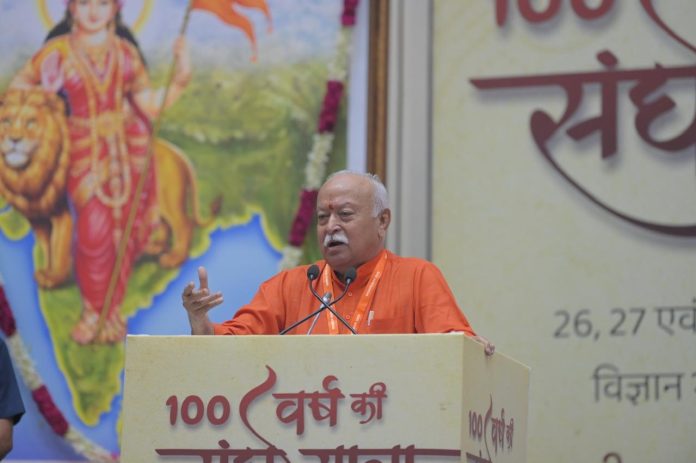
The federal religious-freedom commission urged the U.S. government to revoke the RSS chief’s visa. It did not explain by publication deadline why no comparable visitor-specific action was taken when senior Jamaat-e-Islami figures appeared in the United States, including a deputy leader who spoke in New York about five million youths, guerrilla warfare, and a religiously framed conflict with India.
The unanswered question
When Mohan Bhagwat, the head of India’s Rashtriya Swayamsevak Sangh (RSS), visited the United States, the U.S. Commission on International Religious Freedom (USCIRF) took the unusual step of urging the federal government to consider revoking his visa and barring his future entry.
USCIRF is not a private advocacy organization. It is a taxpayer-funded federal commission in the legislative branch, supported by a fiscal year 2026 congressional appropriation of $4 million and authorized to advise the President, Secretary of State, and Congress.
But when asked what evidentiary standard justified its recommendation against Bhagwat—and whether it applied the same standard to senior Jamaat-e-Islami leaders who appeared in the United States, the commission did not respond by publication deadline.
USCIRF occupies a distinctive position in the federal government. Congress created it as an independent, bipartisan legislative-branch commission to monitor violations of freedom of religion or belief abroad and make policy recommendations to the President, Secretary of State, and Congress. The President and congressional leaders of both parties appoint its commissioners, while a professional staff conducts research, travel, hearings, meetings, and public advocacy. Although the commission cannot itself revoke a visa or impose sanctions, its recommendations carry the authority and visibility of an official federal body.
That makes the standard behind a visitor-specific recommendation a matter of public accountability. Taxpayers have a legitimate interest in knowing how the commission selects cases, distinguishes personal responsibility from organizational affiliation, evaluates competing evidence, and ensures its recommendations are applied consistently, without regard to religion or political pressure.
USCIRF is not required to reach the same conclusion in every case. But when a taxpayer-funded federal commission calls for the government to revoke a named individual’s visa, it should be able to articulate the factual threshold, institutional process, and policy principle that produced that recommendation, and define the standard it used.
GSV examined USCIRF’s public archive and documented appearances by identifiable senior foreign Jamaat figures between 2016 and 2026. We found no comparable visitor-specific intervention concerning the documented U.S. appearances of senior Jamaat-e-Islami figures Yusuf Islahi, Syed Abdullah Muhammad Taher, or Shafiqur Rahman. USCIRF has repeatedly discussed and criticized Jamaat-e-Islami in its country reporting, but GSV did not find any public warning, visa-revocation request, or sanctions recommendation concerning those visits.
The cases are not necessarily identical, and the absence of a public statement does not prove that USCIRF conducted no internal review. But because USCIRF is funded by taxpayers and exercises an official advisory role in federal foreign policy, the public has a legitimate interest in knowing what standard explains the difference between the Bhagwat recommendation and the lack of a comparable visitor-specific action in the Jamaat cases. USCIRF did not provide that explanation by publication deadline.
The Bhagwat Intervention: Urging Visa Revocation for the RSS Chief
In its August 26 statement, USCIRF expressed deep concern about the visit of Mohan Bhagwat, chief of India’s Rashtriya Swayamsevak Sangh (RSS), to the US. The statement referenced USCIRF reporting that “RSS subgroups have perpetrated violent attacks against religious minorities, including Christians, Dalits, Muslims, and Sikhs.”
USCIRF Chair Asif Mahmood said “Religious freedom conditions in India continue to deteriorate as violence and incitement are frequently used to target religious minority communities,” and urged the “U.S. government to consider targeted sanctions against RSS members and Indian officials complicit in religious freedom violations, including revoking the visa issued to Mohan Bhagwat and making him ineligible for future entry into the United States.”
USCIRF’s statement described conduct attributed to RSS subgroups, the BJP-led Indian government, and Indian authorities. It did not publicly set out the precise evidentiary standard connecting Bhagwat personally to conduct warranting visa revocation, or define the standard behind the request.
On August 27, 2026, GSV sent USCIRF a detailed request for comment asking what criteria it uses to recommend visa restrictions against a foreign visitor, whether those criteria had been applied to Taher, Rahman, and Islahi, and what distinction accounted for its different public treatment of the cases. GSV emailed [email protected] on August 27, requesting a response by COB. We sent a follow-up email on August 28 saying we were preparing to publish the story that day and asking them to let us know by 12 PM if USCIRF wished to provide a statement for inclusion. The questions we asked included, but are not limited to, the following:
- What objective standard triggered the Bhagwat recommendation?
- Was the same standard applied to Taher, Rahman, and Islahi?
- Did USCIRF review Taher’s New York remarks?
- Does India’s recommended Country of Particular Concern status explain the distinction?
- Was the Bhagwat statement approved through a formal Commission vote or another process?
USCIRF did not respond by the deadline. The Commission’s silence does not answer those questions. It leaves them unresolved, including the standard it used.
Case Studies in Contrast: Jamaat-e-Islami Leaders in the United States
Taher’s New York speech
Syed Abdullah Muhammad Taher was a deputy chief of Bangladesh Jamaat-e-Islami and traveled to New York in connection with Bangladesh’s delegation to the United Nations General Assembly in 2025 and personally delivered remarks that included religiously framed military rhetoric. The research documents his participation in political and diaspora events while in New York.
At a September 27, 2025 public reception in New York, contemporaneous reporting quoted Taher saying that at least five million Bangladeshi youths would fight India if it intervened militarily, that one group would engage in guerrilla warfare while others would spread across a wider area, and that a hadith concerning “Ghazwa” formed part of the plan.
NDTV, BDDiGEST, Prothom Alo, and other outlets characterized the religious reference as “Ghazwatul Hind.” The contemporaneous account reviewed for this article more specifically reported that Taher referred to a prophetic hadith concerning “Ghazwa” in the context of a potential war with India.
No visitor-specific USCIRF statement concerning Taher’s New York appearances or remarks was located in the Commission’s publicly searchable archive. USCIRF did not answer whether it reviewed the speech, was aware of it, concluded that it fell outside its mandate, or applied a different evidentiary standard.
Shafiqur Rahman’s multi-city visit
During his eight-day visit to the United States in late October 2025, Bangladesh Jamaat-e-Islami Ameer Dr. Shafiqur Rahman met with Bangladeshi expatriate communities, senior journalists, and local community leaders across New York, Buffalo, Michigan, and Washington D.C. He attended diaspora and community events and said he met “governmental and nongovernmental representatives.” There is no information on whether USCIRF reviewed the visit of a senior foreign religious-political leader who reported meeting government representatives in Washington.
Yusuf Islahi’s repeated appearances
Senior Jamaat-e-Islami Hind leader Yusuf Islahi has documented U.S. appearances in 2016, 2017, and 2019 at U.S. mosques, community programs, and the 2019 ICNA convention in Washington. There is no visitor-specific USCIRF intervention available regarding Islahi.
USCIRF is familiar with Jamaat
USCIRF has discussed Jamaat in earlier Bangladesh reporting, and identified it as a major Islamic political party. It has addressed religious-political tensions and conservative Islamic demands in Bangladesh, and even conducted a delegation to Bangladesh in May 2025. USCIRF issued a Bangladesh Factsheet in July 2025
This clearly establishes institutional familiarity with Jamaat-e-Islami and Bangladesh’s religious-political environment.
Double Standard or Distinct Mandate? What Explains the Disparity
USCIRF has recommended designating India a Country of Particular Concern, stating that India’s violations are systematic, ongoing, and egregious. The Commission may regard Bangladesh differently.
USCIRF’s mandate frequently focuses on foreign governments that engage in or tolerate religious-freedom violations. It may distinguish between:
- An individual associated with an influential movement closely connected to a governing party; and
- Opposition-party or religious-political figures who do not control the government.
Personal evidentiary nexus: USCIRF may believe Bhagwat had a stronger personal or organizational nexus to alleged religious-freedom violations than the Jamaat figures, which would explain the different treatment.
Speech versus religious-freedom violations: Taher’s rhetoric may be inflammatory or security-related without necessarily fitting USCIRF’s statutory religious-freedom framework, which could explain why it did not prompt the same response.
CPC status and sanctions policy: USCIRF may reserve visitor-specific sanctions recommendations for individuals connected to governments or countries meeting particular statutory thresholds.
Awareness and timing: USCIRF may have been unaware of one or more visits when they occurred.
Any of those distinctions might provide a principled explanation. USCIRF did not respond, however, and no publicly available written standard located in this review clearly explains which distinction it applied.
Why the standard matters
USCIRF has significant public influence because it advises the executive branch and Congress, recommends sanctions and country designations, shapes public understanding of international religious-freedom conditions, and presents itself as independent and bipartisan.
The issue is therefore not whether every controversial foreign visitor must receive identical treatment. The issue is whether USCIRF has a defined evidentiary threshold, a religion-neutral standard, a consistent process for visitor-specific recommendations, a transparent authorization process, and a method for distinguishing ideological association from personal responsibility.
Consistency does not require identical outcomes. It requires an intelligible standard that can explain different outcomes.
What remains unanswered
USCIRF may have a principled reason for treating Bhagwat’s visit differently from those of Taher, Rahman, and Islahi. It may view the cases as legally, institutionally, or factually distinct. But after publicly urging the U.S. government to revoke one foreign visitor’s visa, the Commission did not explain what threshold it applied, whether it reviewed the other cases, or how it ensures that visitor-specific recommendations are made consistently.
Its nonresponse does not prove a double standard. It leaves the appearance of one unanswered.
USCIRF had not responded as of August 28, 12 PM ET. This article will be updated if the Commission provides a response.

GSV News Service
- GSV News Service#molongui-disabled-link

- GSV News Service#molongui-disabled-link

- GSV News Service#molongui-disabled-link

- GSV News Service#molongui-disabled-link