U.S. Senators Urge Secretary Rubio to Act as Ethiopia’s Security Crisis Escalates
Ethiopian-American Community Calls for Immediate Diplomacy, Inclusive Dialogue, Civilian Protection, and Preservation of Lalibela
WASHINGTON, D.C. — Ethiopia’s human rights, humanitarian, and security crisis is entering another dangerous period. Renewed tensions and reports of conflict in northern Ethiopia, together with continuing instability in Tigrea, Oromia, Amhara, and other parts of the country, have raised serious concerns about the possibility of a broader escalation.
Against this backdrop, a bipartisan group of U.S. senators has urged Secretary of State Marco Rubio and the Trump Administration to intensify diplomatic engagement and work to prevent renewed large-scale conflict in Ethiopia.
Six senators—Jeanne Shaheen (D-NH), Cory Booker (D-NJ), Chris Coons (D-DE), Jeff Merkley (D-OR), Chris Van Hollen (D-MD), and Tim Kaine (D-VA)—issued a statement expressing alarm over the deteriorating security situation and calling for renewed diplomatic efforts involving the Ethiopian government, Tigrayan leadership, and associated armed groups.
The senators warned that the renewed hostilities threaten the progress made under the 2022 Pretoria Cessation of Hostilities Agreement, which ended the 2020–2022 Tigray war. They called for the parties to de-escalate tensions and return to mediation.
Their intervention comes at a critical moment for Ethiopia and the broader Horn of Africa.
A Dangerous Moment for Ethiopia
The continuing violence and political tensions demonstrate that Ethiopia’s conflicts cannot be addressed through military means alone. A sustainable solution requires diplomacy, civilian protection, humanitarian assistance, accountability, and an inclusive political process.
The United States has significant diplomatic interests in Ethiopia and the wider Horn of Africa. Ethiopia’s geographic position near the Red Sea and the Bab el-Mandeb Strait gives developments inside the country consequences that can extend beyond its borders.
Continued instability could contribute to additional displacement, humanitarian suffering, regional economic disruption, and increased tensions among neighboring countries.
For these reasons, the international community should not wait until another large-scale war is fully underway before taking diplomatic action.
The Ethiopian-American community’s message has been consistent: prevent escalation before it becomes another national catastrophe.
The Pretoria Agreement Must Be a Foundation for a Broader Political Process
The Pretoria Cessation of Hostilities Agreement was an important step toward ending the devastating Tigray war. However, Ethiopia’s broader political and security crisis extends beyond one region and cannot be resolved through a process involving only a limited number of actors.
Any future peace initiative should be genuinely inclusive.
Amharas, Oromos, Tigrayans, and other major Ethiopian communities and political stakeholders must have meaningful opportunities to participate in discussions concerning Ethiopia’s political future. Civil-society organizations, religious communities, women, youth, displaced populations, and other affected stakeholders should also have avenues to contribute.
An inclusive peace process does not mean that every organization or political group must agree. It means that those whose communities are directly affected by Ethiopia’s conflicts should have an opportunity to participate in a credible political process.
The experience of previous negotiations demonstrates the importance of broad participation. A sustainable peace agreement will require more than the cessation of fighting; it will require political mechanisms capable of addressing grievances, protecting rights, strengthening institutions, and preventing the recurrence of violence.
The United States Should Strengthen Preventive Diplomacy
The United States has an important role to play in supporting efforts to prevent another major conflict.
Washington should encourage all relevant Ethiopian parties to immediately reduce tensions, protect civilians, facilitate humanitarian assistance, and return to meaningful negotiations.
Diplomatic engagement should focus on several priorities:
- Immediate de-escalation and cessation of hostilities.
- Protection of civilians and civilian infrastructure.
- Unhindered delivery of humanitarian assistance.
- Meaningful and inclusive political dialogue.
- Respect for human rights and fundamental freedoms.
- Accountability for serious violations of international law.
- Support for an Ethiopian-led political process with broad participation.
- Protection of religious and cultural heritage sites.
The objective should not simply be to prevent one particular confrontation. It should be to help create conditions for a durable political settlement that addresses the broader causes of Ethiopia’s continuing instability.
Protecting Ethiopia’s Cultural Heritage: Lalibela Must Not Become a Casualty of War
As concerns about conflict in northern Ethiopia increase, special attention must also be given to the protection of Ethiopia’s irreplaceable cultural and religious heritage.
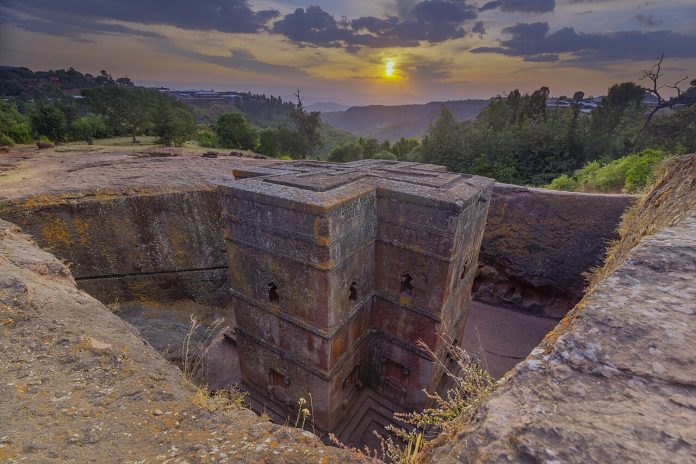
Among the most important sites is the ancient city of Lalibela and its extraordinary rock-hewn churches.
UNESCO recognizes the Rock-Hewn Churches of Lalibela as a World Heritage property. The site consists of 11 medieval monolithic churches carved directly into the rock, traditionally associated with King Lalibela and the creation of a sacred “New Jerusalem.” UNESCO inscribed Lalibela on the World Heritage List in 1978.
The churches include Biete Medhani Alem, Biete Mariam, Biete Amanuel, Biete Gabriel Raphael, Biete Golgotha Mikael, and the remarkable Biete Ghiorgis, among others. Together with their tunnels, courtyards, surrounding landscape, religious objects, manuscripts, and continuing traditions, they represent an extraordinary record of Ethiopian civilization.
Lalibela is not simply a collection of historic buildings. It remains a living center of pilgrimage, worship, and religious devotion. UNESCO describes the site as a place of pilgrimage and devotion and has emphasized its outstanding universal value.
A Responsibility During Conflict
All parties involved in Ethiopia’s conflicts have a responsibility to ensure that Lalibela is protected.
The churches and surrounding cultural properties should not be used for military purposes or exposed unnecessarily to fighting. Civilians, clergy, pilgrims, religious objects, manuscripts, and historic structures must be protected.
UNESCO previously expressed serious concern when fighting reached Lalibela in 2021, calling for respect for international-law obligations and measures to prevent damage, looting, and pillaging of cultural property. UNESCO emphasized that Lalibela is a place of pilgrimage, devotion, and peace—not a place for violence and conflict.
The international community should therefore remain vigilant and encourage all parties to protect Lalibela from the consequences of armed conflict.
A Call to Ethiopian and U.S. Leaders
The current situation requires preventive diplomacy rather than waiting for another humanitarian disaster to unfold.
The Ethiopian government, opposition leaders, armed groups, community leaders, religious institutions, and other stakeholders should work toward immediate de-escalation and a peaceful political process.
At the same time, the United States Congress and Administration should continue to closely monitor developments in Ethiopia and engage diplomatically with relevant Ethiopian and regional actors.
Congressional attention is important because the consequences of renewed conflict would not be limited to one region. Ethiopia’s stability has implications for humanitarian conditions, regional security, economic activity, migration, and U.S. interests throughout the Horn of Africa.
The recent statement by Senators Shaheen, Booker, Coons, Merkley, Van Hollen, and Kaine sends an important message that the deteriorating situation in Ethiopia deserves sustained diplomatic attention.
The Time to Prevent Another War Is Now
Ethiopia cannot afford another devastating war.
The human cost of the 2020–2022 conflict remains deeply significant, and communities across the country continue to experience displacement, insecurity, humanitarian hardship, and political uncertainty.
The international community should therefore act before tensions develop into another full-scale conflict.
For Ethiopian-Americans and others concerned about Ethiopia’s future, the message is straightforward: diplomacy must come before war, dialogue must come before escalation, and civilian protection must remain at the center of international engagement.
A peaceful and stable Ethiopia is important not only to Ethiopians but also to the wider Horn of Africa and the international community.
And as Ethiopia works to preserve its future, it must also protect the extraordinary heritage of its past.
Protect civilians.
Prevent another war.
Support inclusive dialogue.
Protect Lalibela.
Protect Ethiopia’s heritage for future generations.

Mesfin Mekonen
Mesfin Mekonen is the author of Washington Update, a bulletin about Ethiopia’s struggle for freedom and prosperity, and founder of MM Management.
- Mesfin Mekonen#molongui-disabled-link

- Mesfin Mekonen#molongui-disabled-link
- Mesfin Mekonen#molongui-disabled-link

- Mesfin Mekonen#molongui-disabled-link