Any association of young men or women does not deserve the designation of a youth association. A youth association is characterized by a feeling of dissatisfaction with the present order of things, and a desire for a better order accompanied by a vision of that order. Youth movements are not reformist in outlook, but revolutionary.”
~ Subhash Chandra Bose, 3rd Session of the All India Youth Congress, 1928
JAIPUR, India – When Netaji Subhash Chandra Bose delivered these words in 1928, he dared to challenge the prevailing orthodoxies of the era, contrasting his vision with both the Sabarmati school of thought (Gandhi) and the Pondicherry school (Aurobindo). He diagnosed a fundamental paradox: the hypocrisy of demanding political democracy from foreign rulers while tolerating undemocratic hierarchies in our own social fabric.
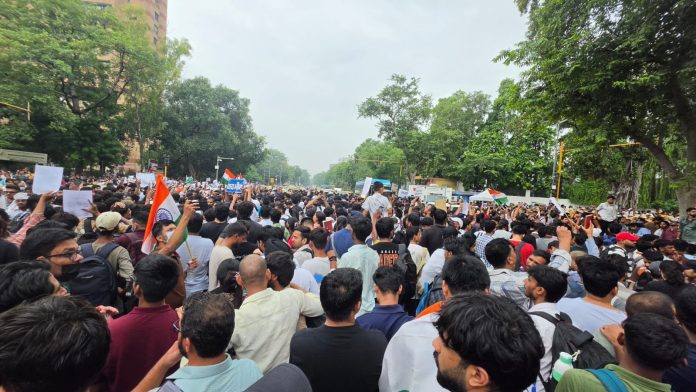
Today, as waves of student anger spill onto India’s streets following recurring paper leaks and examination compromises, Bose’s philosophy lays bare the intent and anatomy of these agitations.
The Financial and Human Toll: Coaching Economics and Systemic Vulnerability
The crisis of compromised public examinations is neither isolated nor sensationalized; it is an existential blow to India’s middle and lower-middle-class families. For millions of young aspirants, competitive exams represent the sole ladder of upward social mobility. Over the past decade alone, more than 70 major paper leaks across 15+ states have jeopardized the futures of over 1.5 to 2 crore candidates.
This systemic vulnerability is further amplified by the backbreaking economic strain imposed by a parallel shadow education industry. India’s private coaching market has ballooned into a massive shadow economy valued at over Rs 58,000 crore to Rs 1 lakh crore, enrolling over 7 crore students nationwide. Families routinely spend anywhere between Rs 80,000 and Rs 2,00,000 annually per child on tuition, study material, and test series, often taking on high-interest loans, mortgaging land, or depleting life savings. Recent National Sample Survey (NSS) data reveals that rural households now spend over 15% to upwards of 40-50% of their total education budget solely on private coaching to compensate for lagging public school infrastructure.
When a single exam flaw or paper leak breaches public trust, it doesn’t just waste a test cycle, it bankrupts families emotionally and financially. More heartbreakingly, the human cost is measured in lost lives. Dozens of young aspirants, weighed down by debt and administrative uncertainty, have succumbed to despair, pushed past the point of no return.
While Parliament enacted the Public Examinations (Prevention of Unfair Means) Act, 2024, promising strict penalties of up to 10 years’ imprisonment and Rs 1 crore fines for organized leak cartels, legislative measures alone cannot immediately repair a broken trust ecosystem. The fundamental flaw remains: a lack of direct, empathetic dialogue between policymakers and the youth. Elected representatives must be more than the passive ‘ears and nose’ of society; they must serve as its voice to demand institutional accountability categorically.
Co-Opted Protests: Digital Sensationalism and Social Fractures
When systemic leakages explode, reform ought to be the priority. Instead, the genuine grief of students is too often made into a political football.
What is particularly worrisome is the shrinking space for objective, sober legacy media, which is rapidly being superseded by digital influencers and YouTubers. Unregulated and frequently driven by algorithms that reward sensationalism, this new media class exposes real grievances, but often with their own populist twists and hidden slants.
Simultaneously, political opportunists and foreign-backed fake-information machinery rush to exploit the chaos. By converting a legitimate youth grievance into an avenue for partisan point-scoring, these forces dilute the core cause and divert focus away from administrative solutions.
This dynamic exposes the inner contradiction of modern street protests. The street agitation mirrored recent paradoxes: truckloads of stones appeared near protest grounds, property was damaged, and polarizing slogans echoed in public spaces. In a telling commentary on our social fabric, nearby commercial institutions and temples shut their doors to perspiring, exhausted youth, while open community spaces like Gurudwaras had to step in to provide safe sanctuary and water. We continue to clamor for political democracy, yet abandon the basic tenets of solidarity in our daily social lives. But such instances shouldn’t be weaponized to deepen socio-political polarization. Caution is not only necessary but urgent.
The Millennial Mandate: Dissecting Slogans to Demand Accountability
Yet, this millennial generation is not easily misled; they are actively showing up to advocate for younger Gen Z aspirants and safeguard their future. Having matured through an era of rapid digital evolution, economic volatility, and high-stakes competition, millennials possess the media literacy required to decipher deepfakes, spot planted political plots, and separate genuine, principled solidarity from transactional opportunism.
They recognize that the current crisis extends beyond a single breached question paper; it reflects a deeply commercialized ecosystem that commodifies youth aspirations while offering minimal safety nets. Most millennials and adolescent aspirants may not physically stand on a protest ground; millions are studying silently in small rented rooms, hostels, and libraries across tier-2 and tier-3 towns. However, do not mistake their silence for apathy or resignation. They value institutional integrity over political rhetoric, demand radical transparency in administrative governance, and firmly reject artificial ideological divides designed to fragment their collective demand for fairness.
What current protest leadership frequently lacks, however, is precisely what Netaji insisted upon: a concrete vision and actionable roadmap for the new order. When an agitation relies solely on anger without offering structural proposals such as standardized audit trails, decentralized exam bodies, or transparent redressal mechanisms, that anger inevitably degrades into public chaos. Consequently, the heavy-handed response of law enforcement leaves lasting physical and psychological scars on innocent, idealistic youth, leaving the underlying systemic malice entirely unchecked.
Restoring Democratic Faith: Structural Solutions Over Political Promises
In the iconic film The Shawshank Redemption, Red (played by Morgan Freeman) cautions that “Hope is a dangerous thing. Hope can drive a man insane.” When citizens feel caged in administrative corruption and stifled by a colonial policing mindset, hope can indeed feel like a cruel illusion.
Political assurances have begun to echo from the highest offices. Speaking at a meeting of NDA parliamentary party leaders, Prime Minister Narendra Modi promised a foolproof mechanism to prevent future exam paper leaks. Emphasizing that members of the NEET paper leak syndicate have been arrested, jailed, and will face the strictest prosecution backed by the country’s top legal minds, the leadership seeks to signal zero tolerance for administrative crime. Yet, assurances from the top must be matched by structural accountability at the helm. As the nation awaits justice, young citizens are left asking whether moral and ministerial accountability will be demonstrably taken, demanding that the Education Ministry own the institutional failure directly rather than merely reshuffling portfolios or deflecting systemic lapses.
Real national movement does not come from cynical surrender, nor from destructive unrest. It requires an actionable framework that restores functionality to our democratic institutions. To achieve this, we must implement airtight, technology-driven examination protocols, establish preemptive ground intelligence to dismantle organized leak cartels before they act, and create institutionalized, direct channels of communication between ministers, senior secretaries, and young citizens.
As Andy Dufresne (Tim Robbins) famously writes in reply (to Red/Morgan Freeman) – “Hope is a good thing, maybe the best of things, and no good thing ever dies.”
Building hope is an ethical imperative for thought leaders, advisors, and society at large. In doing so, we honor the fundamental truth Subhash Chandra Bose articulated nearly a century ago: true youth energy cannot settle for passive reform within a broken framework, but must channel its dissatisfaction toward building a just, accountable order. Let fair, democratic protests exist as a mirror of society; let state institutions act with swift, preemptive integrity; and let us ensure that the merit, dignity, and aspirations of India’s youth remain the beating heart of the world’s largest democracy.

Dr. Shipra Mathur
Dr. Mathur is a veteran journalist based in Jaipur, India. The views expressed here are solely those of the author.
- Dr. Shipra Mathur#molongui-disabled-link

- Dr. Shipra Mathur#molongui-disabled-link

- Dr. Shipra Mathur#molongui-disabled-link

- Dr. Shipra Mathur#molongui-disabled-link