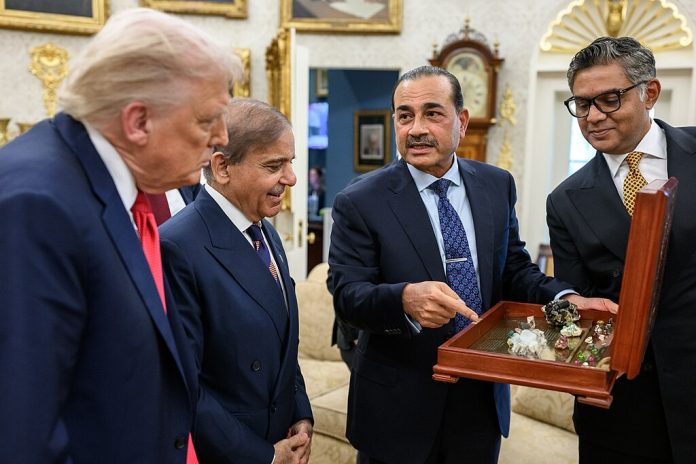
President Trump is quite popular in Pakistan these days, where the military establishment, led by the newly appointed tri-service chief, Field Marshal Asim Munir, is working overtime to gain his trust and favor.
Pakistani decision-makers are pushing the right buttons to get Trump and his team on their side. Pakistan’s Prime Minister Sharif recently hailed Trump’s bold Gaza peace proposal and nominated him for the Nobel Prize twice. In just a few weeks of negotiations, Trump has Pakistan’s whole strategic resources at his disposal to carry out the Middle East security plan.
The military establishment is also pleased that many Trump family members and friends are eager to invest in Pakistan. The government urges American companies to join mineral prospecting in the country. According to reports, Pakistan wants the US to establish and operate a commercial port in occupied Balochistan.
The goal of this costly bargain is to reclaim influence against India that the Pakistani military lost after Article 370 was removed in the Indian state of Jammu and Kashmir. For decades, Article 370, a special provision in the Indian Constitution, enabled Pakistan’s military and Kashmiri leaders to play footsie to preserve mutual interests. It granted Kashmiris final say over all decisions, securing a strategic edge for Pakistan’s military and extending veto over India.
The dispute over the predominantly Muslim Kashmir Valley remains Pakistan’s most potent instrument for blackmailing and arm-twisting India. The Kashmir card ensures that the Pakistani military bosses receive the money they need from taxpayers in the name of national security and serving Islam.
The army asserts that a failing Kashmir policy poses threats to national cohesiveness since hostility against Hindu India is the glue that holds different ethnic groups of Muslim Pakistan together. In addition to bolstering patriotism, rhetoric on Kashmir also augments Islamic Jihadi recruiting.
It works out well for all stakeholders, including China, Pakistan’s closest ally. China is pleased that the Pakistani army keeps India busy on its western frontier, while the Communist Party continues with largely unhindered expansion in Tibet and Xinjiang.
With a diminished influence in Kashmir due to the policies of the Modi government, it has become difficult for the Pakistani army to sustain and justify the cash it sucked from the civilian subjects.
The Arab leadership once played an important role in keeping the Kashmir issue alive. Given India’s expanding economic footprint, Arabs increasingly favor improved relations with New Delhi over meddling in Indo-Pakistan conflicts. Muslim countries, such as the UAE, have become so close to India that their maps now include Pakistan-occupied-Gilgit-Baltistan as an integral part of India.
The lack of Arab sponsorship hinders and stalls Pakistan’s Kashmir policy, as well as badly impacting military relations with local religious groups who rely on Arab donations. As Trump’s reliance on Pakistan deepens, the military believes that an American nod will reignite Arab commitment to resuscitate the Kashmir bogey.
Likewise, China is concerned about India’s rapidly evolving global prominence. If Pakistan can slow down India by isolating it from the United States and the Arab world, China will benefit as well.
On the home front, Asim Munir is better positioned to deal with two imminent challenges as his worldwide profile grows. One is Pakistan’s withering economy and mounting debt, where the trade imbalance has increased by about 40 percent in recent years, accompanied by a considerable reduction in investment in manufacturing and exports.
The other problem is dealing with former Prime Minister Imran Khan. The imprisoned Khan has amassed and trained a sizable, zealous following that intends to follow in the footsteps of Turkey’s Erdogan and reduce the military to size.
President Trump is attempting to lessen US military involvement in the Middle East, according to the new national security strategy. Arab regimes appear to be interested in having Pakistan on their side as America retreats. As a result, Pakistan is signing strategic partnerships with Arab countries that previously assisted Pakistani assets in Kashmir.
Pakistan perceives itself to be perpetually at war with India. The promotion and tenure extension granted by PM Sharif to Munir demonstrates that the ruling establishment does not wish to change horses in midstream. Munir issued a stern warning to India of swift, severe, and intense action shortly after taking over as Chief of Defense Forces. His radical mindset against Hindus will script a regional geopolitical paradigm for decades to come.
The Pakistani military’s commitment to fight for the unity of the Islamic Ummah and preservation of the two-nation theory signals seriousness about reviving Jihad in Kashmir. The rhetoric represents long-term ambitions and plans, as well as a cruel promise of much more tragedy and bloodshed for the people of Jammu and Kashmir.

Senge Sering
Senge Sering is a native of Pakistan-occupied-Gilgit-Baltistan and runs the Washington DC based Gilgit Baltistan Studies
- Senge Sering#molongui-disabled-link

- Senge Sering#molongui-disabled-link

- Senge Sering#molongui-disabled-link

- Senge Sering#molongui-disabled-link