
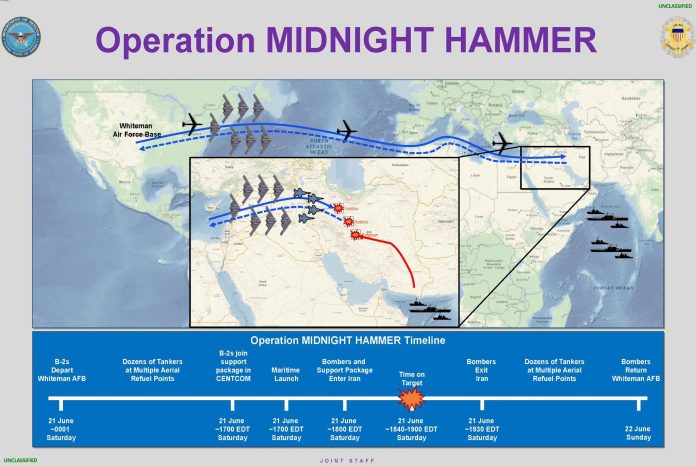
WASHINGTON — China strongly condemned U.S. military strikes on Iranian nuclear facilities, warning that the actions violate international law and risk plunging the Middle East into deeper turmoil. Meanwhile, Gulf nations, including Saudi Arabia and Qatar, expressed grave concern and urged restraint but stopped short of directly condemning the United States.
In a statement, China’s Foreign Ministry said the U.S. actions “seriously violate the purposes and principles of the U.N. Charter and international law” and accused Washington of escalating tensions in the region.
“China strongly condemns the U.S. attacks on Iran and bombing of nuclear facilities under the safeguards of the IAEA,” the ministry said. “China calls on the parties to the conflict, Israel in particular, to reach a ceasefire as soon as possible, ensure the safety of civilians, and start dialogue and negotiation.”
The Chinese government added that it was ready to work with the international community “to uphold justice and restore peace and stability in the Middle East.”
The strikes, which targeted sites linked to Iran’s nuclear program, have drawn global attention and stirred fears of a broader conflict between Iran and Israel. In response, several Gulf nations called for diplomatic efforts to prevent further escalation.
Saudi Arabia said it was following developments “with deep concern,” particularly the targeting of Iranian nuclear facilities. The Kingdom reaffirmed its earlier statement condemning the violation of Iranian sovereignty without explicitly naming the United States.
“The Kingdom underscores the need to exert all possible efforts to exercise restraint, de-escalate tensions, and avoid further escalation,” the Saudi Foreign Ministry said, urging the international community to work toward a political solution.
Qatar also expressed regret over the deterioration of the situation and warned of “catastrophic consequences” if military operations continue. Its Foreign Ministry called for the immediate suspension of hostilities and a return to diplomatic channels without directly addressing the U.S. strikes.
“The Ministry of Foreign Affairs warns that the current dangerous tension in the region could lead to catastrophic consequences at both the regional and international levels,” the statement read. “Qatar hopes all parties will exercise wisdom and restraint and avoid further escalation.”
In Bahrain, authorities activated a remote work system for government employees and shifted schools to online learning in response to regional instability. Residents were advised to use main roads only when necessary.
Amid the rising tensions, the U.S. Department of State issued a Worldwide Caution Security Alert for American citizens overseas. The advisory cited potential disruptions to travel, including airspace closures across the Middle East, and warned of possible demonstrations targeting U.S. citizens and interests.
“The Department of State advises U.S. citizens worldwide to exercise increased caution,” the alert said.
The escalation follows months of rising hostility between Iran and Israel, with the latest U.S. military action adding a new dimension to an already volatile regional crisis.

GSV News Service
- GSV News Service#molongui-disabled-link

- GSV News Service#molongui-disabled-link

- GSV News Service#molongui-disabled-link

- GSV News Service#molongui-disabled-link