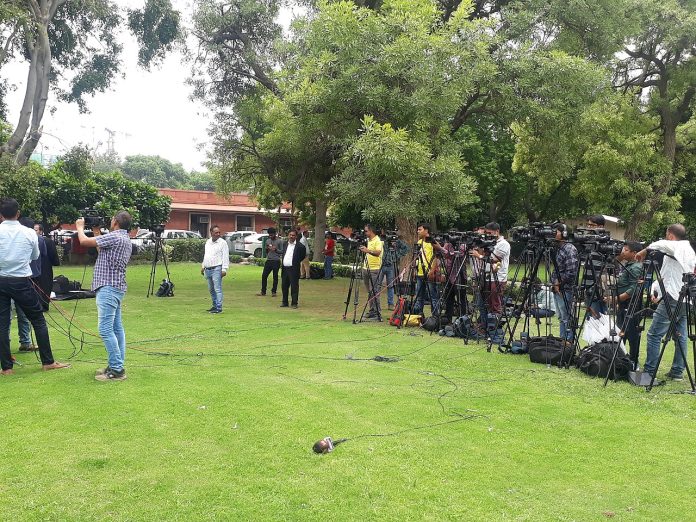
India’s information ecosystem is undergoing a profound test of credibility. With the rise of influencers and digital creators, defining who counts as a journalist has never been more urgent. As the Supreme Court raises concerns and the boundaries between paid content and public-interest journalism blur, India stands at a crossroads for media ethics and democratic integrity.
JAIPUR, India – The Indian courtroom has nudged the Indian press again. The ongoing protests have become a flashpoint for concerns about both internal peace and the information ecosystem. The question of who counts as a journalist is no longer academic; it’s real and urgent, given global unrest and India’s positioning as a responsible democracy. As political narrative increasingly moves from traditional newsrooms to paid influencers and platform algorithms, the credibility of India’s information channels is being tested. How India regulates, or fails to regulate, the monetization of influence will shape perceptions of its democratic resilience.
Journalism in India has long swung between power and editorial ethics. Media proprietors acted as power brokers, and media owners (most with other major businesses) remained ringmasters of a certain set of stories where mutual interest was primal. The remainder was often theatrics of public-spirited stories to sustain brand credibility. The journalist’s face sold the product; the underlying business remained lobbying and transactional survival.
The Supreme Court has casually but emphatically placed the definitional question on the table.
During hearings on 15–16 October 2026 concerning the treatment of journalists at the protest sites, Chief Justice Surya Kant and Justice Joymalya Bagchi observed that distinguishing accredited journalists from freelancers, independent reporters, influencers and reel-makers has become extremely difficult. Solicitor General Tushar Mehta noted that in the digital era, anyone with a mobile phone can claim the label, and that many self-proclaimed freelancers are primarily engaged in producing reels. The same Court has historically been cautious in issuing strong directions on long-pending petitions by working journalists seeking enforcement of Wage Board awards. Its expressed worry through oral observations therefore carries particular weight, and corresponding responsibility.
Media organizations, for their part, have largely escaped sustained scrutiny for the progressive erosion of labor protections. Genuine ‘working journalist’ appointments have been replaced by many regional and national media houses designating recruits as ‘content creators’ to evade the Working Journalists Act, 1955 and court rulings of 2014/2017. But big media houses fear none; they prefer contractual recruitments and use every legal tool to enjoy the benefits of a free press, constitutionally guaranteed to every citizen. Senior editors who draw corporate-level compensation or hold equity interests often function more as management executives than as independent editorial gatekeepers serving public interests. As private entities, these organizations remain outside the Right to Information Act, demanding accountability from public institutions while offering limited transparency themselves.
Political parties have accelerated a parallel development. Their IT cells and social-media strategies have cultivated influencers and YouTubers even as full-time journalistic roles have contracted. Platforms were designed so that ordinary users with cameras would generate a continuous content stream that sustains the business model. Treating every citizen with a phone as a journalist may appear democratic, yet the underlying platform incentives (attention, amplification, and profit) remain well documented. When self-proclaimed journalists and influencers converge on protest sites, a practical question arises: who funds their enthusiasm, and who measures the output? For some creators, this is livelihood; for others it is opportunistic income. These activities are now under legitimate examination.
Reported developments illustrate the scale of the shift. In 2023, the Congress government paid influencers up to ₹500,000 ($5,278) in the western Indian state of Rajasthan, while in 2024 the government of the southern Indian state of Karnataka began extending digital advertising allocations to creators. The 2019 Cobra Post “OperationKaraoke” investigation showed multiple celebrities willing to accept payment for statements designed to appear spontaneous. No major political party has remained entirely outside this bracket and market. As social platforms overtook traditional outlets in reach, political spending migrated from newsrooms toward influencers. The BJP’s disclosed expenditure for the 2026 West Bengal elections, reported at approximately ₹2.86 billion ($30.19 million), included significant outlays on content creators.
Governments that once calibrated resources by newspaper circulation and television ratings now increasingly do so by digital reach metrics.
Traditional media at least maintains the formal category of “advertorial,” which requires clear labeling under existing ethical guidelines. Influencers face no equivalent obligation for political content. India’s January 2023 ‘Influencer Disclosure Rules’ mandate transparent labeling of paid brand promotions but remain silent on political messaging, leaving a substantial regulatory gap. Paid content presented as independent commentary sits in tension with core journalistic norms. Elevating such material to equal institutional status risks weakening the foundations of public-interest communication.
In October 2026, fact-checker Vishal Maheshwari conducted an undercover investigation and contacted self-designated independent journalists and influencers covering protests in Delhi. After being approached with a proposal to produce content for the Samajwadi Party ahead of Uttar Pradesh elections, several respondents, according to the investigation, quoted rates ranging from ₹15,000 ($158) to ₹300,000 ($3,167) per reel. State governments in Uttar Pradesh, Punjab and Rajasthan have established arrangements for monthly payments to influencers. Meta’s Ad Library and networks of surrogate pages provide further evidence of the volume of political spending. The primary structural beneficiary of this ecosystem remains the major technology platforms.
Comparable trends are visible elsewhere. In the United States, political campaigns and political action committees (PACs) have sharply increased spending on influencers and digital creators. In the European Union, debates continue over platform accountability, transparency of political advertising, and the responsibilities of large technology firms. India’s experience is distinctive mainly in the speed of the transition and the relative weakness of disclosure requirements for political content.
Yet the same platforms that monetize influence and blur the line between journalism and content creation are also the primary vectors for organized hatred that now threatens democratic societies. In October 2026, U.S. Congressman Raja Krishnamoorthi publicly stated that he and his family were worshipping at the Sri Venkateswara Balaji Temple in Aurora, Illinois, when a self-identified white supremacist attempted a mass shooting targeting Indian Americans. The plot was thwarted only because the rifle jammed. Krishnamoorthi linked this near-tragedy directly to a documented 240 percent surge in monthly anti-South Asian hate speech on X between January 2024 and June 2026, as reported by the Center for the Study of Organized Hate (CSOH). He has charged that major technology companies profit from the amplification of such hatred while failing to police their platforms, allowing online radicalization to spill into real-world violence. In his view, Big Tech cannot be left to decide the boundaries of acceptable speech when those boundaries are measured in body counts; the platforms must be held accountable, not merely observed. The point is not peripheral to the Indian debate over who counts as a journalist.
When algorithms reward outrage, when influencers can be paid to manufacture consent or manufacture hate, and when traditional newsrooms shrink while unaccountable digital voices proliferate, the information ecosystem itself becomes a threat to public safety and democratic order. Journalism’s credibility test is inseparable from the question of whether platforms that claim to host free expression will accept responsibility for the organized hatred they amplify.
Reels and algorithm-driven distribution have affected both critical capacity and public trust.
Informed citizenship remains a precondition for sound democratic choice. When the Supreme Court expresses concern about uncontrolled crowds at protest sites, the observation is not inherently anti-democratic; the same institution also has a responsibility to press governments to address legitimate grievances so dissent does not escalate into disorder. Discontent is real; the scarcity of responsive institutional forums is equally real. Paid content and paid voices cannot substitute for independent scrutiny.
The apex court has a greater obligation to clarify its stand: where do the free press and freedom of speech rest? Is the court primarily concerned about the institutional health of journalism, or the management of public spectacle? Without professional standards, institutional commitments, and some form of social security, journalism cannot fearlessly and fiercely perform its function.
After two Press Commissions, a third was never constituted. A rigorous examination of these questions might have produced a less improvised and more coherent media order than the one that currently exists.

Dr. Shipra Mathur
Dr. Mathur is a veteran journalist based in Jaipur, India. The views expressed here are solely those of the author.
- Dr. Shipra Mathur#molongui-disabled-link

- Dr. Shipra Mathur#molongui-disabled-link

- Dr. Shipra Mathur#molongui-disabled-link

- Dr. Shipra Mathur#molongui-disabled-link